
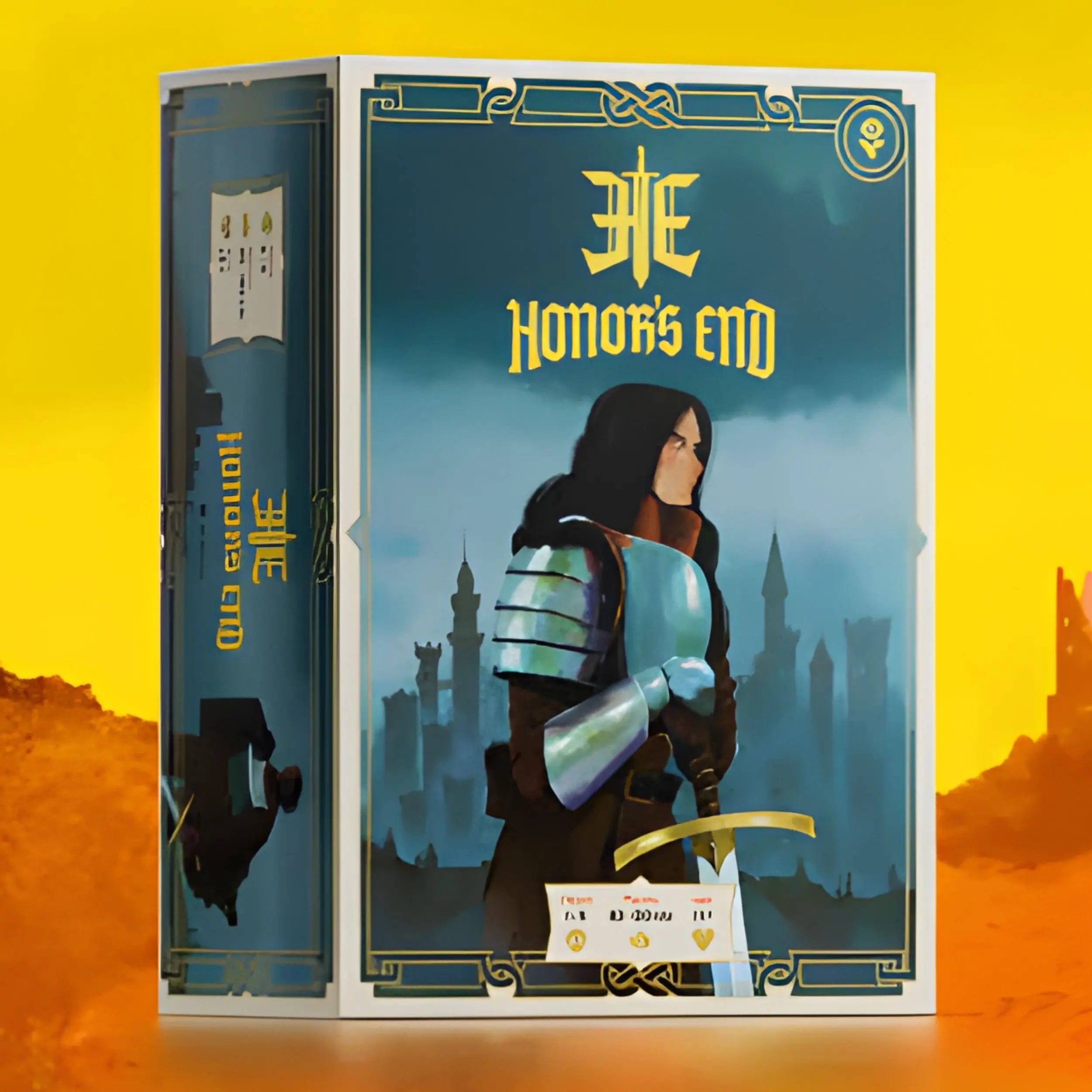
The Soul of Honor's End: Beyond the Box
Imagine a world where chivalry isn't just shining armor, but a crushing burden on the shoulders of the few. Honor's End doesn't simply ask us to defeat a monster; it asks us to survive our own integrity. Valoria is a kingdom in decline, shrouded in mystery that has corroded the very foundations of virtue. When you sit at the table, you won't just be shuffling a deck of cards: you'll be managing your party's last remaining resource: Honor .
The atmosphere is dense, almost palpable. This isn't your typical dungeon crawler where you count damage; here, you're counting how much you're willing to sacrifice for the companion at your side. It's a game that looks you in the eye and asks, "How far will you go to avoid breaking the oath?"
The Signature of IV Studio
If you've ever played Moonrakers or Veiled Fate , you know that IV Studio (formerly IV Games) doesn't just make board games: they create cult objects. Their editorial philosophy is a guarantee of aesthetic and tactile excellence. But with Honor's End , they've taken a quantum leap in emotional design.
Their magic touch here lies in their ability to make even a pure cooperative game feel "social." They've taken the minimalist, luxurious graphic elegance that distinguishes them (thanks to Glenn Thomas's art direction) and fused it with mechanics that force communication. There's no room for the lone player optimizing their turn in silence; IV Studio's signature is the controlled chaos of tabletop discussion.
/pic9146863.jpg)
The Beating Heart: Mechanics and Strategy
Let's enter the engine room, because this is where Honor's End shines. The game presents itself as a cooperative deck builder , but forget the classic "I play my hand and buy from the market" approach. Here, everything revolves around versatility and sacrifice.
Multi-Use Cards and "Tucking"
Every card in your hand is a decision-making crossroads. You can play it for its primary effect (attack, defense, utility), or you can use it to enhance (in technical jargon, boost or tuck ) an ally's action or one of your future cards. This system of "tucking"—sliding cards under other cards to activate secondary or enhanced effects—creates monstrous strategic depth. Often, the best move isn't the one that deals the most damage now, but the one that sets the stage for your teammate's final blow.
Honor as Shared Hit Points
You have no individual life points. Only the group's Honor exists. Danger Dice rolled by enemies erode this pool. This mechanic eliminates player elimination and shifts the pressure onto the collective: every wound taken by a player is a step closer to defeat for everyone. You'll have to balance managing the Monarchy and Temple tracks to unlock upgrades, while desperately trying to mitigate the opponent's dice.
Campaign vs. Adventure Mode
The game offers two distinct souls. The narrative campaign is structured into episodes that permanently unlock new cards (like mini-expansions) in the game's "Pool." Once unlocked, these cards enrich the Adventure Mode , an infinitely replayable rogue-like "Boss Rush" mode. It's a persistent Pool Building system that rewards dedication without punishing those who just want a one-off game.
/pic9146859.jpg)
Overview: The Creative Team
Behind this project is an exceptional design triumvirate: Zac Dixon, Austin Harrison, and Max Anderson . Their synergy transformed a card concept into a fluid narrative engine, proving that innovation is possible even in a crowded genre like deckbuilding.
Spotlight: Let's see it in action
Honor's End isn't a game you "win" simply by reducing the boss's health to zero. It's an experience you win when, on the last card, you look at your teammates and realize that the only reason you're still standing is because someone sacrificed their own glory to parry a blow meant for you. In an age of solo games, Honor's End reminds us that true honor is what we build together.
Condividi:
Magic Number Eleven: Tactical Football Board Game for 2 Players (with Expansion)
Tenby Review: Strategy and Colors from Cosy Cub Games