
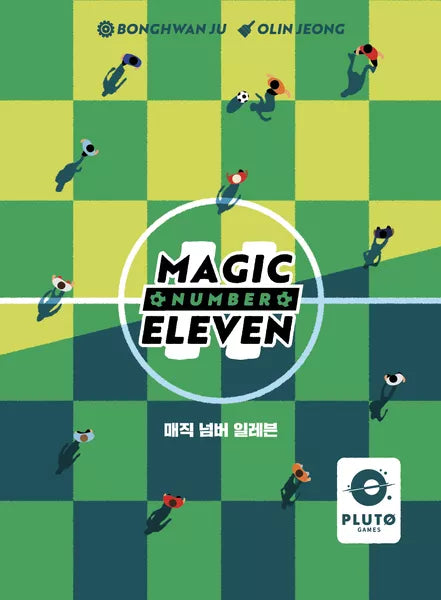
Magic Number Eleven : football like you've never seen it before.
Here you don't "shoot." Here you build.
If I say “ board game about football ”, you might think of dice, tables and eternal games. Magic Number Eleven does the opposite: it's a 2-player strategic board game where You place cards on the field to build the action… and when you decide to shoot you have to hit the perfect number: 11 .
It's a fast-paced, tense duel: you win because you read your opponent , understand the timing, and choose when to “go all-in.” Here the goal is not power: it is precision.
1) Football as you don't expect it: here you don't "shoot", you build
If I say “board game about football,” you imagine dice, tables, and eternal matches. Magic Number Eleven does the opposite: it gives you a field, some cards, and a continuous choice of timing.
Every card you place isn't just any action: it's a maneuver. You're setting up the lane, the assist, the right space. And when you finally shoot… you realize that the real game was getting there .
2) Why is it called “Magic Number Eleven”?
The name isn't just an atmosphere. It's a rule that sticks in your head. At the moment of shooting, the game presents you with a brilliant idea: there is a perfect number . 11 .
If your attack power reaches exactly 11 , it is the ideal shot: a “highlight” goal. If you go over 11, you've overdone it: too heavy, too dirty... and it could end up outside.
3) What game is it really (if you don't know it)
Magic Number Eleven is a 2-player strategic board game and a competitive board game football themed, but it's not a simulation: it's a tactical puzzle . You and your opponent place cards on the field to build an action made of positions, symbols and values.
In practice: each turn you add a maneuver piece, prepare combos, open a line and try to create the right window. Then you choose when to shoot: and there is only one challenge – to get to 11 exactly .
4) Mechanics: What you actually do each turn
The heart is card placement + icons + combos . When you place a card you are not just adding "value": you are choosing where to position it and which symbols to activate to grow your business.
The pitch makes the difference: it opens up lines, closes spaces and forces you to think like in a real match. You don't win because you have the "highest card." You win because you put the right card in the right spot.
Prepare the shot
You arrive at the right time with the right values: you don't "shoot", you build .
Active synergies
Micro-combos that become lanes: draw, boost, chain.
Manage the pace
Timing, pressure, control: knowing when it's your moment.
5) How the rule of 11 works (real example)
Build an action: You have an attack worth 7. You activate a synergy worth +4 . 7 + 4 = 11. Perfect shot.
Then comes the temptation: “I’ll add something else.” Add +2 → go to 13 . It's not "stronger." It's too much . And too much, here, is a mistake.
6) How to play
The flow
Fast turns and constant pressure: build the action with cards until you see the right window.
Your turn
You place a card on the field and make it pay off: symbols and positioning create real micro-advantages.
The shot (the “magic” part)
When you decide to roll, add up the values and bonuses: if you get exactly 11, it's the perfect roll. If you go beyond that, it's not power: it's greed .
7) Beginner Mistakes + Tips for Your First Game
Mistake #1 — “Higher is better”
Getting past 11 can be worse than not getting there at all. This is where you need to hit the mark , not push.
Mistake #2 — “I attack as soon as I can”
Too early = you waste cards and synergies. Prepare 1–2 turns: then close.
Mistake #3 — “I only look at the numbers”
The pitch is the soul: positioning and pattern. Think in zones: push, cover, close.
8) Publisher trivia: why is it called Pluto Games?
Pluto Games has chosen a name that sounds like a manifesto: “Pluto” is the most “out of orbit” object in the pop imagination, with a trajectory all its own. The idea is clear: compact, recognizable games with a strong concept at their core.
And Magic Number Eleven is just that: an iconic rule (11), a puzzle-field, tension in a short time, and that feeling of a duel that leaves you breathless.
9) Expansion: What really changes
The expansion is not necessarily needed for the first game. It's useful when you want the match to become richer and more unpredictable… without losing the precision of the base.
More variety
More cards and more puzzles: fewer “similar” games and more surprises even after many sessions.
More decisive moments
More situations that change the pace: the match changes face and you have to adapt immediately.
More atmosphere
More twists and turns, the same heart, but with more “game noise.”
10) Images


11) Useful links
A puzzle field. A perfect number. And that thrill that comes when you realize that “Too much” is the real mistake.

Condividi:
Navoria + Forgotten Lands | Strategic Board Game (MS Edizioni)
Honor's End: The Final Frontier of Cooperative Deckbuilding