Porta 1
−40%
Prezzo VIP PlayBold
Risparmi oltre 15 €
Entra
A few games at a time. Tell us about them one by one.
To escape, you have to dig a tunnel, and the best tool you have is a spoon stolen from the cafeteria. But the real work isn't digging: it's constantly keeping track of what every other inmate is hiding in their hand.
Borderline Editions is a small French publisher, and this is their first game. It was designed by a newcomer, David Simide. On paper, nothing to make heads turn.
Then you look at who drew it: Mihajlo Dimitrievski, aka The Mico, the Macedonian behind the aesthetics of Architects of the West Kingdomand Raiders of the North Sea, among the most instantly recognizable games of the decade. In 2019, the same year he illustrated Paladins of the West Kingdom, he entered a prison of tattooed convicts, gangs, and cigarette butts.
A major publisher's artist on a French debut that requested thirteen thousand euros on Kickstarter. It's the kind of encounter that usually doesn't happen.
You're a prisoner, and you have only one thing on your mind: the tunnel. But digging isn't enough.
Everything in here is out in the open. You know what the person next to you has scavenged, and they know what you've scavenged. The spoon you need is also needed by them: if you don't take it from them first, they'll take it from you.
So you play a divided game. One part digs, the other keeps count — of who has what, who's about to jump you, who you can exploit tonight. You trust no one, and the table won't let you forget it.
How does an escape game turn you into someone who spies on others?

Dig Your Way Out. Two to six players, forty minutes, movement between prison locations and hand management. Two actions per turn: you move by rolling a die, search places to draw cards, craft tools, and in the cell block you dig. The first one to reach the tunnel points escapes. So far, it's a race.
Above, Simide weaves an economy of bullying. Cigarettes are money: you build a tool, buy it, or extort it with threats. Gangs give you passive powers, beatings slow you down.
Then the heist. Everyone sees what you collect. So the engine isn't the dice or the spoon: it's memory. You have to remember every hand to know who to rob and who will rob you. And the Background cards, one-time powers, turn the right moment on its head.
The tunnel is in front of everyone. The game is played behind their backs.
Lights out. You scratch the wall with a spoon, slowly, and listen.
Because in the other cells, they aren't sleeping. They are digging too. And everyone, as they dig, keeps track of you.
Freedom is beyond the wall. Danger is in the room.
In 2018, an Austrian molecular biologist and cancer researcher placed three different games on the nominations for Germany's top awards in the same year. No one had ever achieved this before. Three years later, the same man designed a game that is played with a pair of tweezers
He is called by CMYK, the American studio of Alex Hague and Justin Vickers, the authors of Monikersand the company behind Wavelength, two pillars of party games in the last decade. People who thrive on laughter around a table, not on board games.
The Austrian is Wolfgang Warsch, and his three games from 2018 were The Mind, The Quacks of Quedlinburg, and That's Pretty Clever: sophisticated, well-thought-out stuff, awarded as Game of the Year.
On one side, the man who has won numerous awards with clever games. On the other, the specialists in boxed laughter. Put together, a serious game could not have come out of it.
Before you stands a tower that shouldn't be standing. Hairy, piled-up balls, jutting out in all directions and miraculously holding together.
It's your turn. You have to remove one and place it higher up, on that already impossible structure, without getting up from your chair. Your hand moves slowly. The table goes silent. Three people hold their breath with you, because they all think the same thing: it's going to collapse now.
And here's the trick. The only way to lose is if you make it fall. Everyone else, at that moment, is secretly hoping it will happen.
How does a tower of balls manage to captivate four people like this?

The Fuzzies. Two to four players, ten minutes, ages six and up. You draw a card, pull a fuzzy of that colour from the tower – with tweezers or your fingers – and place it higher up. If it holds, it's the next person's turn. So far, it's a Jengain reverse: instead of removing, you add.
On top of that, the designers add a twist. If you knock over any fuzzies, you draw a challenge card for each one, and on your next turn, you have to repeat the handicapped move: moving a fuzzy with one eye covered, or with your non-dominant hand.
Then comes the clincher, and it's just one rule. Whoever knocks over the tower loses. Just one person. Everyone else, together, wins. It's the only game where the entire table roots against a single person.
You don't win by building. You lose by collapsing.
The tower is leaning. It's leaning to one side, held up by nothing, by friction and luck.
There's a hand suspended over it, with tweezers. And that's you.
Everyone around is waiting for the soft little collapse. Except you.
There's a card game built around one thing: bragging. You sit at a table, recount the feats you've accomplished—the monsters slain, the treasures snatched from the dark—and the others, in turn, try to debunk you or tell a bigger tale.
Companies come from another game. In 2020, the small American publisher Phase Shift Games released Dungeon Drop, and the idea is crazy in its simplicity. The maze is not printed anywhere: you create it by dropping a handful of colored cubes onto the table from a few centimeters high. Where they land, there's the dungeon. No two games are ever the same.
It works. Dungeon Dropwon a dozen awards, including the Dice Tower's Family Game of the Year, and a small universe grew around it.
This is the chapter after. Gregory Skulnick takes those heroes, pulls them out of the dungeon, and brings them to where true heroes ruin themselves: at a tavern table, to tell their stories.
It's your turn. You announce your feat at the table: three trolls, alone, bare-handed. And as you say it, you watch their faces.
Because someone around the table is already opening their mouth to say four. Or to say it didn't happen like that at all. You don't know if they'll believe you, they don't know if you're bluffing, and in between there's only your brazenness.
So the game isn't about remembering what you did. It's about deciding how big you dare to tell the story, and holding the gaze of those ready to call you a liar.
How does a game turn boasting into strategy?
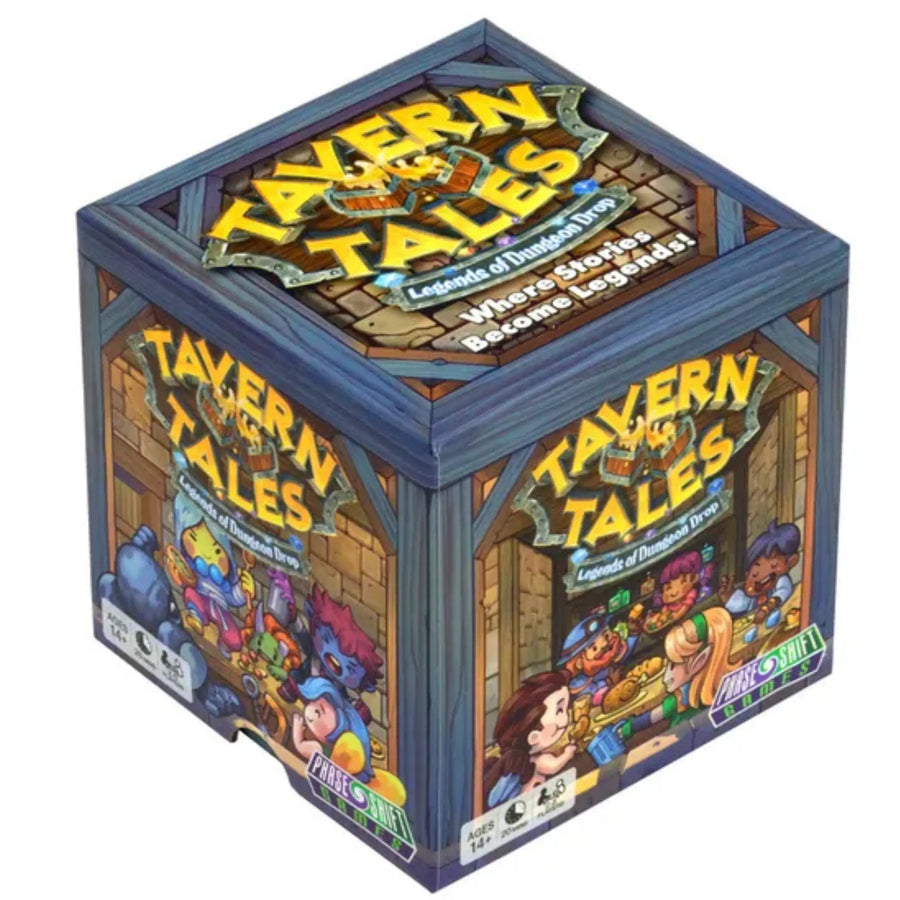
Tavern Tales: Legends of Dungeon Drop. Two to five players, twenty minutes, cards and no cubes. With your hand of heroes, you stake a claim on a location: how many monsters you've defeated there, what treasures you've taken. So far, it's a game of boasting.
Above, Skulnick starts the dispute. Every claim can be challenged: others play their cards to snatch your glory, and a contest of exaggeration begins. The last one standing takes the contested cards.
Then the twist. The loudest boast doesn't win: scoring is about collection. It counts how many identical cards you've already accumulated, thus pushing you to choose a legend and defend it every round. You have to decide what you want to be remembered for, and then stick to that role.
It's not about who did the most. It's about who tells the same story consistently, and defends it.
The fire crackles. You just swore you killed a dragon with your bare hands, and for a moment, everyone around the table believed you.
Then someone puts down their tankard and says, “I killed two.”
A California math teacher, former economist and devotee of Reiner Knizia games, enters a universe of space mercenaries with one thing in his hand: twelve dice.
Robert Hovakimyan doesn't come from the gaming industry. He teaches mathematics, he used to be an economist, and he started designing out of an obsession: Reiner Knizia's games. Tigris & Euphrates, Ra, Modern Art— works where the rules fit on one page and all the tension arises from the people sitting around the table. That's the lesson he carries with him: few rules, real choices, fun that comes from fellow players and not from the rulebook.
He is hosted by IV Studio, the home of Moonrakers, a space deck-builder of alliances and negotiations. They entrust him with their universe of mercenaries and ask him to enter it through a light, side door.
A disciple of Knizia in a world of spaceships, armed only with dice.
You've rolled the dice and someone has landed well. There's already a small pile of progress in front of you: just stop and it's yours, safe and sound. Or you can re-roll, and if the dice are in your favor, the pile grows even bigger.
But if they fail, everything disappears. Not just a part: everything you've built this turn.
Your hand hovers over the dice. The table falls silent and watches you. You know exactly how much you risk and how much you can gain, and precisely for that reason, you can't decide.
How can a handful of dice pin you down like this?

Moonrollers. Two to five players, thirty to forty minutes, dice, and open drafting. You roll five dice, commit the matching ones to a crew card, and at each step you choose: you stop and save, or you re-roll. If you fail, the turn is lost. So far, an honest push-your-luck game.
On top of that, the designer builds an engine, and he builds it in common. Each crew you acquire gives you a new power, but the cards are a single row for everyone: when you take something, you take it away from the person next to you.
Then comes the twist, and it's pure Knizia. Dangerous missions are worth points at the end of the game, but whoever accumulates the most danger is punished and gets nothing. The thing you chase is the same thing that screws you over: beneath the dice there is no luck, there is an accounting of costs and benefits disguised as a gamble.
At the table, everything is shared – the cards, the powers, the dangers. Everything except victory.
The dice are in your hand. You have enough to stop now and win clean. The table is silent, waiting.
And you feel your thumb moving on its own, ready to roll them one more time.
In 2025, an American studio takes its most collaborative deduction game—nine demigods and a roomful of people secretly maneuvering their favorites—and rebuilds it for just two players.
IV Studio wasn't born in board games. It was born in animation: a Nashville team that signed work for Bad Robot, Nike, Netflix. At a certain point, they stopped animating for clients and started building boxes for themselves.
The first successful release was Moonrakers, in 2020: a space deck-builder of fragile alliances and open negotiations. From there, the same trio, Max Anderson, Zac Dixon, and Austin Harrison, signed Veiled Fateand Brink.
Their signature is always the same: the game doesn't live on the board; it lives among the people sitting around it. Recreating this in a room with only one opponent, where there's no crowd to disappear into, is the most uncomfortable gamble they could have made.
In a group deduction game, you hide in the pile. Not here. In front of you there's only one person, and for the entire game, they look at nothing but you.
You move a demigod up, and you've said something. You move it down, and you've said something else. Every gesture you make for your favorites is also a confession about who they are.
And there's the worst doubt: the person in front of you might secretly love your same demigod. When you push it, you don't know if you're winning or setting them up for victory.
How can such a small system weigh on you so much?

Scales of Fate. Two players, half an hour, three ages. In each turn, you send demigods on missions: they gain or lose renown along a track. You secretly choose two of them and score based on the space they land on together or the distance separating them. So far, a clean abstract positioning game.
On top of that, the designers added just one rule that changes everything: you can move any of the nine demigods, not just yours. To push the two you're interested in, you also have to move the others and mask which ones are truly yours.
Then comes the twist. Your opponent might have chosen one, or both, in common with you. And at the end of the three ages, you guess each other's choices. Making a mistake costs, guessing correctly pays off.
A duel where you move the entire board to hide two squares
Two chairs, a narrow table, nine cards in the middle. You hold two in your heart and pretend not to have them. The person opposite does the same, and perhaps holds yours.
You reach out to a demigod. And the person sitting opposite only looks at that.