
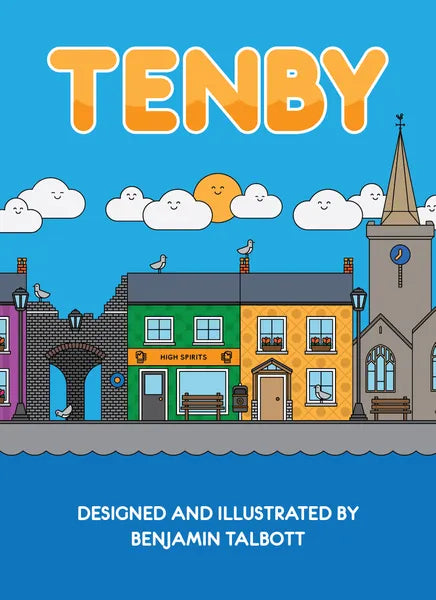
The Soul of Tenby: Beyond the Box
Imagine the pungent scent of salt air mingling with the sweet aroma of wildflowers, while the Atlantic wind caresses the pastel-colored facades of a clifftop village. Tenby doesn't simply ask us to play; it invites us to slow down, breathe, and become the architects of an idyllic landscape. In a market often saturated with dark or abstract themes, this title feels like a breath of fresh air, capturing the picturesque essence of the famous Welsh town.
This isn't just a stylistic exercise: Tenby's soul lies in the promise of building something beautiful, balancing aesthetics with a rigorous need for efficiency. It's a game that speaks to down-to-earth dreamers, to those seeking visual elegance but unwilling to give up the satisfaction of a well-oiled game engine.
The Signature of Cosy Cub Games
When you see the Cosy Cub Games logo, you know one thing for sure: accessibility will never be synonymous with banality. This publisher has carved out a precious niche for itself: that of "cozy" games that hide sharp teeth beneath a tender and welcoming appearance.
Their touch on Tenby is evident in the meticulous attention to materials and the color palette that relaxes the eyes even during moments of intense decision-making. Cosy Cub understood that the tactile and visual experience is an integral part of the gameplay; manipulating these tiles and cards isn't just functional, it's enjoyable. They've transformed managing a coastal town into an almost Zen-like ritual, where every component seems to say, "Sit down, take your time, but play smart."
/pic8221981.jpg)
The Beating Heart: Mechanics and Strategy
Under the pastel-colored hood, Tenby reveals a game engine that runs with the precision of a clock. The structure is based on Open Drafting , eliminating blind luck: options are visible, opponents' intentions are predictable. The challenge isn't "what do I draw," but "what do I leave behind."
The core of the gameplay is a refined Tile Placement combined with Pattern Building . It's not enough to simply place buildings; you have to weave a network of adjacencies that meets specific criteria. This is where Set Collection management comes into play: each placed tile must serve a multiple purpose, unlocking immediate bonuses or contributing to end-game objectives. It's a spatial puzzle that requires foresight.
Particularly interesting is the Turn Order system: Stat-Based . The turn order is neither static nor rotating in the traditional sense, but fluctuates based on player performance and choices. This adds a layer of sophisticated tactics: sometimes it's worth making a suboptimal move to ensure priority in the next round, especially when there's a crucial tile on the table that's needed to close a sector.
And for lone wolves? Solo/Solitaire Game mode isn't a gimmick. It's a pure optimization challenge, where the game itself becomes an unforgiving opponent, forcing you to exploit every single synergy between the cards.
/pic8221980.jpg)
Overview: The Creative Team
- Author: TL Simons
- Illustrator: TL Simons
- Publisher: Cosy Cub Games
Spotlight: Let's see it in action
At the end of the game, when you look at your board, you see more than just victory points. You see a small world that has taken shape, orderly and vibrant. Tenby reminds us that beauty comes from the harmony between constraints and freedom, and that even in a small seaside town, every choice can open unexpected horizons. It's an experience that leaves a pleasant feeling of complete order, like a puzzle finally revealing its complete image.
Condividi:
Honor's End: The Final Frontier of Cooperative Deckbuilding
The Druids of Edora: The Art of Dice Placement in Feld's Green Labyrinth