
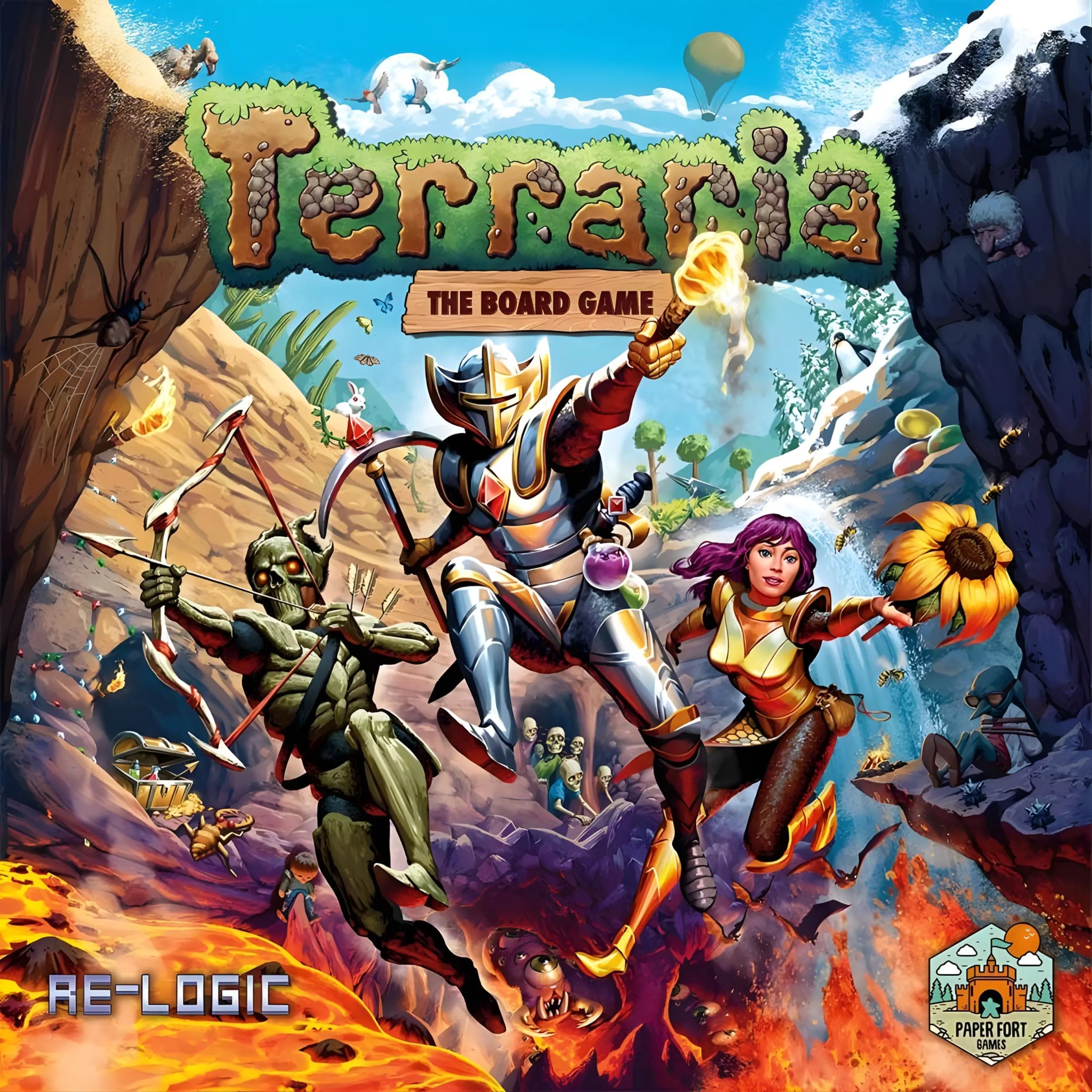
The Soul of Terraria: The Board Game: Beyond the Box
There's an unmistakable sound that resonates in the memories of millions of players: the rhythmic thump of a pickaxe hitting rock, followed by the clinking of precious metal falling into the inventory. Terraria has never been just a video game; it's an ecosystem of possibilities, a manifesto of creative freedom in a 16-bit world. Bringing this vastness to a gaming table is a feat that makes any designer's wrists tremble.
When we approach Terraria: The Board Game , we're not simply looking for a 1:1 conversion. We're looking for that "one more block, one more cave" feeling. The soul of this project lies in the promise of preserving the verticality of exploration and the unpredictability of the biome, transforming pixels into cardboard without losing the magic of discovery. This isn't about following a path, but about digging it.
The Paper Fort Games Signature
Adapting an indie giant like Terraria requires more than a license; it requires respect and vision. Paper Fort Games , in close collaboration with Re-Logic (the original creators), has demonstrated that they understand the task. Often, in licensed games, we see publishers pasting a theme over generic mechanics. Here, the philosophy seems to be the opposite: the mechanics were born from the needs of the theme.
/pic8230725.jpg)
The guarantee offered by Paper Fort Games lies in their desire not to oversimplify the experience for a mass audience, but to create a layered system that satisfies the experienced tabletop player (our target audience). They have embraced the complexity of crafting and combat, translating it into a fluid, analog language. Their touch is evident in the material management and art direction, which doesn't betray the pixel art style but elevates it to a functional aesthetic for tabletop playability.
The Beating Heart: Mechanics and Strategy
Let's enter the engine room, where we Frogames fans love to get our hands dirty. Terraria: The Board Game is designed as a pure cooperative game , and this is the first winning choice: Terraria is, par excellence, an experience to be shared.
The game's engine is a refined hybrid. It features a deck-building system that acts as an evolving inventory. Cards aren't just static actions; they represent the equipment you forge. Improving your deck literally means "crafting" better tools to face escalating threats. This is complemented by an Action Point mechanic that governs the pace of the turn: digging, moving, attacking. Managing these points is crucial, creating that typical tension between "I want to explore over there" and "I have to get back to base before nightfall."
The board, or rather, the game world, uses a Modular Board with Grid Movement . This is essential to replicating the procedural generation of the video game. You'll never play on the same map twice. Biomes reveal themselves, and with them, threats. This is where the Sandbox aspect comes into play: players have objectives, but the path to achieving them is clear. You can focus on building an impregnable fortress or descend into the underworld as quickly as possible.
/pic8230724.jpg)
Combat uses Dice Rolling , but don't be afraid of uncontrolled randomness. Variable Player Powers (given by different armor and accessories) allow you to mitigate and manipulate the results. Interestingly, the game manages resources through Pool Building systems, simulating random yet manageable enemy loot. Whether you're in a group or in Solo/Solitaire mode, the sense of progression is palpable: you start vulnerable with a copper sword and end up as a destructive deity, just like in the video game.
Overview: The Creative Team
- Publisher: Paper Fort Games
- Collaboration: Re-Logic (Original creators of the video game)
- Genre: Cooperative, Sandbox, Adventure
- Focus: Exploration, Crafting, Boss Battle
Spotlight: Let's see it in action
At the end of the game, when the dice stop rolling and the final boss has been defeated (or decimated the party), what remains isn't the mathematical calculation of hit points. What remains is the story of how you built a makeshift arena while the zombies knocked on the door, or how the last piece of equipment, forged at the last second, changed the tide of the battle. Terraria: The Board Game succeeds in the challenging task of capturing the essence of the digital adventure and transforming it into a tangible social ritual. It's an invitation to delve not just into the cardboard, but into the shared imagination of your group.



 https://frogames.it
Condividi:
Marvel Dice Throne: Deadpool – When Chaos Rolls the Dice
Hot Streak – the story of the CMYK party game born in 2014