
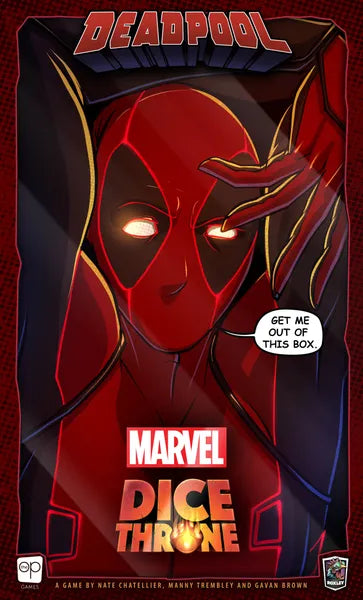
Marvel's Soul Dice Throne: Deadpool: Beyond the Box
There's a precise moment, when you lift the lid of this box, when you realize you're about to play more than just a duel game . There's something irreverent in the air. If Dice Throne is the arena where stoic warriors and honorable paladins clash with martial discipline, Deadpool is the one who enters the scene eating a taco and drawing mustaches on his opponents' portraits. The soul of this title lies not only in the Marvel brand, but in the perfect gaming transposition of Wade Wilson's psyche . We're not dealing with a simple aesthetic skin: here, the theme bleeds into the mechanics, creating an experience that constantly oscillates between tactical genius and total, exhilarating anarchy. It's an invitation not to take yourself too seriously, even while wanting to destroy your opponent with surgical precision.
/pic8748955.jpg)
Roxley's Signature
To talk about Roxley Games (in collaboration with The Op) is to talk about a production standard that has redefined the expectations of the Kickstarter and retail markets. Roxley doesn't produce boxes, they produce design objects. Even in a chaotic edition like Deadpool, their touch is unmistakable: the ergonomics of the Game Trays are designed to speed setup to a matter of seconds, the marbled dice have a specific weight that makes rolling rewarding, and the readability of the boards is never sacrificed for the altar of artistic style. Roxley's greatness lies in making order invisible: the entire complex system of icons and status effects is handled with such graphical clarity that the player can focus solely on strategy (and laughter), without ever stumbling over the rules.
The Beating Heart: Mechanics and Strategy
Beneath the red and black hood beats the solid heart of the Dice Throne engine, but Deadpool pushes it to the limits of Push Your Luck . Let's analyze the gameplay:
Says Rolling & Probability Management
The core loop remains classic Yahtzee-style combat: three rolls to activate an ability on the board. However, Deadpool introduces a unique level of variance. His abilities aren't just linear (pure damage); many play with risk. Dice management here requires a flexible approach: you're not just looking for a straight or four-of-a-kind, but you have to be ready to improvise when the outcome is... bizarre.
Hand Management and Variable Powers
True mastery lies in the use of Combat Points (CP) and cards. In Marvel Dice Throne, cards aren't just modifiers, they're your life insurance. With Deadpool, card tucking (though less prominent than with other heroes) and deck manipulation become tools for breaking the rules. His passive abilities, such as regeneration, force the opponent into constant aggression, turning the game into a King of the Hill -style race against time.
Take That and the Fourth Wall
It wouldn't be Deadpool without a direct element of disruption. The "Take That" mechanics are integrated not only to deal damage, but to disrupt opponents' plans through unique status effects that simulate the character's unpredictable nature. Expect to have to manage tokens and conditions that change the rules of engagement turn after turn.
/pic8748950.jpg)
Overview: The Creative Team
- Game Design: Nate Chatellier, Manny Trembley
- Artwork: Manny Trembley (whose distinctive line gives life to the dynamic angularity typical of the series)
- Development: Gavan Brown and the Roxley team
Spotlight: Let's see it in action
Ultimately, a game of Marvel Dice Throne: Deadpool never leaves you indifferent. You close the box with the feeling of having survived a violent and frenetic cartoon. It's not the game for those seeking chess determinism, but it is the ultimate experience for those who want to feel the adrenaline rush of a die rolling at the last second, turning a certain defeat into an absurd victory. It's controlled chaos, served with a sardonic smile.





 https://frogames.it
Condividi:
The Art of War and Betrayal: Sekigahara
Terraria: The Board Game - When the Digital Sandbox Becomes Cardboard and Strategy