
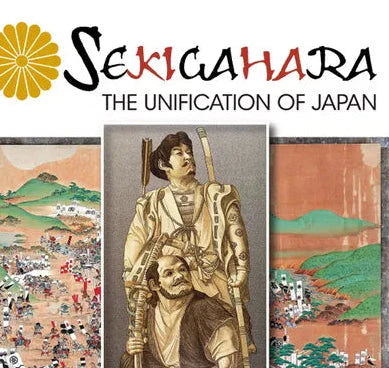
The Soul of Sekigahara: The Unification of Japan: Beyond the Box
Japan, the year 1600. The air is thick with humidity and foreboding. The country is torn in two, suspended on a thin thread between unification and perpetual chaos. Sekigahara: The Unification of Japan doesn't simply ask you to move armies or conquer territories; it asks you to look your generals in the eye and ask, "Will they betray me today?"
The soul of this title lies in uncertainty. Not the kind borne of a roll of the dice, but the kind born of human doubt. It's a game that manages to convey the visceral feeling of a military campaign where politics and loyalty weigh as heavily as the sword and blunderbuss. Here, the fog of war isn't an afterthought; it's the silent protagonist that envelops every decision, making every move an act of faith or a calculated gamble.
/pic8685997.jpg)
The Signature of GMT Games
When you see the GMT Games logo on the box, the expectation is immediate: historical rigor, functional components, and dense rules. However, with Sekigahara, the Californian publisher has taken a lateral, almost Zen-like step toward absolute elegance.
While retaining the strategic depth that is GMT's trademark, this title ditches the excessive complexity of traditional hex-and-counter wargames. It's proof that a hardcore publisher can produce an accessible title without sacrificing an ounce of historical simulation. The quality of the wooden blocks and the assembled map are a statement of intent: this is a game destined to remain on tables (and in collections) for decades.
The Beating Heart: Mechanics and Strategy
Let's analyze the engine that makes Sekigahara such a masterpiece of design. This is a block wargame , but forget everything you know about sheer strength of numbers.
Fog of War and Secret Unit Deployment
The rectangular block mechanic is perfectly used to manage Fog of War . The opponent sees where your troops are and how many there are (the number of blocks), but he doesn't know who they are. Is that block a weak infantry unit or the elite cavalry of Clan Ii? This hidden information creates constant psychological tension, forcing players to bluff about their actual strength.
Hand Management: Loyalty is Everything
Here lies the true genius of the system. Having troops on the field isn't enough; you have to motivate them. To have a block belonging to a certain clan fight, you must discard a card from your hand with the corresponding symbol (the Mon ).
If you have a huge Mori clan army but no Mori cards in your hand, those soldiers will stand idly by while the enemy slaughters them. This brilliantly simulates the logistical challenges and, above all, the fickleness of feudal alliances. Hand management thus becomes an exercise in military planning: don't move troops you can't "pay" with loyalty.
Point to Point Movement and Area Control
Movement on the Point-to-Point map is fluid and rapid, simulating forced marches along major routes like the Nakasendo or Tokaido. The objective is to control castles and key economic resources, but be careful: pushing too far forward exposes your supply lines and risks a rogue bloc switching sides via "Loyalty" cards, a mechanic that can turn the tide of a battle in an instant.
/pic8166889.jpg)
Overview: The Creative Team
- Game Designer: Matt Calkins
- Artist: Rodger B. MacGowan, Mark Mahaffey
- Publisher: GMT Games
Spotlight: Let's see it in action
At the end of the game, when the last block is revealed and the map of Japan turns a single color, what remains is not just the calculation of victory points. What remains is the feeling of having rewritten history, of having held together a fragile alliance through sheer force of will and charisma. Sekigahara teaches us that victory belongs not to the one with the sharpest sword, but to the one who best interprets their opponent's silence and hesitation.


 https://frogames.it
Condividi:
The Soul of Wondrous Creatures: Beyond the Box
Marvel Dice Throne: Deadpool – When Chaos Rolls the Dice