
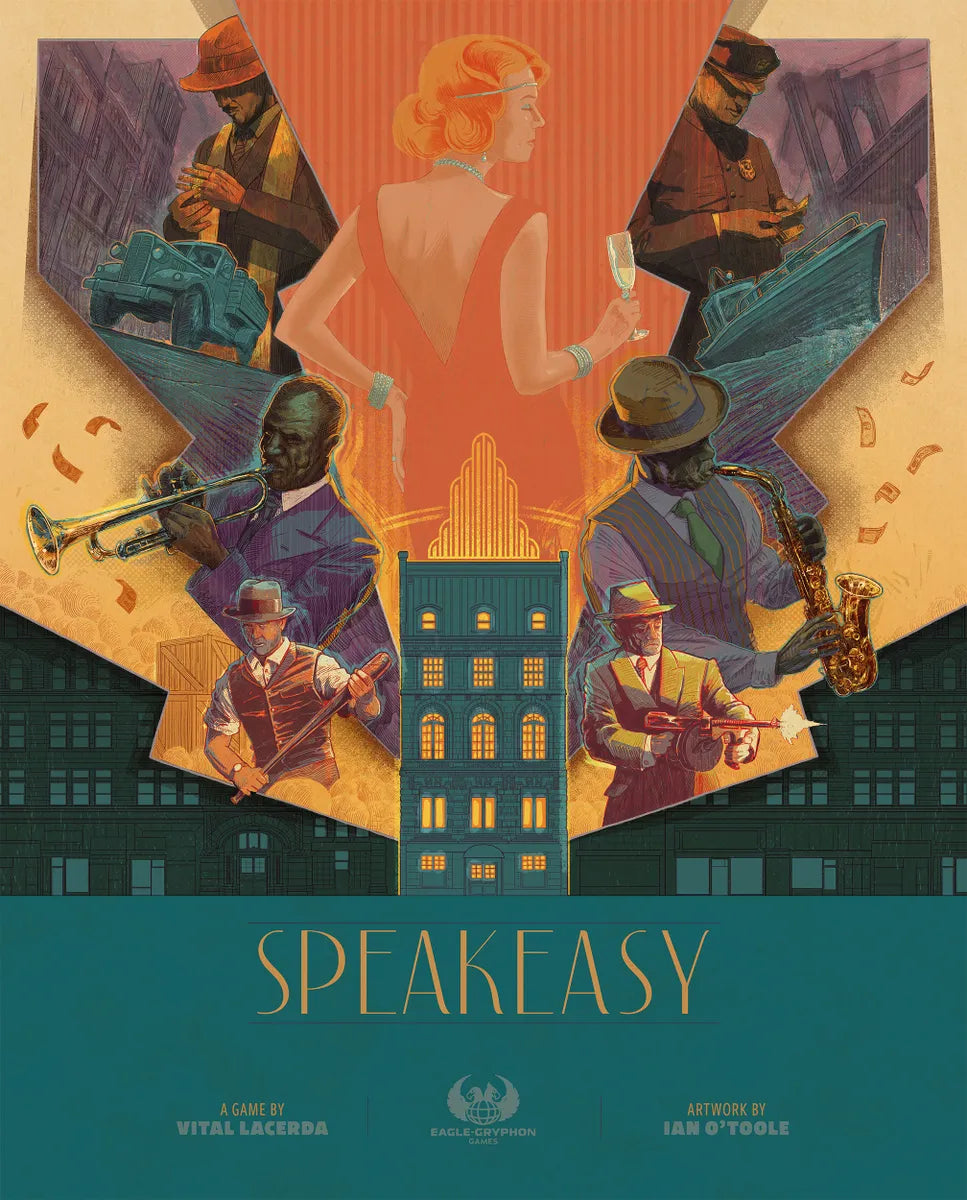
Speakeasy: Vital Lacerda's board game, featuring jazz, whiskey, and gangsters' "armed peace."
A strategic board game where Manhattan isn't conquered by gunfire... but by influence, management, and clandestine deliveries.
New York, 1920s. Jazz seeps from the basement like thick smoke, the door has a password slot. and the glass shouldn't exist… and yet there it is, shining. Outside, the city pretends to be clean. Inside, Manhattan is a chessboard of speakeasies, favors, bribes and “friends” who suddenly become very interested in your business.
And the most disturbing thing? It's not a war. It's worse: it's a period of non-war, a truce between predators. where no one shoots you… until you break the balance.
/pic8165052.jpg)
The “Commission”: the peace that suffocates you
In Speakeasy you are not “a generic gangster”: you are a boss within an organized system. Manhattan is divided into districts, each boss has an area of jurisdiction and everyone is under a non-aggression pact… at least on paper.
This is the real tension of the game: building an empire without blowing up the city . Because as soon as you really expand (more luxurious speakeasies, bigger businesses, even casinos), you start to shine like a neon sign… and when you shine, everyone sees you.
Prohibition: When the "Forbidden" Becomes Economics
The Roaring Twenties aren't just fringe bands and saxophones: they're a city where illegal alcohol creates networks, and networks create power. If the market is clandestine, money is not just money: it is information , protection , delivery channels , trusted men .
Speakeasy 's thematic genius is that it doesn't ask you to "play the bad guy": asks you to manage risk . A smart boss doesn't shoot: he plans, buys silence, moves resources, “cleans” the accounts, pays those needed and collects where no one is looking.
How to play (without getting lost in a wall of rules)
An example of a shift (mini-story)
“Okay, I need to get some cash in today.”
I place a man in the right district to unlock the action I need, but it costs me time and closes off a path I wanted to use later. I play a card to push the delivery: I collect immediately, but I'm using resources that I would need to upgrade the premises.
Here's the dilemma: if I grow now, I become visible. If I delay, they'll overtake me. So I do the most 1920s boss thing: I pay for the problem . A favor here, a cover there, and I keep the whiskey rolling like it's water.
“Speakeasy is when you have a brilliant move… and realize it costs you two moves tomorrow.”
The 3 crossroads that remain before you
Want to dominate Manhattan? Fine. But dominating means getting noticed.
Playing “fair” is easy… as long as the game offers you an irresistible dirty trick.
Controlling districts is power. Without a solid engine, however, it only lasts a few turns.
Curiosities that change the perception of the game
It's structure: you plan zones, open routes, occupy key spaces and make sure your men always arrive first.
You're not in an action movie: you're in a film where the threat is political. If you make too much noise, there will be consequences.
The aesthetic conveys a manager of the forbidden with white gloves and cooked accounts: elegant… and disturbing.
Who it is for (and when it gives its best)
you want a strategic board game with real planning and constant pressure;
you love management games with bad choices and big rewards;
You're intrigued by building a “legal-illegal” empire during Prohibition.
you are looking for a light and very fast experience;
You want a match without pressure and without consequences to deal with.
If you want to continue your walk in Manhattan…
Strategic Eurogames with a strong signature.
Intense and well-crafted titles, same vibe.

Condividi:
Black Orchestra: Historical Co-op + Resistance + Valkyrie: A Black Orchestra Game
Fliptown and Flip Voyage: Flip-and-write poker deck board games