
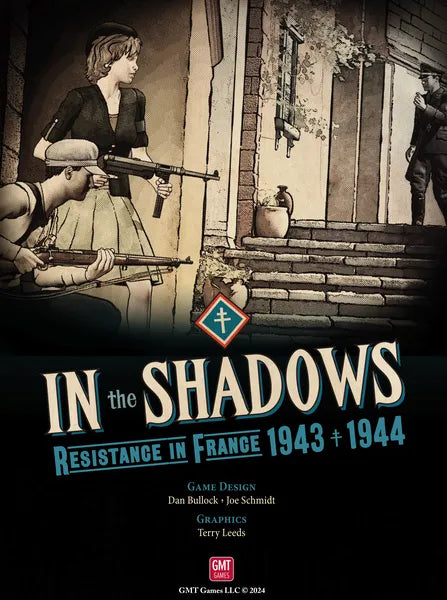
The Soul of In the Shadows: Resistance in France 1943-1944: Beyond the Box
Imagine the ticking of a clock that marks not only time, but the distance between freedom and capture. In the Shadows: Resistance in France 1943-1944 is not simply a wargame; it is a dark room, dimly lit by a lantern, where every decision weighs as much as a human life. We are in the heart of occupied France, in the most critical period preceding D-Day. The atmosphere this title manages to evoke transcends cardboard and tokens: there is a palpable sense of oppression, the urgency to organize resistance cells (the Maquis) while the omniscient eye of the Gestapo and the Milice scrutinizes every move.
We're not talking about moving large armored divisions, but an asymmetric warfare of sabotage, intelligence, and silent courage. Why should you be interested? Because rarely does a board game make you feel so vulnerable and powerful at the same time. You are alone against a brutal system, and the box challenges you to rewrite history by operating, literally, in the shadows.
/pic9137249.jpg)
The Signature of GMT Games
When we see the GMT Games logo on a box, we already know we're dealing with a work of historical rigor and functional design. However, with In the Shadows , the Californian publisher demonstrates remarkable versatility. Known for their 6-hour monsters and enormous maps, here they manage to condense the strategic depth of their "Lunchtime Series."
GMT's signature touch in this title is the clean interface combined with the rawness of the simulation. They don't try to sugarcoat the difficulty of the Resistance. The components are, as always, spartan but elegant: clear maps, legible counters, and cards that are small compendiums of history. This is a guarantee because the gameplay doesn't hinder immersion, but the structure. GMT isn't just selling you a game, it's selling you a functioning historical context.
The Beating Heart: Mechanics and Strategy
Let's now analyze the engine under the hood, where my critical eye turns on. In the Shadows is a pure Solitaire game . It's not an adaptation with a fake bot; the system was designed to pit a single player against the procedural AI of the German occupation.
The core of the game is a classic yet refined Card Driven (CDG) system. Each card presents the genre's typical Hamlet-like dilemma: should I use it for the Historical Event (often powerful but single-use) or for Operation Points (Ops)? This is where brutal hand management comes into play. Cards are your lifeblood: they represent weapons, intelligence, and morale. Wasting them means being exposed when the Repression phase kicks in.
Map movement is managed via Area Movement , which divides France into key zones. It's not the hexes that matter, but the connections. You'll have to move your Maquis pieces to prepare the ground for the Allies, but every movement increases the risk. Here, the game shines for its Variable Setup and the unpredictable nature of events: no two games will be the same because the sequence in which the Gestapo strikes or the Allies send aid drastically changes the tactical flow.
A fascinating technical aspect is the management of "Action Points" in relation to the alert level. The more you act, the more exposed you are. It's a "push your luck" mechanic integrated into a wargame: want to blow up that railway bridge now? Do it, but be aware that the level of surveillance in the area will increase, making future operations almost suicidal. It's a simulation of attrition, not conquest.
/pic8706864.jpg)
Overview: The Creative Team
- Game Design: Dan Fournie
- Development: A guarantee of rigorous playtesting typical of GMT
- Art: Functional, evocative, based on vintage photographs
Spotlight: Let's see it in action
When you put away the last card and look at the map of France, marked by your successes and the voids left by your fallen comrades, you won't think of victory points. You'll think of Jean Moulin, of the anonymous saboteurs, of the cold of the French countryside. In the Shadows doesn't just ask you to win, it asks you to resist. It's an experience that leaves an echo, a silent reminder of the cost of freedom. A title that deserves a place on the shelf not for its volume, but for its emotional and historical weight.
Condividi:
House of 1000 Corpses: Review and Gameplay Analysis
Cozy Stickerville: Cooperative Legacy Game Review