
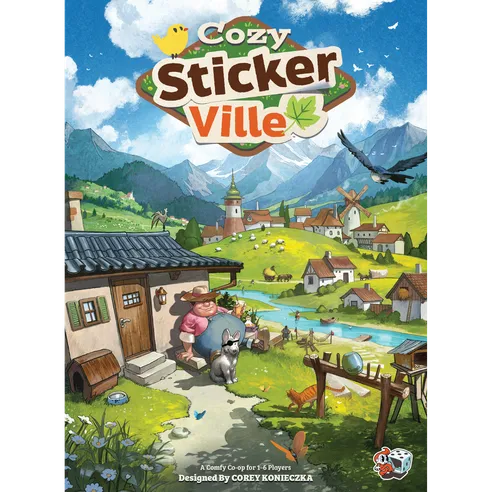
The Soul of Cozy Stickerville: Beyond the Box
There's a precise moment, when you lift the lid of Cozy Stickerville , when the scent of printed paper seems to mingle with that of hot tea and freshly baked cookies. We're not just talking about a board game, but a refuge. In a gaming landscape often dominated by intergalactic conflicts and dark dungeons, this title presents itself like a woolen blanket on a rainy day. The bucolic setting isn't just an aesthetic backdrop, but the stage for an experience that asks us to slow down.
Here, the act of playing transforms into a ritual of shared construction. It's not about defeating an enemy, but about shaping a community that breathes and grows with us, game after game. It's an invitation to rediscover the tactile joy of childhood—that of sticker albums—elevated, however, to an adult and conscious strategic structure.
Asmodee's Signature
For us enthusiasts, seeing the Asmodee logo on the box is synonymous with a production promise kept. In the case of Cozy Stickerville , the publisher has demonstrated particular sensitivity. They didn't just print components; they also took care of the tactile experience. The weight of the cards, the quality of the stickers (which must stand the test of time without damaging the board), and the ergonomics of the materials reveal a publishing process that deeply understands the target audience.
Asmodee's touch here is clarity : in a game that evolves and changes rules, the ability to keep the rules clear and the components organized is crucial. They've created a product that eliminates friction between the player and the mechanics, allowing for total immersion.
The Beating Heart: Mechanics and Strategy
Don't be fooled by the cute aesthetic: under the hood of Cozy Stickerville beats a solid and interconnected engine. This is a cooperative game with a legacy structure that doesn't punish, but rewards perseverance.
The core gameplay is elegant worker placement . Players must assign their villagers to various tasks in the village to gather resources. However, resource management is tense: there is no infinite abundance, and every resource spent must make sense in the game's long-term economy.
Evolution through Sticker Placement
The real technical magic lies in the use of stickers. In many legacy games, permanent changes are scary; here, it's cathartic. Sticker placement doesn't just mark progress on the map, it modifies the cards themselves and the player boards, unlocking new abilities or altering action costs. It's a design that evolves organically: the rules you learn on your first playthrough will be enriched and overwritten, creating a smooth yet profound learning curve.
Narrative and Choices
The Narrative Choice/Paragraph element acts as the emotional glue. Between one management phase and the next, the game will ask you to read specific paragraphs that will present you with moral or practical crossroads. These choices aren't cosmetic: they affect the state of the village and can open or close entire branches of the campaign.
Finally, a special mention for the Solo/Solitaire Game mode. Co-op games often suffer from cumbersome management of multiple characters when playing solo. Here, the automaton or solitaire management system has been streamlined to allow you to enjoy the story without having to deal with the cognitive overhead of an entire gaming group.
Overview: The Creative Team
- Game Design: Focus on evolutionary mechanics and accessibility.
- Art Direction: Watercolor/pastel style to maximize visual comfort.
- Narrative Lead: Branching narrative writing focused on themes of community and growth.
At the end of the campaign, you'll look at your sticker-filled board and see more than just a finished game. You'll see the map of your afternoons, the colorful scars of difficult decisions, and the monuments to shared victories. Cozy Stickerville reminds us that the board game is, above all, a vehicle for togetherness, a safe place where the only risk is wanting to stay a little longer. It's not just a game to have, it's a place to return to.


Condividi:
In the Shadows: Resistance in France 1943-1944
Cozy Stickerville: Corey Konieczka's Legacy Game Preview