
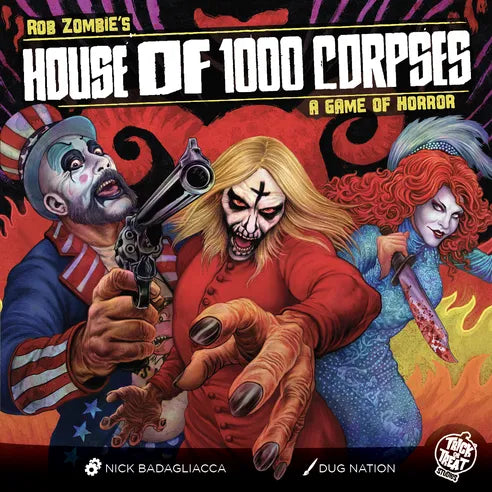
The Soul of House of 1000 Corpses: Beyond the Box
Halloween, 1977. There's a stale smell of gasoline mixed with fried chicken in the air, and a raucous laugh echoes in the darkness. House of 1000 Corpses isn't your typical horror game where you shiver as you wait for a die to decide your fate while fleeing an invincible monster. Here, the paradigm is reversed: you are the monster . You are the madness.
Entering this game means accepting a strong narrative pact: stepping into the shoes of the depraved Firefly family. The goal isn't to survive, but to "celebrate" the holiday in their own way. The atmosphere at the table is dense, grotesque, and saturated with acidic colors, just like Rob Zombie's film. It's a game that asks you to leave morality at the door and embrace the kinetic chaos of a manhunt orchestrated with macabre precision.
/pic8947603.jpg)
The Signature of Trick or Treat Studios
When you see the Trick or Treat Studios (TOTS) logo on a box, your expectations immediately change. We're not talking about a publisher who simply purchased a license to slap on standard mechanics. TOTS was born from the world of special effects, masks, and high-end horror collectibles.
This artistic background is powerfully reflected in the game design. The aesthetic attention is obsessive, but what makes this title a guarantee is its thematic coherence . TOTS doesn't create abstract games; it creates atmospheric simulators. In House of 1000 Corpses , every card, every token, and every illustration serves not only to advance the game, but to immerse you in the dirty, lived-in "texture" of the film. It's the guarantee of a product made by fans for fans, where respect for the original source elevates the gaming experience.
The Beating Heart: Mechanics and Strategy
Under the hood of this infernal machine lies a solid engine that blends cooperative play and resource management with a fast pace. Don't let the "trash" theme fool you: the mechanics require coordination and composure.
The system is based on careful management of Action Points (AP) . Each member of the Firefly family—from Captain Spaulding to Otis—has unique abilities (Variable Player Powers) that define their role on the board. The core gameplay is a macabre Pick-up and Deliver : you must intercept the unfortunate victims wandering around the house and "transport" them to the designated rooms for their end. But beware, the victims are not sacks of potatoes; they have unpredictable behaviors, and the police are always lurking.
A technically interesting aspect is Hand Management . Cards aren't just for movement or attack, but often must be sacrificed or played in sequence to activate the most powerful actions. This is where a tucking mechanic comes into play (sliding cards under the board or other cards) that simulates setting traps or accumulating sadistic energy.
The game also shines in its Solo/Solitaire mode, where managing the AI victims and the timer imposed by the event deck create a tight optimization puzzle. There's no downtime: either you collaborate perfectly by sharing priorities, or the evening will end with the family in handcuffs, which, for the Fireflys, is the only true Game Over.
/pic8947614.jpg)
Overview: The Creative Team
- Authors: The mechanics have been carefully adapted to reflect the controlled chaos of Rob Zombie's direction.
- Graphics: The illustrations are not stills from the film, but original art that captures the 70s grindhouse aesthetic.
- Publisher: Trick or Treat Studios
Spotlight: Let's see it in action
House of 1000 Corpses doesn't try to be a game for everyone, and that's its greatest virtue. It's a visceral experience that transforms the table into a stage for cooperative nastiness. At the end of the game, you won't so much remember the score as that moment when, with a knowing grin, you coordinated the perfect play with Captain Spaulding, realizing that, for one night, it was fun to be the bad guys.

Condividi:
Echoes of Emperors: Review and Gameplay Analysis
In the Shadows: Resistance in France 1943-1944