
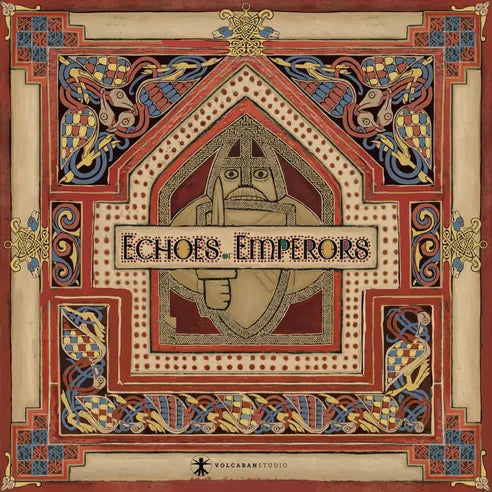
The Soul of Echoes of Emperors: Beyond the Box
Imagine a chessboard that isn't fixed, but breathes, grows, and changes before your eyes. Echoes of Emperors isn't simply a skirmish game; it's a temporal bridge between the abstract purity of medieval chess and the narrative complexity of modern civilization games. There's something deeply evocative in seeing your capital rise on a modular map, knowing that every conquered forest or mine isn't just a resource, but a defensive outpost against the inevitable enemy tide. We're not moving helpless pawns: we're writing the history of an empire that, turn after turn, strives not to become just an echo in time.
/pic9247894.jpg)
The Signature of Volcaban Studio
In an industry dominated by giants, Volcaban Studio is the classic story of passion we love to tell. Founded by Stef and Niel , two childhood friends who grew up on Age of Empires , this studio brings a handcrafted approach to the table that's evident in every card. Volcaban doesn't seek "mass-produced" gaming; it seeks authenticity. Their signature is an obsessive attention to historical detail fused with accessible design. Choosing a Volcaban title means supporting an idea born in school and sculpted (literally, given Niel's artistic background) with absolute dedication.
The Beating Heart: Mechanics and Strategy
The gameplay of Echoes of Emperors is a clockwork mechanism where Grid Movement meets asymmetrical Deck Construction . Forget free and chaotic movement: here, every hex and every square counts like in a game of chess, but with one crucial difference: the terrain is alive.
Hand management is vital: cards aren't just actions, they're the lifeblood of your economy and military tactics. Every civilization—from the mobile Mongols to the stationary but sturdy Scots—has Variable Player Powers that aren't just passive bonuses, but dictate radically different playstyles.
The resource system is elegant: by controlling the tiles on the map ( Tile Placement and Area Control), you generate the resources needed to play cards from your technology deck. This creates a constant dilemma: expand to gain resources, exposing your supply lines, or consolidate your defense around the Capital? The victory condition—the destruction of the enemy Capital or the total elimination of all units ( Player Elimination technique)—keeps the tension at a fever pitch until the last die is rolled.
Overview: The Creative Team
- Game Design: Stef & Niel (Volcaban Studio)
- Artwork: Niel Sunins (with a style reminiscent of medieval art and hand-sculpted miniatures)
- Focus: 1v1 historical strategy (or 2v2 in the 4-player variant)
Spotlight: Let's see it in action
At the end of the game, when the dust settles on the map and the last Capital falls, Echoes of Emperors leaves you with that rare feeling of having fought a real war, not just moved cubes. It's a game that rewards boldness but punishes recklessness, an experience that reminds us that every empire, large or small, is built on the decisions of its leaders.
Condividi:
Mistborn: The Deckbuilding Game - Review and Gameplay Analysis | Frogames
House of 1000 Corpses: Review and Gameplay Analysis