
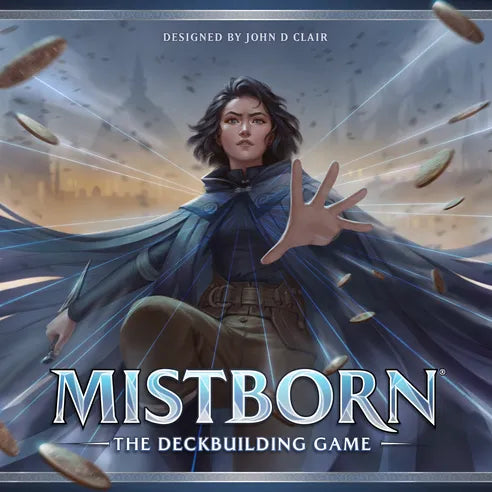
The Soul of Mistborn: The Deckbuilding Game: Beyond the Box
Imagine a world where ash falls incessantly from the sky, drowning out the colors of a blood-red sun. A millennia-old empire ruled by an immortal tyrant. It is here, among the smoky alleys of Luthadel, that Mistborn: The Deckbuilding Game asks us to position ourselves. We are not talking about a simple exercise in cards and numbers, but a descent into the Final Empire created by the pen of Brandon Sanderson .
The soul of this game lies not only in the mathematics of victory, but in the palpable feeling of being a Misting or a Mistborn . There's a sense of urgency and impending danger that permeates every turn. It's not just about building an efficient deck; it's about assembling a desperate team to accomplish the impossible. It's a game that promises to make you feel the metallic weight of Allomancy in your veins, transforming resource management into a lethal dance of risk and reward.
/pic8935769.jpg)
The Brotherwise Games Signature
When it comes to adapting great literary sagas into board games, the fear of a "fan-only" product is always lurking. However, Brotherwise Games has demonstrated a rare sensitivity over the years. Consider their work with Call to Adventure: The Stormlight Archive : they didn't simply paste illustrations over stale mechanics, but sought to capture the essence of the characters' evolution.
In Mistborn, their touch is felt in the clean design and accessibility that doesn't sacrifice depth. Brotherwise understood that Sanderson's setting is built on rigid magical rules (Allomancy is almost a science), and chose to reflect this logical rigidity in gameplay that rewards precise planning rather than uncontrolled chaos. This is a publisher that treats lore not as a garment, but as the very skeleton of the game.
The Beating Heart: Mechanics and Strategy
Let's get to the point, the engine room of this title. Mistborn presents itself as a cooperative deckbuilding game (with a solo mode), but to dismiss it like that would be an understatement. The true brilliance lies in the way designer John D. Clair interpreted the concept of "resource management."
The core of the game is the "Burning" mechanic. In many deckbuilding games, cards provide resources to purchase other cards and are then discarded. Here, the management is twofold and creates a constant dilemma. Cards provide "metals" that can be spent to acquire new cards from the market (Open Drafting), or they can be "burned" to activate powerful Allomantic abilities immediately.
This tactical choice is brilliant: do I burn my Pewter now to defeat a Steel Inquisitor threatening the party, or do I save it as currency to buy that crucial late-game card? This introduces a level of tension missing in many similar games, where purchases are often automatic. Furthermore, the concept of Variable Player Powers is perfectly integrated: each player embodies an iconic character (like Vin or Kelsier) with specific affinities for certain metals, making deckbuilding asymmetrical and personal.
Let's not forget the cooperative aspect. Hit points or defeat conditions are often shared or interdependent, forcing players to communicate. The enemy deck acts like a relentless clock, and the mechanics of "tucking" (placing cards under others) or manipulating the opponent's deck become vital to survival.
/pic8909760.jpg)
Mistborn 's magic system, Allomancy, relies on the physical consumption of metals to gain power. In the game, John D. Clair wanted to replicate the feeling of "exhausting" supplies. Unlike other games where magic is infinite, here the feeling of scarcity is intentional: when you burn a metal, you truly feel like you've consumed a precious resource to gain a momentary but crucial advantage.
Overview: The Creative Team
- Designer: John D. Clair (author of hits such as Mystic Vale , Space Base and Dead Reckoning ).
- Publisher: Brotherwise Games.
- Based on: The "Cosmere" universe by Brandon Sanderson.
Spotlight: Let's see it in action
At the end of the game, when the ash stops falling on the table and the cards are put away, what remains is not the satisfaction of a well-oiled mathematical engine, but the echo of resistance. Mistborn: The Deckbuilding Game achieves a rare feat: making us feel small in the face of immense power, yet capable of overthrowing it with the right amount of sacrifice and cunning. It's an experience that speaks to those who love close-quarters challenges, where every burned metal is a spark of hope in the darkness.

Condividi:
Dewan: Review and Analysis of the New Game Space Cowboys
Echoes of Emperors: Review and Gameplay Analysis