
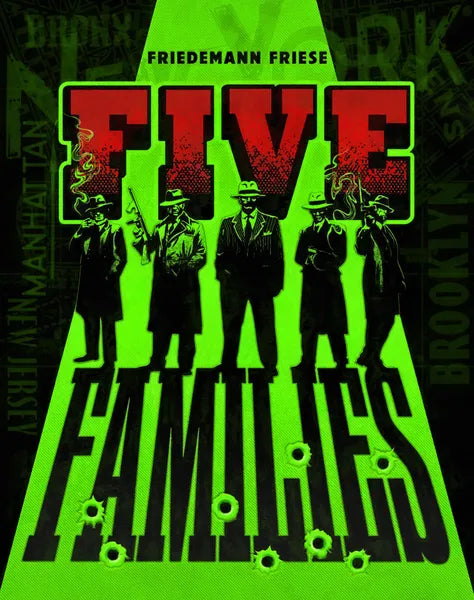
Mechanical Identity: A Review of Five Families
Five Families isn't meant to be loved by everyone; it's meant to be solved by those with strong nerves. Imagine walking into a room where five heads of families glare at each other, but instead of drawing guns, they pull out their accounting ledgers. This is the world depicted by Friedemann Friese (the green-haired author famous for High Tension ). We're not dealing with a narrative Americana where dice decide who lives or dies, but with a hybrid Eurogame disguised as a gangster movie. The target audience? 2 to 5 players who appreciate mathematical tension and direct, almost mean, yet incredibly elegant interaction. Here, the mafia is a pretext for an experiment in game engineering: transforming the chaos of territorial control into an equation that can only be solved with perfect timing.
The Architecture of Conflict: Analysis of Time-Based Area Control
Most Majority and Area Control games work in a binary fashion: you place a piece, the area is contested, and the conflict is resolved. Friese takes this concept and adds a cruel variable: time. In Five Families , placing one of your henchmen in a neighborhood doesn't mean you own it. It just means you've "reserved" the right to try and take it.
/pic9416891.jpg)
This creates what we call a "window of vulnerability" in technical design. From the moment you place your bid until the area is actually secured, that territory is suspended in limbo. This is where the game shines. Opponents must not only overcome your numerical strength, they must do so before the turn ends and the neighborhood is permanently blocked. This creates constant psychological pressure: every move is a gamble on whether others are too poor or too distracted to intervene.
The Relentless Engine: How the Gears of the Economy Turn
Many approach the board as if it were a war map, thinking, "I have to conquer everything." Wrong. The real game, the beating heart hidden beneath the gangster theme, is Revenue Management . It's a game of flow. Districts aren't there for the color on the map; they're there to generate constant income .
If you conquer three territories but empty your coffers to do so, on the next turn you'll be a passive bystander as others dismantle you. The balance between liquidity (money) and manpower (people) is crucial. Running out of leverage means certain doom. The Five Families engine requires you to generate resources to spend them, in a cycle that is unforgiving to those who don't plan their cash flow.
Anatomy of a Fatal Mistake: The Move That Dooms You
We observe a table of experts. A player, let's call him Marco, decides to go all-in on a key neighborhood to block his opponent. He places all his men. His opponent, with a seraphic smile, decides not to raise. Did Marco win the neighborhood? Yes. Did he win the game? He probably just lost it.
Why? Because Five Families punishes inefficiency. Spending all your capital on a single control point leaves you exposed on all other fronts. But there's a brilliant design detail: when you're outbid, your resources are returned to you. Friese included this rule to avoid the destructive snowball effect. If you get blocked, you don't lose the economy, you lose time . And in this game, time is more valuable than money.
A Turn in the Mud: Impossible Choices and Consequences
The silence at the table is thick. You're the last one in turn. There's an open neighborhood in front of you that would complete your set, but taking it means exposing yourself to the player to your left, who's been accumulating money for two turns. If you place now, you open your window of vulnerability. If you wait, someone else could consolidate elsewhere and become unreachable.
You decide to place. The cube touches the cardboard. Everyone's eyes shift to their money reserves. You've just activated an invisible timer. It's not a direct fight, it's a hovering threat. You feel the weight of the choice: were you baiting your opponents into wasting moves, or have you just bitten off more than you can chew? In Five Families , the tension comes not from rolling a die, but from the knowledge that every action offers valuable information to your rivals.
The System Anomaly: The Rule That Breaks the Pattern
There's one aspect that's causing controversy among critics: permanent consolidation. Once a neighborhood is "closed," it's yours forever. It can't be stolen, bombed, or traded. This creates a potential runaway leader effect (whoever is first tends to stay first), which many consider a flaw.
However, analyzing the game's engineering, it becomes clear that this isn't a bug, but a feature . Friese is telling you: "If you let someone consolidate too much, it's your fault for not reacting in time." The game system isn't artificially self-balancing (the famous rubber-banding of racing video games). If the table sleeps, the leader escapes. It's a design that requires alert, reactive, and aggressive players. The stability of the acquired territory is the anomaly that forces preemptive action.
/pic9416889.jpg)
Psychology at the Table: What Happens Between Players
There's no written "Bluff" mechanic in the rules, yet the table is full of them. When you reserve a fringe neighborhood, you're saying, "I want this." But is that true? Or are you trying to lure an opponent's offer to commit their mobsters there, leaving the city center free? It's a structural, non-verbal bluff. The five families (which are present in the system even with fewer than five players to maintain friction) become tools of psychological manipulation. You're not playing against the game; you're playing against your friends' greed.
The Player's Metamorphosis: From First Game to Advanced Strategy
In their first game, the average player tries to grab everything that glitters. They spend, conquer, then run out of gas by the third turn. The experienced player, however, undergoes a metamorphosis. They learn to evaluate "opportunity cost." They begin to view the map not as territories, but as income slots. They understand that sometimes it's better to lose an auction and regain resources to strike hard on the next turn, rather than win a Pyrrhic auction. Strategy evolves from pure territorial control to cash flow management under stress.
The Verdict: Pros, Cons, and Final Thoughts
Five Families is a divisive title, exactly as its author intended. It's not a plate of pasta with tomato sauce that everyone likes; it's a spicy dish that you either love or hate.
PROS:
- Systemic Tension: The window of vulnerability creates an electric table without the need for dice.
- Outbid Mechanics: Recovering resources when outbid makes the auction strategic and never frustratingly punishing.
- Intelligent Scaling: “Bot” families ensure the map is tight even in 2-player mode.
- Short Running Time: 90 minutes of dense decisions without excessive downtime.
AGAINST:
- Runaway Leader: If the group fails to counter the leader in time, the game can seem doomed midway through.
- Abstract Theme: You won't smell the gunpowder; it's a very mathematical exercise.
- Learning Curve: Requires a table that can "turn on" the game; with passive players it becomes flat.
The Final Imprint: Why Five Families Remains in Your Heart
Five Families remains a fascinating exercise in style. It proves that you can play a territory control game without combat, relying purely on economic pressure and timing. If you're looking for an experience where every penny counts and where the silence at the table speaks louder than a thousand words, this experiment by Friese deserves a place on your shelf.
Do you like Friedemann Friese's unique design style? Check out his other games here .
Ready to take over the neighborhood?
Find out more on Frogames.it


 https://frogames.it
Condividi:
Vicious Gardens: When Gardening Becomes Psychological Warfare
Origin Story: The Darwinian Evolution of Grip Mechanics