
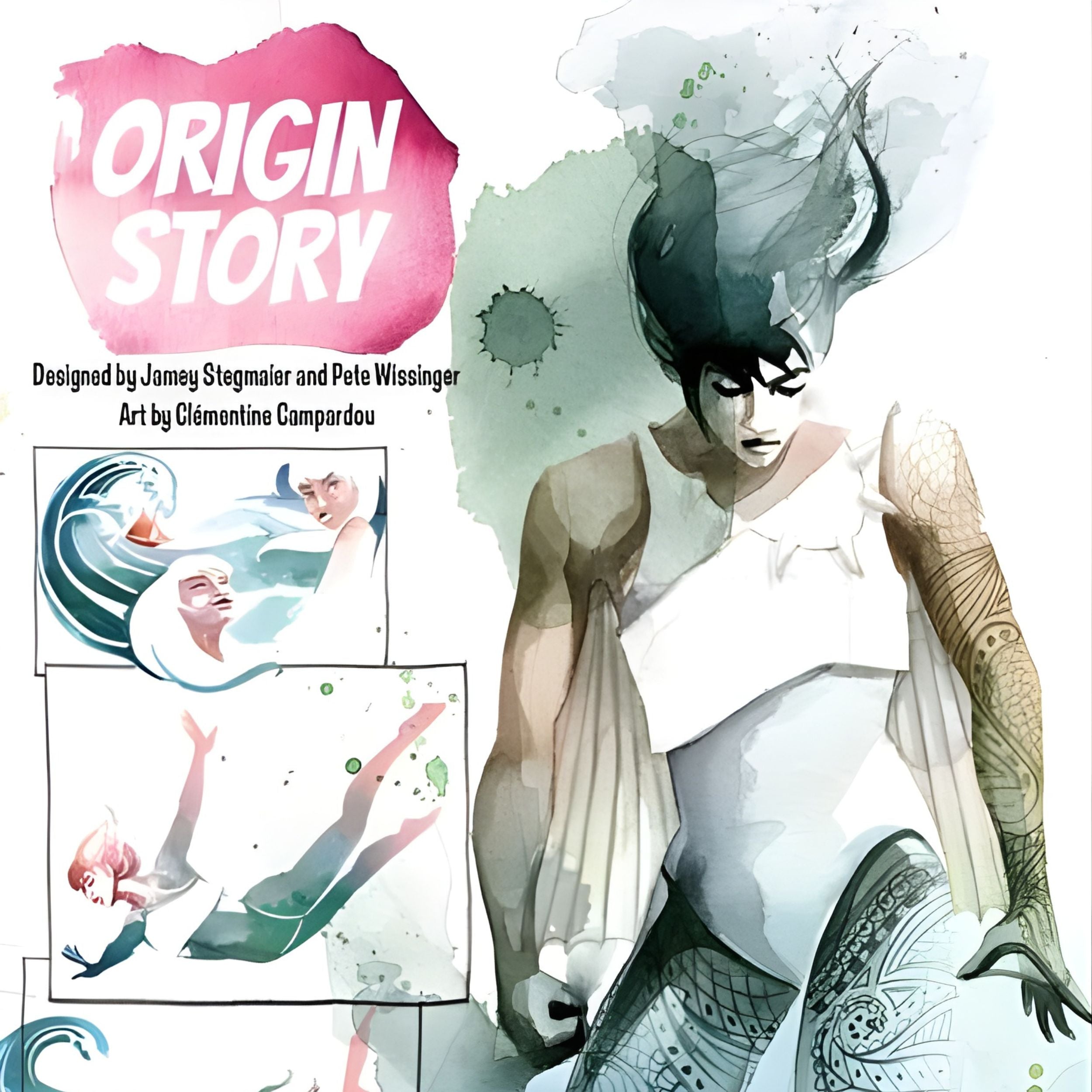
The Mechanical Identity: Origin Story Review
Look at the table: there are no dice rolling, but the silence is charged with the static that precedes a storm. Origin Story, localized in Italy by Ghenos Games, presents itself as an anomaly in today's gaming landscape. At first glance, the untrained eye might dismiss it as a simple superhero-themed card game. A grave error of judgment. Beneath the patina illustrated by Clémentine Campardou, pulsates an engineering hybrid that blends classic Hand Management with progressive Engine Building .
We're not talking about a light filler. This title, designed for 1-5 players, requires the mental dedication typical of medium-sized games. The target audience isn't the player seeking controlled chaos, but the architect who wants to see their project come to life turn after turn. Here, the narrative isn't colored text: it's pure mechanics.
The Architecture of Conflict: Analyzing the Mechanics of Grasping
The backbone of the system is the Trick-Taking Mechanics . In a standard gaming ecosystem, the rules of trick-taking are gravitational constants: the highest value wins, the suit rules. Origin Story accepts these axioms only to later scientifically shatter them. The "Love" suit acts as a fixed trump, a beacon of stability in a stormy sea, but it's the only certainty you're granted.
Imagine playing cards, but every time you win or lose a hand, you gain the ability to alter the very physics of the table. It's not just about matching the led suit; it's about manipulating the outcome to suit your hidden agenda. The tension isn't about "what do I have in my hand," but about "how can I bend the rules so that this 2 card becomes lethal?"
The Relentless Engine: How the Gears of Origin Story Turn
Here we enter the realm of Tableau Building . Story cards aren't just modifiers; they're comic book panels that assemble on your player board. In the first round, your engine is a ramshackle prototype. By the fifth act, it's a well-oiled war machine.
This five-act progression system creates an emergent narrative arc. The permanent abilities you acquire don't just give you points: they override victory conditions. Some cards change the value of suits, others alter the turn order. It's a textbook case of evolutionary design: you're not playing the same game at the beginning and end of the session. Your "Origin Story" is the algebraic sum of the rule exceptions you've accumulated.
Anatomy of a Fatal Mistake: The Move That Dooms You
The critical moment often comes between the second and third rounds. A player, intoxicated by new abilities, forgets to manage Stamina . In this system, Stamina isn't just fuel; it's "narrative time."
I've seen games collapse because a player spent all their energy activating a spectacular combo at the wrong time, only to remain inert when the next trick was crucial. The fatal mistake isn't playing the wrong card, but losing control of the pace. Running out of Stamina means becoming a passive spectator in your own defeat, watching your opponents rewrite history without being able to offer any resistance.
A Turn in the Mud: Impossible Choices and Consequences
We're in Round 3, the "Narrative Midpoint," and the atmosphere at the table is getting tense. A Special Event comes into play. It's not a generic unexpected event; it's a structural twist that temporarily changes the laws of the game's physics. Suddenly, the strategy you've been cultivating for twenty minutes becomes obsolete.
A player stares at his cards. He must decide: sacrifice a powerful card now to secure a vital resource, or save it for the final act, risking losing control of the current round? You see his fingers drumming on the table. Analysis paralysis here isn't a flaw, but the symptom of a system that offers painfully meaningful choices. Every card played is a door closing on a possible future.
The System Anomaly: The Rule That Breaks the Pattern
The true Copernican revolution of Origin Story lies in the Hero/Villain duality. At the start of each round, you must declare your identity. And here, the design shines with boldness.
If you choose to be the Villain, your goal is to lose . You must fail tricks, hide in the shadows, sabotage others' success without ever claiming the glory. This reversal of the Victory Condition is destabilizing. It allows a player with an objectively "weak" hand (low cards) to transform it into a lethal weapon. Winning without ever winning a trick is a feeling of technical omnipotence that is extremely rare in the trick-taking genre.
Psychology at the Table: What Happens Between Players
The interaction is indirect but fierce. You don't attack one another head-on, but manipulate the ecosystem in which others must survive. When one opponent revs up their engine to become a "Power Combo Builder," the others must adapt. In a two-player game, the introduction of "Sidekicks" simulates external pressure that keeps the tension palpable, avoiding the classic stagnation of head-to-head duels.
A subtle paranoia sets in. "Is he playing low because he has no cards or because he wants to activate that damned Villain ability?" Reading the table becomes as crucial as reading your own hand. It's poker played with superpowers.
The Player's Metamorphosis: From First Game to Advanced Strategy
In your first game, you'll be playing cards. From the third onward, you'll be playing the system. You'll begin to see emerging archetypes: the manipulator who changes suits at will, the controller who influences the final scores, or the anti-taking specialist.
The learning curve isn't steep, it's deep. You'll discover that the cards aren't static resources, but tools for building an engine that, ideally, by the end of the fifth act, is almost playing by itself. The satisfaction comes not from a single victory, but from having built a perfect machine.
The Verdict: Pros, Cons, and Final Thoughts
Origin Story is a successful exercise in style that demonstrates how old mechanics can be revitalized with the right graft.
Strengths (Pros)
- Hybrid Innovation: Blends Grapple Mechanics with Engine Building in an organic way.
- Tactical Flexibility: The Hero/Villain choice makes any starting hand playable (and winning).
- Emergent Narrative: The 5-act structure creates a real, not artificial, climax.
- Functional Aesthetics: The reversible box and art direction support the theme of dual identity.
Weaknesses (Cons)
- Hidden Complexity: May be disconcerting to those expecting a fast-paced traditional card game.
- Cognitive Overload: In rounds 4 and 5, managing all active abilities requires a lot of attention.
The Final Imprint: Why Origin Story Remains in the Heart
Stonemaier Games and Ghenos deliver a title that defies the very definition of a trick-taking game. It's not just math disguised as a comic book. It's a laboratory where you are the mad scientists. The feeling you get isn't that of having won a game, but of having written, through mechanics and sweat, a unique narrative arc. And in a world of often identical games, this is the true superpower.
Do you want to write your story or suffer it? Take control of the narrative.
Find out more on Frogames.it


 https://frogames.it
Condividi:
Five Families: Friedemann Friese's Temporal Tension Experiment
The White Castle: Duel - When Silence is Stronger than Dice