
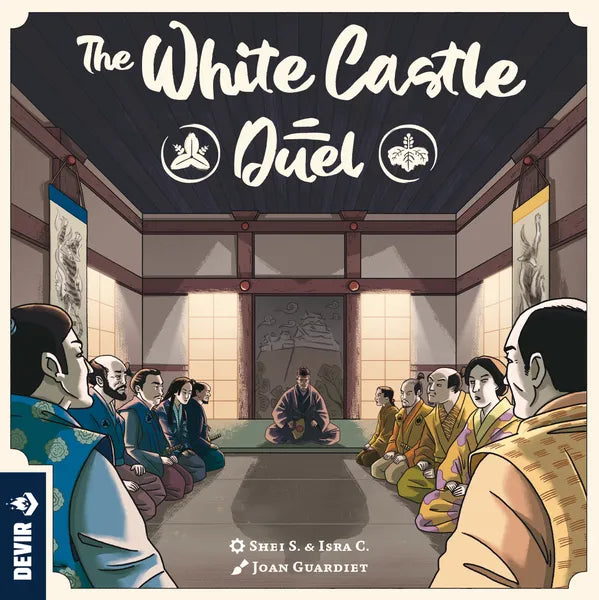
The Mechanical Identity: The White Castle: Duel Review
This is not an adaptation: it is an open-heart operation where the chaotic ticking of the dice has been replaced by a cold clockwork mechanism.Imagine a Japanese Zen garden. The gravel is perfectly raked. There's no wind. From across the table, your opponent is watching you. In The White Castle: Duel , a title published by Devir and designed by the duo Isra C. and Shei S. , the tension no longer comes from the roll of a die, but from the total absence of noise. We're faced with a game for two players only, lasting about 30 minutes, but requiring the decision-making intensity typical of a heavyweight.
Many approached this box with skepticism: "The base game already scaled well for two players, why create another?" The technical answer lies in the transformation of the game's identity. If its predecessor was a tactical race against bad luck, Duel is an exercise in "Deterministic Planning" and "Resource Management" with almost complete information. Here, there's no hope. Here, there's calculation.
/pic9420797.jpg)
The Architecture of Conflict: Analysis of the Lantern System
Forget about colored bridges and dice drafting. That was the father's soul; the son has a different heart. The core of this game is based on a revisited Worker Placement (or rather, Lantern Placement) mechanic. This is where the game's engineering really shines.
There are no random values on the table. There are Lantern tokens. The flow is binary and merciless: either you place them or you retire them. In the first few turns, you place your tokens on the board. You're not just occupying a space; you're literally seeding your future actions. When, in subsequent turns, you decide to retire that lantern, you'll activate the enhanced action.
It's a complete paradigm shift. In the basic game, you reacted to a 6 or 1 die. Here, you decide when the action should be triggered. Randomness has disappeared, giving way to a delightful analysis paralysis: should you place now to block your opponent or reroll immediately to collect resources?
The Relentless Engine: How the Gears Turn
The time structure has been expanded and segmented. Where previously we had nine turns compressed in a steel grip, now we have twelve turns that breathe at a different pace. It's a game in two acts. The first half is pure Engine Building: you accumulate resources, position gardeners, prepare the ground.
The second half is the harvest. And this is where income management comes into play. Unlike the base game, where the economy was punishing and often left you with one coin less than you needed, here resources flow more fluidly. But beware: abundance doesn't mean ease. It means the bar for optimization has been raised. It's not enough to just do "something"; you have to do the thing that generates the most points in a cascade.
Anatomy of a Fatal Mistake: The Move That Dooms You
It's turn 8. Your opponent has just taken an Influence card that multiplies your samurai's points. You look at your board: you've invested everything in the gardeners. A cold sweat begins to break out.
The error in The White Castle: Duel isn't immediate. It's a slow poison. Often, the fatal mistake occurs in the first three turns, when you place a Lantern in a slot that seemed advantageous for immediate resources, but which has denied you access to the Influence cards crucial to the endgame. The absence of dice removes the excuse of bad luck: when you realize you're stuck, you know exactly which turn you signed your doom. It's the butterfly effect applied to the gaming table.
A Turn in the Mud: Impossible Choices and Consequences
Picture the scene. You need two rice to activate the Castle. To get them, you must withdraw a Lantern from the Garden. But if you withdraw it now, you free up the slot for your opponent, who is waiting in that very space to close a set of Influence Cards. What do you do?
This is where the Open Drafting mechanic shines. The new "Influence Cards" aren't just passive bonuses; they're the heart of scoring. Every choice is a painful trade-off. Sacrificing the efficiency of your turn to deny your opponent a card (Hate Drafting) is a valid, but costly, strategy. The game constantly forces you to weigh the "opportunity cost": gain 5 points for yourself or deny them 8?
/pic9409520.jpg)
The System Anomaly: The Rule That Breaks the Pattern
There's a paradox at the heart of this design. It's called "Duel," but the interaction is, ironically, less violent than in the base game. In the original The White Castle , a stolen die could destroy an opponent's entire strategy. Here, the interaction is more subtle, indirect. It's a parallel race where you trip each other up, but rarely shoot each other.
This is the anomaly: a dueling game that rewards the lone optimizer more than the aggressive warrior. To some conflict purists, this might seem like a flaw. For fans of Eurogame puzzles, it's a blessing: victory depends on your ability to build synergies between card symbols and your own tracks, not on how much you can disrupt someone else's game.
Psychology at the Table: What Happens Between Players
The atmosphere at the table changes dramatically compared to its older brother. There are no exclamations at a lucky dice roll. There's silence. You can hear the mental ticking of calculations. "If he draws that crane card, I have to veer onto the red track."
The psychology here is Cold War-like. You accumulate resources, flex your muscles through tracks, and try to guess whether your opponent will go for the Castle or the Well. And when your opponent makes the move you predicted but couldn't prevent, the look you exchange is one of pure intellectual recognition.
The Player's Metamorphosis: From First Game to Advanced Strategy
On your first game, you'll feel lost without the dice. You'll be looking for that all-or-nothing adrenaline rush, and you won't find it. You might even think the game is too loose, too gentle.
By the fifth game, the fog lifts. You begin to see the matrix. You understand that Lanterns aren't just tokens, they're timers. You understand that Influence Cards shouldn't be drawn randomly, but rather chained together to create an exponential scoring engine. The experienced Duel player doesn't play turn by turn; they play turn 1 with turn 12 already in mind. The learning curve is steep, not in the rules, but in the depth of vision required.
The Verdict: Pros, Cons, and Final Thoughts
So, was the surgeon successful? Did the patient survive the nut removal? Absolutely, but he became a different person.
PROS:
- Total Control: The lack of dice makes the game a paradise for those who hate chance. 100% pure strategy.
- Layered Scoring: Influence cards and multipliers offer more depth to scoring than basic.
- Specific Design: There are no "adapted" rules. Everything works perfectly for two players.
AGAINST:
- Less Emotional Tension: Without the uncertainty of the dice, there are no moments of "thrill" or sudden reversal.
- Loss of Identity: For many, the dice and bridges WERE The White Castle. Without them, the flavor is different.
- Indirect Interaction: If you're looking for a "bad" game where you destroy each other, you might be disappointed.
The Final Touch: Why The White Castle: Duel Remains in Your Heart
The White Castle: Duel doesn't replace the original; it complements it like the dark side of the moon complements the light side. If the original is a chaotic and lethal samurai fight in the rain, the Duel is a game of Go played in the silence of a teahouse.
It stays in your heart because it makes you feel smart. Because when you win, you know you've built a perfect machine, without any help from fate. It's a game that whispers instead of shouts, but its words stick in your head much longer.
Ready to tempt fate... or eliminate it altogether?
Find out more on Frogames.it

 https://frogames.it
Condividi:
Origin Story: The Darwinian Evolution of Grip Mechanics
Grendel: The Game of Crime and Mayhem - When Chaos Becomes Game Engineering