
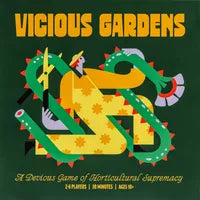
The Mechanical Identity: A Review of Vicious Gardens
Vicious Gardens is a wolf in sheep’s clothing, a game that smiles at you as it pours salt into your freshly plowed soil.Imagine a nature documentary where the narrator, instead of describing photosynthesis, discusses industrial sabotage. This is the ecosystem created by Pops & Bejou Games and illustrated by Ross Bruggink. At first glance, the table is filled with pastel colors, grotesque yet adorable illustrations, and an atmosphere that screams "quiet family evening." But the technical analyst sees beyond the colors: he sees a competitive engine for 2 to 6 players, lasting 20 to 45 minutes, that masks its predatory nature.
This isn't a passive farming management game. The target audience here is a group seeking the accessibility of a filler but craving the friction of a war game. The game's identity is based on a design paradox: "cute on the outside, mean on the inside." It's not an indiscriminate massacre, but a constant tactical annoyance. It's the perfect game for those who want to tease their friends without necessarily destroying decades-long friendships, positioning itself exactly halfway between a chaotic party game and a light strategy game.
/pic8932082.jpg)
The Architecture of Conflict: An Analysis of the Set Collection
In Vicious Gardens, you're not collecting plants for the sake of botany, you're assembling munitions for an arms race.At the heart of the system is an extremely dynamic Set Collection mechanic. Players don't just lay down cards: they must build their garden according to adjacency and type criteria to maximize their harvest. Each plant has a value, and combining the right sets is the only way to generate the currency needed to purchase objective cards.
The technical brilliance lies not in the complexity of the sets, but in their volatility. The table is constantly changing. While in a classic Euro game you build your engine in isolation, here the interaction is driven by the scarcity of common resources and the constant threat of Specialists . The basic mechanics ask you to plant, build, and harvest, but the design forces you to constantly look at your neighbor's garden. If you accumulate too many resources without spending them, you become a mathematical target, not just a social one.
The Relentless Engine: How the Gears of Vicious Gardens Turn
The gameplay flow was iterated and refined until it became hydrodynamic. Ross Bruggink didn't create mechanics and then paste a theme on top; he built a world and adapted the engine so it didn't get in the way of the experience. The main loop is simple: Plant -> Manage -> Harvest -> Victory .
What makes this engine interesting for an analyst is the end-of-game system. It's a race . The game ends when a player gets their third victory card. This radically changes the evaluation of each move. There's no fixed number of turns in which to optimize points; there's an invisible hourglass managed by the players themselves. If you see someone rushing toward their second victory card, the entire table experiences a sudden acceleration. The central mechanism isn't accumulation, but conversion speed: turning your hand into victory points before the market changes.
Anatomy of a Fatal Mistake: The Move That Dooms You
Greed is the fertilizer of defeat: waiting for the perfect moment often means never acting.Observing hundreds of simulated games, a recurring error pattern emerges among newcomers: overoptimization. The average player tends to want to complete the perfect garden to maximize the amount of coins harvested. In Vicious Gardens , this is strategic suicide. While you spend a turn searching for the last card to complete a 10-coin set, an opponent with a mediocre 6-coin set collects, buys the last available victory card, and ends the game.
The consequences are brutal. You haven't just wasted a turn; you've lost the opportunity to convert your work into points. The game punishes waiting. Victory cards are limited, and end-of-game bonuses reward those who dared, not those who planned endlessly. Seeing a player with a hand full of powerful cards but zero victory points on the table is the perfect crime scene for this design.
A Turn in the Mud: Impossible Choices and Consequences
Let's analyze a crucial mid-game turn. You have a Specialist card in your hand with a Direct Interaction effect (Take That) and a rare plant needed for your set. Hand management becomes painful here. Using the Specialist to slow down your opponent means sacrificing your own growth (because the Specialist takes up an action slot or is discarded). Planting means ignoring the opponent's threat.
The table is silent. If you play the bad card, your opponent might lose vital resources, but you don't advance. It's a zero-sum calculation typical of game theory. Often, the "bad" effect is more of a tactical nuisance than a killing blow—a "little thorn" rather than a bomb. However, in such a tight contest, causing someone to lose a harvest turn can be tantamount to victory. The tension comes from the fact that each card has a very high opportunity cost.
/pic8932084.jpg)
The System Anomaly: The Rule That Breaks the Pattern
In a genre dominated by free-for-all, Vicious Gardens introduces a team mode that changes the physics of the table.The real technical surprise, rare for a card game of this magnitude, is the Team Play mode (2v2 or 3v3) . This isn't a last-minute variation, but a system that transforms chaotic Take That into coordinated military tactics. The anomaly lies in allowing coordinated actions on shared or allied gardens.
Suddenly, cards that allow you to manipulate the garden aren't just used to destroy your opponent, but to optimize your partner's engine. It goes from a one-on-one race to a synchronized relay. This mode also solves the problem of "meanness": taking an attack hurts less if you know your partner can cover your back the next turn. This is where the game scales better, transforming from a simple card game into a complex social experience.
Psychology at the Table: What Happens Between Players
There's a fascinating psychological phenomenon in Vicious Gardens : visual cognitive dissonance. Players are surrounded by reassuring images, which lowers their emotional defenses. When a low blow lands, the impact is amplified by the contrast. However, because the game is perceived as "light," anger rarely erupts.
An atmosphere of amusing passive aggression is created. Excuses abound: "Sorry, I really have to put this snail in your garden; I need it to free my hand." No one believes it. Everyone knows it's a declaration of war. Table psychology quickly shifts toward involuntary kingmaking : attacking the leader is a must, but calculating who the real leader is (given the face-down objective cards or potential points) requires a social reading of the opponents.
The Player's Metamorphosis: From First Game to Advanced Strategy
In the first game, the player is an aesthete: he looks at the illustrations, laughs at the names of the plants, tries to make the garden as beautiful as possible in terms of color. He plays attack cards randomly, just to see what happens. This is the "tourist" phase.
By the fifth game, the metamorphosis occurs. The player stops seeing the plants; he sees only numbers and symbols. He learns to count the cards in the discard pile. He understands that Specialists shouldn't be used immediately after being drawn, but rather saved for the turn when his opponent is about to make the decisive "Harvest." Advanced strategy lies in the timing of the interruption. The Vicious Gardens veteran knows that winning isn't about having more points, but rather preventing others from reaching the closing threshold a moment before him.
The Verdict: Pros, Cons, and Final Thoughts
After a complete structural analysis, here is the technical balance:
- PROS: Excellent scalability from 4 to 6 players, where chaos becomes social fun.
- PRO: Squad mode offers a tactical depth that is rare for the genre.
- PROS: Clean gameplay flow (thanks to extensive development and playtesting) that eliminates downtime.
- CONS: In 2 players the experience is too quick and lacks the necessary political tension.
- CONS: The base game might be too "gentle" for those looking for destructive interaction (needs expansions).
The Final Touch: Why Vicious Gardens Remains in Your Heart
Vicious Gardens doesn't rewrite the game design books. It doesn't introduce revolutionary mechanics that we'll be studying ten years from now. Its strength lies in its personality . It's a product that knows exactly what it wants to be: a bridge between the "cozy" world and the competitive world. It stays in your heart because it creates stories at the table—that time you stole victory by a single weed point, or that time your team turned around a losing game with a combo of specialists.
It's elegant design meets irony. It makes you smile as it pushes sticks through the leaves, reminding you that, ultimately, even in the most well-kept garden, nature is always a little cruel.
Want to start your own botanical war?
Find out more on Frogames.it


 https://frogames.it
Condividi:
Rumble Nation: Technical Analysis of the Blitzkrieg in Feudal Japan
Five Families: Friedemann Friese's Temporal Tension Experiment