Vicious Gardens: When Gardening Becomes Psychological Warfare
by Andrea By Frogames
The Mechanical Identity: A Review of Vicious Gardens
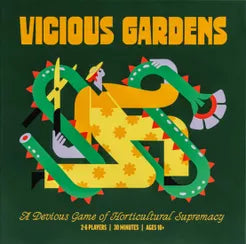
Beneath the watercolored surface of a perfect flowerbed lies the brutality of a World War I trench. Welcome to the ecosystem of Vicious Gardens , a title published by Pops & Bejou Games that challenges every preconceived notion of the "nature" genre. At first glance, Ross Bruggink's creation appears to be a harmless exercise in botanical aesthetics for 2-6 players. However, the first five minutes of a game that lasts 20 to 45 minutes are enough to understand the true nature of the beast: we are faced with a Set Collection and Hand Management engine disguised as a Sunday pastime. The target is not the zen gardener, but the ruthless strategist capable of smiling while pouring acid on his opponent's begonias.
There's no room for compassion here. The goal is to build the most prestigious garden, but the method to achieve it requires a surgical balance between creation and destruction. The atmosphere at the table shifts rapidly: from compliments on the illustrations to tactical paranoia, where every card played by an opponent is analyzed as a potential nuclear threat.
The Architecture of Conflict: Hand Management Analysis
The beating heart of Vicious Gardens lies in its ruthless Hand Management . Observe a player in their natural habitat: their gaze bouncing between the cards in their hands and the common board. It's not indecision, it's probability calculation. Every card in this game has a dual nature: it can be a resource for construction or a weapon for sabotage. The player's hand is limited, and this creates a harrowing decision-making bottleneck.
The tension stems from the fact that planting flora in your garden requires discarding other cards as payment. Gameplay engineering shines here: to gain an advantage (a plant in your tableau), you must deprive yourself of tactical options. It's a zero-sum system that eliminates autopilot. You can't simply play the best card; you have to decide which cards you're willing to "kill" to make another flourish.
The Relentless Engine: How the Gears of Vicious Gardens Turn
Lifting the hood of this game reveals a highly compressed Tableau Building engine. Your garden is a grid, a mathematical lattice where placement is everything. It's not enough to have the right plants; they must be adjacent to the right decorations or arranged in specific patterns to trigger End Game Bonuses .
The flow is deceptively simple: Fish, Plant, Harvest. But it's during the "Harvesting" phase that the cogs crush the less attentive players. The resources you accumulate are finite, and the space in the garden is visibly diminishing. As the grid fills, the options become limited, turning the final turns into a claustrophobic puzzle where every move must be optimized down to the last millimeter.
Anatomy of a Fatal Mistake: The Move That Dooms You
Here we enter the territory of the game's most fascinating and cruel mechanic: Victory Points as a Resource . It's a concept rarely seen implemented so boldly. In Vicious Gardens, you can spend your hard-earned points to activate special abilities or unlock instant perks. It's a pact with the devil.
Imagine the scenario: a player is up 5 points. He decides to spend 3 to eliminate a pest infestation launched by an opponent. He's saved his garden, but destroyed his score. The fatal mistake is almost never technical, it's economic. Inexperienced players tend to protect their points like dragons over a treasure, paralyzing themselves. Veterans, on the other hand, know that points are just another form of ammunition. But spend too many, and you'll reach the final count with a beautiful garden and a score of zero.
A Turn in the Mud: Impossible Choices and Consequences
Let's analyze an average turn under the microscope. Marco has a "Wicked Pumpkin" and a "Garden Gnome" in his hand. His goal is to complete a set of three vegetables for a Set Collection bonus. But Julia, to his right, has just played a card that threatens to steal half of his harvest if she doesn't act now.
Silence falls. Marco twirls a chip between his fingers. If he plays the Zucchetta, he completes the set but remains exposed to Giulia's attack. If he spends resources defending himself, he loses the tempo (play time) needed to close the set before the game ends. He decides to take a risk. He plays the Zucchetta. Giulia smiles. The butterfly effect is immediate: Marco's greed has opened a gap in his defense that Giulia will exploit for the next three turns. In this game, every action generates an equal and opposite reaction, usually painful.
The System Anomaly: The Rule That Breaks the Pattern
Most gardening games are solitaire multiplayer games: each player tends their own little garden. The anomaly in Vicious Gardens is Direct Interaction (Take That) elevated to a structural system. It's not a rare occurrence; it's the norm. There are cards designed solely to ruin other players' work.
This unwritten rule breaks the classic pattern of pure optimization. It's not enough to be efficient; you have to be politically astute. You have to convince others you're not a threat, just as you're about to win.
Psychology at the Table: What Happens Between Players
When observing social dynamics, Vicious Gardens acts like a truth serum. The veil of politeness falls away. You hear phrases like, "It's nothing personal, but that rose bush of yours aesthetically offends me." In reality, it's all personal. The frustration of seeing a three-turn plan dismantled by a single "Weed" card creates a desire for revenge that transcends the current game.
The psychology here is one of deterrence. Players accumulate offensive cards not always to use them, but to show others they have their finger on the trigger. It's a Cold War fought with shovels and rakes.
The Player's Metamorphosis: From First Game to Advanced Strategy
In the first game, the novice player focuses on aesthetics. He tries to match colors, make complete sets, and ignore his opponents. This is the "Innocent Gardener" phase. Around the third game, the metamorphosis occurs. The player understands that points are worthless if they don't get to the end of the game.
The advanced strategist no longer looks at his own backyard; he looks at everyone else's. He begins to practice hate-drafting (selecting cards only to take them away from his opponents) and learns to manage Victory Points as a resource with the coolness of an investment banker. He understands that winning 10-0 is impossible; better to win 3-2, dragging everyone through the mud.
The Verdict: Pros, Cons, and Final Thoughts
After dissecting the corpse (or compost) from Vicious Gardens, this is what remains on the autopsy table:
PRO: The use of Victory Points as currency is brilliant and creates some heartbreaking decisions.
PROS: The art is delightful and creates a perfect ironic contrast to the evilness of the mechanics.
PRO: Short duration that immediately encourages a rematch.
CONS: The high level of direct interaction (Take That) may frustrate players who enjoy total control and long-term planning.
CONS: With 2 players, the nastiness is very concentrated; the game shines more with 3-4 players to distribute the "beatings".
The Final Touch: Why Vicious Gardens Remains in Your Heart
Vicious Gardens is not a game you'll easily forget. It leaves scars, metaphorically speaking. It stays in your heart (and on your shelf) because it manages to condense a complete emotional arc into 30 minutes: hope, construction, desperation, revenge, and, sometimes, triumph. It proves that you don't need 100-page rules to create depth; just give players the right tools to thwart each other. If you're looking for a game to relax in, look elsewhere. If you want to test the strength of your friendships in an arena of petals and poison, this is your game.
Ready to get your hands dirty (with dirt and more)?
A ring of tiles, 96 pieces of broken ceramic, and three scores of which only two count. The second game that Dani Garcia dedicates to Barcelona asks only one question, and repeats it at every turn.
Three modules in a single box, and two base game rules that no longer apply. The rulebook isn't public yet, but the content is. Which of the three will remain on the table after the third game?
A gentleman from Kyoto who describes himself as "a middle-aged guy" spent three years explaining, by word of mouth at a trade fair, the waiting maneuver of a sport you can bet on. Then, someone walked past his table.
Narratore ufficiale di FroGames, viandante tra mondi incantati e tavoli imbanditi di meeple, sono il vostro umile (ma irresistibile) Bardo.
Raccolgo storie, avventure e aneddoti da ogni angolo del Regno Ludico per trasformarli in articoli che… beh, almeno non vi faranno addormentare.
Spoiler succosi, dritte epiche o semplici farneticazioni a tema giochi da tavolo? Siete nel posto giusto.
Preparate il tè (o la pozione), accendete la candela e sistemate i dadi: sto per cominciare a cantare.
Seguitemi, avventurieri... la leggenda è appena iniziata.
Choosing a selection results in a full page refresh.
Opens in a new window.
🐸📦
Last dispatch: Tuesday at 11 am
We're moving to a bigger warehouse: room for many more games
Ranaldo has seen the new warehouse and he's so happy he even called his parents to tell them!
Ranaldo has been up since dawn, labelling the first boxes with a list in one hand and a coffee in the other.
The first boxes are on their way! Ranaldo is directing the move with a megaphone and a helmet two sizes too big.
The new shelves are up. Ranaldo counted them twice and called his parents again: “There's really room for more games!”
The games are settling onto the shelves, one by one. Ranaldo checks every box against his list and hasn't missed one. Almost.
Ranaldo has already got the ribbon ready to cut. The new warehouse opens today.
From Friday at 11 am everything is back to normal.
📦Day One games and pre-orders are delivered as usual: for those, we're up and running.
🐸The shop stays open: you can order whenever you like.
Until Monday 8 pm
The more you add, the less you pay
15%from €90
20%from €130
25%from €180
Based on the total of your full-price games. It applies by itself in your cart, no code needed. Example: €130 of games → you pay €104.
🏷️
Left out: pre-orders and games already on offer (crossed-out price). They stay at their price and don't count towards the amounts.
🎁
FrogVIP free from €180 of full-price games: with the 25% that's €45 off plus FrogVIP (€19.99) as a gift. It lands in your cart by itself at €0 (remove it if you don't want it). Under €180 it costs €19.99. See FrogVIP

/pic8932084.jpg)
/pic8932080.jpg)





 https://frogames.it
Condividi:
Eila and Something Shiny: When Resource Management Becomes an Emotional Thriller
Shikoku 1889: The Brutal Elegance of Railroad Capitalism