Eila and Something Shiny: When Resource Management Becomes an Emotional Thriller
by Andrea By Frogames
Mechanical Identity: Review of Eila and Something Shiny
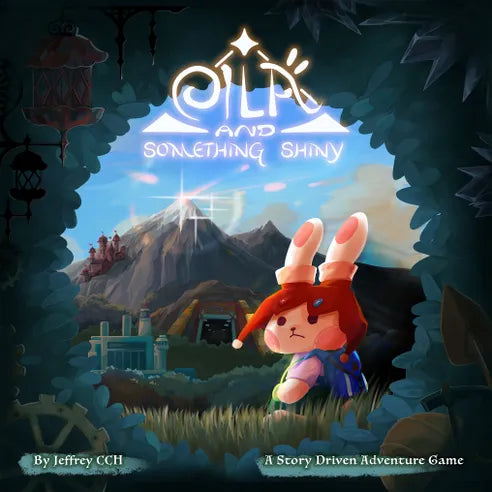
On the table there is the deafening silence of someone who has just understood that the tender illustration of a rabbit hides a deadly trap for their conscience.
Imagine tuning in to a nature channel. The camera pans to an enchanted forest, pastel colors, creatures seemingly straight out of a Pixar dream. This is your first encounter with Eila and Something Shiny . But as any good nature documentary teaches, beauty is often a disguise for survival. Beneath the hood of this narrative game, played solo (or cooperatively for 2-3 brave souls), beats a mechanical heart built on pure resource management and time optimization. This isn't a game for children; it's an existential crisis simulator disguised as a fairy tale. The target? The solo player seeking a profound experience, where card engineering meets the brutality of irreversible consequences.
The Architecture of Conflict: Resource Management Analysis
In this gaming ecosystem, the currency isn't just gold or food, but time itself. The core mechanic is based on hand and deck management that simulates the flow of time. The deck of cards represents the "Present." Every time you draw, time passes. When the deck runs out, night falls, or something terrible happens. Here, the technical analyst immediately notices the tension: each card revealed represents a turning point.
This isn't a simple "roll the dice and move" game. The system requires you to pay resources (carrots, coins, energy) to interact with opportunities. If you don't have the resources, the story continues without you, often leaving you with permanent wounds. It's a closed economic system: spending one energy now to help a friend might mean not having the strength to escape from a predator three turns later. Resource management here isn't hoarding, it's wartime rationing.
The Relentless Engine: How Eila's Gears Turn
Jeffrey CCH's engineering genius lies in the card-flow system: the Past-Future loop. When you resolve a card, it doesn't simply disappear. Your choices send it to the "Past" deck (which will become your future in subsequent rounds) or eliminate it forever, altering the statistical makeup of the events you'll face.
It's an engine that learns from your behavior. If you choose to ignore a problem, that problem is reshuffled and will come back to haunt you, perhaps amplified. From a game mechanics perspective, this creates a feedback loop where the player actively, often unwittingly, builds their own prison or salvation. You're not just reading a story; you're programming the database of future events through emotional actions.
Anatomy of a Fatal Mistake: The Move That Dooms You
Let's take a critical moment under the microscope. Chapter 1. You find a shiny object. The RPG player's instinct is to "take everything." You spend 2 Energy to get that object. It seems like a victory. The tech analyst, however, looks at your board: you're down to 0 Energy.
Two cards later, the game presents you with a storm. It requires 1 Energy to find shelter. You don't have any. You take 2 Damage. Now you're injured, slow, and that shiny object in your backpack is no match for the cold. The mistake wasn't taking damage from the storm; the mistake was made five minutes earlier, giving in to greed. In Eila and Something Shiny , cause and effect are often separated by enough time to make you forget the cause, making the punishment even more bitter.
A Turn in the Mud: Impossible Choices and Consequences
The table is cluttered with tokens. The light is dim. Eila is tired. You must decide: cross the rickety bridge (a skill test based on luck, mitigated by resources you don't have) or take the long way around (a sure cost of time resources). This is the "Narrative Grind."
You choose the long game. Place the card in the Future deck. You know it will return. But now you must discard cards from the Present deck to simulate the lost time. Among those discarded cards was the only cure for your wound. Do you feel the weight? It's not just bad luck. It's the Push Your Luck mechanic reversed: how much are you willing to pay to avoid the risk? Often, the price of safety is mission failure.
The System Anomaly: The Rule That Breaks the Pattern
In many board games, death is a "Game Over." Restart, try again. Here, the anomaly is emotional persistence. The game uses a chapter structure (Campaign) where moral decisions transcend the single game. But there's a subtle rule, often overlooked in first-time readers: deck transformation.
Some choices physically change the cards you'll encounter in subsequent chapters. You're not just changing your stats, you're changing the topography of the game. It's like moving a pawn in a chess game, changing the color of the squares for the next game. This Branching Narrative integrated into deckbuilding creates a sense of vertigo: there's no real "reset" for your consciousness.
Psychology at the Table: What Happens Between Players
Even when played in "Solo Mode," Eila and Something Shiny creates a split in the player's psyche. On one side is the Resource Manager: cold, calculating, willing to sacrifice an NPC ally to keep a gold coin. On the other is the Empathetic Narrator: the one who looks into Eila's wide eyes and wants a happy ending.
The conflict isn't on the board, it's in the player's head. I've seen expert players of "Boars" (complex games) hesitate for minutes on end not because of the probability calculations, but because of an ethical refusal to perform the mathematically correct action. The game exploits cognitive dissonance as a gameplay mechanic. It forces you to choose between winning as a player or winning as a "human being."
The Player's Metamorphosis: From First Game to Advanced Strategy
In your first game, you're a tourist. You look at the pictures, read the text, and react to the events. Around the third chapter, the metamorphosis occurs. You stop just reading the story and start reading the matrix. You start counting the cards.
You realize that that "friendly rabbit" is actually a resource generator with a three-turn cooldown. You begin manipulating the Future deck not to follow the plot, but to optimize your next hand's draw. This is where the game reveals its ruthless puzzle nature. You become cynical. And just when you think you've mastered the system, the game throws you an emotional curveball no calculation could have predicted, reminding you that Eila is more than just a wooden token.
The Verdict: Pros, Cons, and Final Thoughts
Analyzing the data collected in the field, here is the final report:
PROS: Narrative depth that rivals the best gamebooks, seamlessly integrated with solid Resource Management mechanics.
PROS: Sublime art direction that creates a shocking contrast with the dark themes covered.
PROS: High replayability thanks to narrative forks and multiple endings.
CONS: The punishing nature of some event cards may seem unfair or too random for perfect strategy purists.
CONS: Once all the mysteries of the plot are revealed (after several campaigns), the surprise effect vanishes, leaving only the bare mechanics.
The Final Imprint: Why Eila and Something Shiny Stays in Your Heart
Eila and Something Shiny isn't just an exercise in style. It's an interactive documentary about loss, hope, and the cost of every step we take toward something shiny. As an analyst, I admire the mathematical engine that sustains it all without ever jamming. As a player, I admire the courage of a design that dares to hurt. At the end of the game, as you put the components back in the box, you won't be thinking about victory points. You'll be thinking about what you could have done differently to save those you left behind. And that, gentlemen, is the mark of great design.
Are you ready to face the consequences of your choices? Eila's journey awaits.
A ring of tiles, 96 pieces of broken ceramic, and three scores of which only two count. The second game that Dani Garcia dedicates to Barcelona asks only one question, and repeats it at every turn.
Three modules in a single box, and two base game rules that no longer apply. The rulebook isn't public yet, but the content is. Which of the three will remain on the table after the third game?
A gentleman from Kyoto who describes himself as "a middle-aged guy" spent three years explaining, by word of mouth at a trade fair, the waiting maneuver of a sport you can bet on. Then, someone walked past his table.
Narratore ufficiale di FroGames, viandante tra mondi incantati e tavoli imbanditi di meeple, sono il vostro umile (ma irresistibile) Bardo.
Raccolgo storie, avventure e aneddoti da ogni angolo del Regno Ludico per trasformarli in articoli che… beh, almeno non vi faranno addormentare.
Spoiler succosi, dritte epiche o semplici farneticazioni a tema giochi da tavolo? Siete nel posto giusto.
Preparate il tè (o la pozione), accendete la candela e sistemate i dadi: sto per cominciare a cantare.
Seguitemi, avventurieri... la leggenda è appena iniziata.
Choosing a selection results in a full page refresh.
Opens in a new window.
🐸📦
Last dispatch: Tuesday at 11 am
We're moving to a bigger warehouse: room for many more games
Ranaldo has seen the new warehouse and he's so happy he even called his parents to tell them!
Ranaldo has been up since dawn, labelling the first boxes with a list in one hand and a coffee in the other.
The first boxes are on their way! Ranaldo is directing the move with a megaphone and a helmet two sizes too big.
The new shelves are up. Ranaldo counted them twice and called his parents again: “There's really room for more games!”
The games are settling onto the shelves, one by one. Ranaldo checks every box against his list and hasn't missed one. Almost.
Ranaldo has already got the ribbon ready to cut. The new warehouse opens today.
From Friday at 11 am everything is back to normal.
📦Day One games and pre-orders are delivered as usual: for those, we're up and running.
🐸The shop stays open: you can order whenever you like.
Until Monday 8 pm
The more you add, the less you pay
15%from €90
20%from €130
25%from €180
Based on the total of your full-price games. It applies by itself in your cart, no code needed. Example: €130 of games → you pay €104.
🏷️
Left out: pre-orders and games already on offer (crossed-out price). They stay at their price and don't count towards the amounts.
🎁
FrogVIP free from €180 of full-price games: with the 25% that's €45 off plus FrogVIP (€19.99) as a gift. It lands in your cart by itself at €0 (remove it if you don't want it). Under €180 it costs €19.99. See FrogVIP

/pic7375406.jpg)
/pic7796994.jpg)


 https://frogames.it
Condividi:
Sardinia: Chronicle of a Silent Siege Between Sea and Land
Vicious Gardens: When Gardening Becomes Psychological Warfare