
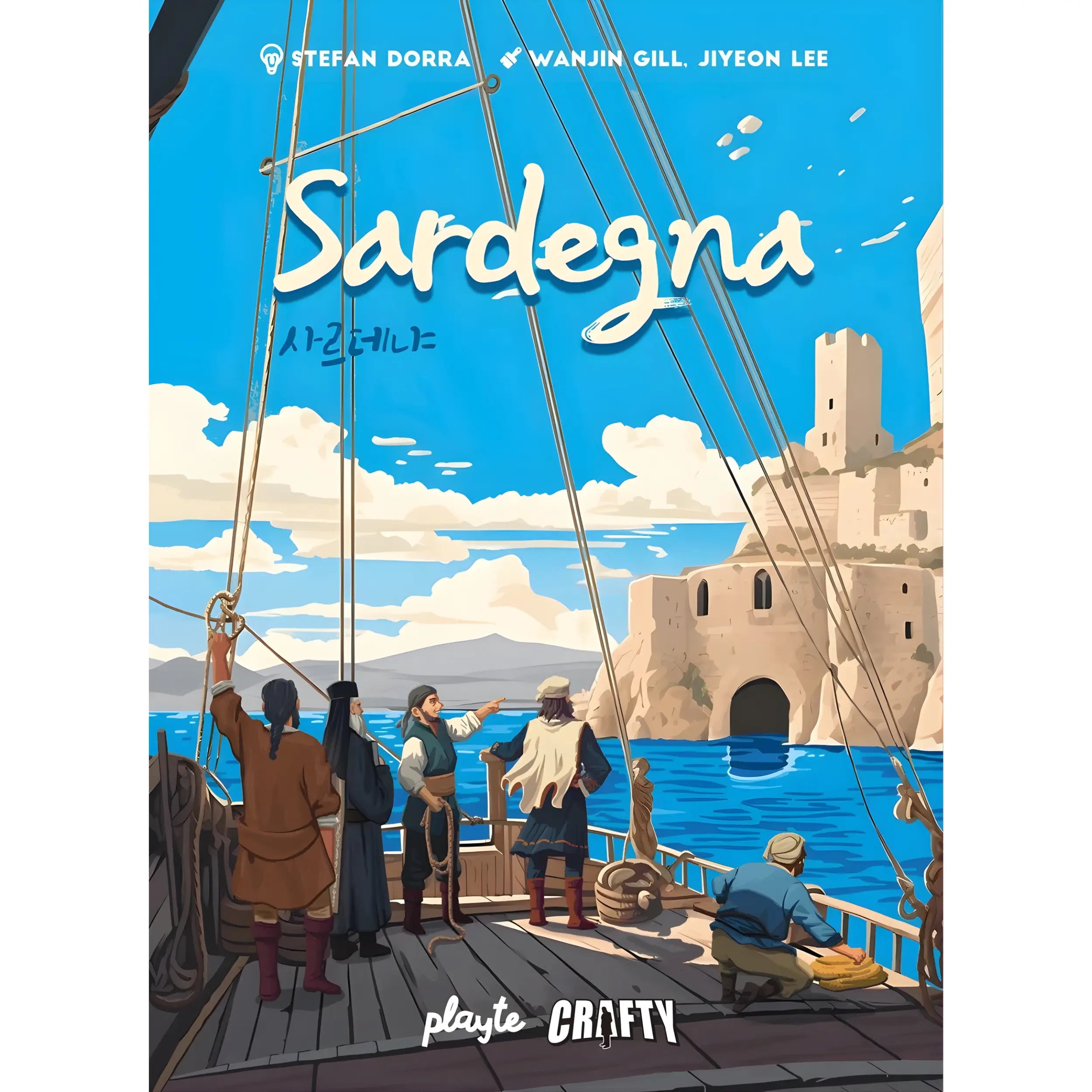
Mechanical Identity: A Review of Sardinia
What appears to be a holiday idyll is, in reality, a brutal calculation arena where sand is measured in influence points.Imagine the game board not as a flat surface, but as a topography of invisible tensions. Sardegna , a modern re-release of Stefan Dorra's classic Kreta , curated by Playte, presents itself with the relaxed aesthetic of a tourist map, but hides a ruthless Territorial Control system in its genetic code. This is not a game for those seeking passive cooperation or group solitaire. It is a feat of playful engineering designed for 2-4 strategists who aren't afraid to look each other in the eye after stealing a region for a single, paltry power point.
The atmosphere at the table changes rapidly: from the initial smiles during setup, we pass into a dense silence, broken only by the clicking of the wooden cubes on the board. We're faced with a medium-weight Eurogame that uses hand management like a ticking clock, forcing players to balance spatial expansion with the temporal scarcity of available actions.
/pic8865615.jpg)
The Architecture of Conflict: An Analysis of Territorial Control
It's not enough to be there; you have to be there at the exact moment the story, or in this case the score, is being written.The beating heart of Sardinia lies in the Area Majority mechanic. Unlike other games where the majority is static, here the map is a fluid organism. Players place their influences—represented by tokens symbolizing ships, towers, and workers—not just to occupy space, but to alter the balance of power in specific regions. The game's engineering imposes a fundamental physical constraint: adjacency. You can't project power everywhere; you must build a supply chain.
Every placement is a declaration of intent. Placing a ship serves not only to control the sea, but also to prepare for landing on adjacent coasts. This is where Dorra's design shines with wicked elegance: the value of a region isn't fixed, but depends on how violently players are willing to fight for it. The tension comes from the knowledge that each cube placed is a spent resource that won't be returned until the cycle is complete.
The Relentless Engine: How the Gears of Sardinia Turn
The game's drive system is based on a cyclical Action Recovery mechanism. Each player has an identical set of character cards. Each card is a specialized cog: the Architect builds, the Admiral moves fleets, the Merchant generates resources. Technical magic occurs in the discard pile.
Once played, a card is "burned." It's no longer available. This creates a phenomenon of strategic entropy: as the round progresses, your options narrow. The table sees your hand dwindling and can calculate with mathematical precision what you can no longer do. The engine restarts only when you decide to play the recovery action or when game conditions force a reset. This flow management creates a syncopated rhythm: bursts of activity followed by turns of forced maintenance, where the player must "breathe" to be able to strike again.
Anatomy of a Fatal Mistake: The Move That Dooms You
The disaster in Sardinia does not come with a roar, but with the muffled sound of a card played a turn too early.The most common, and technically most devastating, mistake is timing the count. In the game, certain characters activate the scoring for a specific region. An inexperienced player will use this action as soon as they have a majority. Seems logical, right? Mistake. Activating the scoring when you only have a slight advantage and your hand is almost empty exposes your flank to an immediate counterattack.
Your opponent, observing your structural weakness (few cards in hand, limited response actions), can use Area Movement cards to move adjacent units, overturning the majority after you declare your intent to count, but before the counting is definitively closed or crystallized in future turns. The result? You've spent a precious action to gift points to the person sitting to your left.
/pic8865611.jpg)
A Turn in the Mud: Impossible Choices and Consequences
We're halfway through the game. The Sardinia map is a mosaic of conflicting influences. You have only two cards in your hand: a builder and the Castellan (which triggers scoring). The Cagliari region is hotly contested. If you play the builder, you consolidate your position but lose the scoring initiative. If you play the Castellan, you cash in immediately, but are left without any operational cards to react to your opponent's next move.
This is the "mud." The analysis paralysis that sets in when Hand Management conflicts with tactical necessity. Experienced players slow down here. You can feel the mental strain of simulating the next three turns. Spending your last resource now means being a passive spectator for the next ten minutes. In Sardinia , forced inaction is a punishment worse than losing points.
The System Anomaly: The Rule That Breaks the Pattern
The score is not a democratic event marked by time, but a gun pointed at the temple.The real anomaly of this design compared to modern Eurogames is that the game lacks a neutral timer for intermediate scores. Players decide where and when to score points. This mechanic transforms scoring from simple accounting to an offensive tool. You might decide to evaluate a remote and poor region only to force your opponents to shift their attention there, distracting them from the true strategic objective. It's a structural bluff, made possible by the complete freedom the rules grant regarding the order in which regions are activated.
Psychology at the Table: What Happens Between Players
There's no room for diplomacy in Sardinia . The map is too narrow. The psychology at the table quickly veers toward paranoia. When a player stares insistently at the west coast but keeps his hand of cards face down, is he bluffing? Is he calculating points for the west coast or preparing an invasion from the east? Body language becomes a component of the game. The Action Retrieval is a moment of psychological vulnerability: when a player picks up his cards, everyone at the table knows that his offensive potential is back to its maximum. The atmosphere becomes tense. It's the moment when tacit alliances crumble.
The Player's Metamorphosis: From First Game to Advanced Strategy
In the first game, the average player behaves like a tourist: placing cubes wherever there's space, trying to be everywhere. It's a strategy doomed to failure. The metamorphosis usually occurs around the third game. The player evolves into a "surgical opportunist."
The goal is no longer ubiquity, but concentration of power. You learn to read your opponent's card flow . "He's already played his two naval moves, so my coast is safe for at least two turns." This level of deduction transforms the game from a tile-laying exercise to a counterintelligence battle. Advanced strategy requires memorizing not only the state of the map, but the state of your opponent's hands.
The Verdict: Pros, Cons, and Final Thoughts
Sardinia is a stylistic exercise in achieving abysmal depth with rules that can be explained in ten minutes. It's not a game for those who like to build their own backyard alone.
- PROS: Interaction is highly responsive and straightforward. The action selection system creates constant dilemmas. The clean graphics help clarify tactical situations.
- PROS: Excellent scalability. With 2 players it's like chess, with 4 it's a tactical brawl.
- CONS: Can be punishing for mistimed card retrieval. Risk of analysis paralysis in the final turns.
- CONS: If you're looking for an immersive theme, you might find it a bit abstract: Sardinia is a geographical pretext for mathematical mechanics.
The Final Imprint: Why Sardinia Remains in the Heart
It leaves a mark because it respects the players' intelligence. There are no dice, no luck. If you lose a region, it's because someone was smarter, faster, or more patient than you. And that feeling of having lost by a hair's breadth, due to a miscalculation of a single unit, is what drives you to reset the map and start over immediately. It's the cruel beauty of German design, dressed in the warm colors of the Italian summer.
Accept the strategic challenge and conquer the island.
Find out more on Frogames.it

 https://frogames.it
Condividi:
Harvest: When Agriculture Becomes a Cold War of Efficiency
Eila and Something Shiny: When Resource Management Becomes an Emotional Thriller