Harvest: When Agriculture Becomes a Cold War of Efficiency
by Andrea By Frogames
Mechanical Identity: Harvest Review
Beneath the watercolor surface of an idyllic farm lies an optimization algorithm that does not forgive waste.
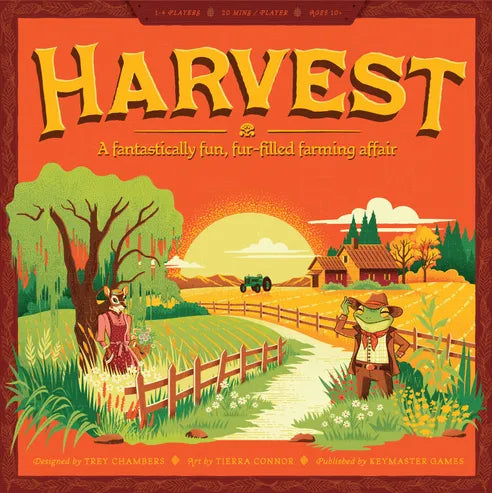
Imagine yourself in a clearing, the sun is rising over Gtown, but there's no poetry in the air, only calculation. Harvest , published by Keymaster Games, presents itself as a harmless farming game for 1-4 players, but the reality at the table is quite different. We're not talking about a relaxed farming simulator where carrots grow while you sip tea. This is a resource management and worker placement game condensed into four brutal rounds, where each turn is a razor's edge between success and agricultural failure. The target is not the player who wants to "do things," but the analyst who wants to "do things better than others." The limited running time of 60 minutes is a trap: the decision-making density per minute is extremely high.
In this closed ecosystem, scarcity isn't a bug; it's the dominant feature. There isn't enough water for everyone. There isn't enough fertilizer. And certainly, there aren't enough action spaces in the village for everyone to execute the perfect strategy. It's a game that stares you in the eye and asks you to do more with less, turning farming into a high-pressure logistical challenge.
The Architecture of Conflict: Worker Placement Analysis
The beating heart of Harvest lies in its central mechanic: a tight, almost claustrophobic Worker Placement . Unlike epic games where you deploy armies of tokens, here you have only two farmers (represented by custom meeples) at your disposal. Just two main actions to define the fate of your season.
The central board, representing the town, offers limited space. When an opponent places their token on the Emporium to buy seeds, they're not just acquiring a resource; they're physically blocking one of the few access routes to that resource. Look at the table: the player to your right is staring greedily at the "Market" space. If you occupy that space now, you're not just doing it to earn coins, but to sabotage their cash flow. It's an indirect but violent interaction. In game engineering terms, this creates a decision bottleneck. You can't do everything. You must choose whether to expand your fields (increasing future production capacity) or harvest now (to cash in on immediate victory points).
The system punishes hesitation. If you wait for the perfect moment to water, you'll find your well drained by someone else. The mechanic forces players to painfully prioritize, creating what we call an "agonizing action bottleneck" in tech jargon.
The Relentless Engine: How the Gears of Harvest Turn
The game engine is based on a three-phase cycle: planting, tending, and harvesting. It may seem trivial, but the technical implementation of resource management here is diabolical. The main resources (water, fertilizer, seeds) don't accumulate infinitely; they must be used to activate crops.
The real genius lies in the Sunrise phase. This is where Open Drafting of Initiative cards comes into play. At the start of each round, players don't roll dice for turn order. Instead, they choose a card that determines three crucial factors simultaneously: the turn order for the round, an immediate bonus (resources), and a passive bonus. Want to be first to steal the best action space? Fine, but you'll have to choose the initiative card that offers the fewest resources. Prefer to fill your pockets with seeds and water? Then you'll have to act last, picking up crumbs in the city.
This mechanism links turn order directly to the game economy. It's not a static variable; it's a tradeable commodity. The engine runs smoothly because each input (choosing the Dawn card) generates a complex output that influences both immediate tactics (resources) and the round's strategy (positioning). It's an elegant system that eliminates dead time and forces you to calculate the marginal value of acting early versus having more resources.
Anatomy of a Fatal Mistake: The Move That Dooms You
In a game of just four rounds, a mistake isn't a blip, it's a curse. The most common, and fatal, mistake is overexpansion: the excessive expansion of fields without an adequate irrigation system.
Imagine the scenario: you spend your first worker plowing new land. You now have room for six crops instead of three. Fantastic. But you've run out of actions to fetch water. Your plants are withering, or worse, not growing at all. You've spent 50% of your capital in actions (one of your two workers) to create potential you can't exploit. Meanwhile, your opponent has maintained his three base camps, fertilized them, and collected victory points. At the end of the round, you have empty land, he has points. This exponential gap is difficult to bridge. In Harvest, carrying capacity (how many fields I have) must always be perfectly synchronized with resource flow (how much water I have). Breaking this balance means watching others play for the next 15 minutes.
A Turn in the Mud: Impossible Choices and Consequences
As you look at your board, you realize you have water for either pumpkins or corn, but not both, and your neighbor is smiling.
We're in the third round. The tension is palpable. On the table is an Alba card offering "Elite Fertilizer," capable of doubling the value of your next harvest. But that card puts you last in turn order. If you take it, you'll get the multiplier, but the market spaces will surely be occupied when it's your turn to move workers. It's a classic dilemma: power or speed?
You decide to take the card. You get the fertilizer. The turn begins. Player A occupies the field expansion. Player B, as expected, occupies the Main Market. It's your turn. You have a magnificent crop, boosted by the fertilizer, but nowhere to sell it at the maximum price. You're forced to use the "Black Market" or a less efficient secondary action. You've earned points, yes, but fewer than you would have done by acting first with a standard crop. The consequence? You've wasted the fertilizer's potential due to a logistical bottleneck you accepted by choosing the last position.
The System Anomaly: The Rule That Breaks the Pattern
What elevates Harvest from a simple mathematical exercise to a replayable challenge are the Variable Player Powers . Each player plays a unique character with an ability that breaks the standard rules of the game. And we're not talking about small percentage changes.
Take "The Ancient Mariner," for example. While everyone else is struggling to plow new fields, he can utilize the waterways in ways the others can't even imagine. Or the "Mayor of Gtown," who manipulates the village economy to her advantage. These asymmetries force each player to play a different game on the same board. If you try to play the Gravedigger like you would a standard farmer, you'll fail. This mechanic introduces an anomaly into the system: there's no universal "winning strategy," only an optimal strategy for that specific character in that specific market configuration.
Psychology at the Table: What Happens Between Players
There's no direct combat interaction, but the psychological violence of drafting Dawn cards is real. You hear phrases like, "I don't need that card, but I'm only taking it because you need it." This is the level of nastiness Harvest encourages.
The board becomes a map of intentions. When a player accumulates water, they're telegraphing their intention to plant water-guzzling crops. Attentive opponents will use this information to block the purchase of specific seeds or to occupy planting spaces. A metagame of glances and bluffing develops. Pretending to be interested in one strategy only to switch to another at the last minute is a crucial skill. The fear that someone will steal your critical action at the wrong time keeps the adrenaline levels surprisingly high for a game about growing turnips.
The Player's Metamorphosis: From First Game to Advanced Strategy
In the first game, the novice player focuses on his own little garden. He thinks, "I plant seeds, I water, I harvest." It's a linear approach, satisfying, but a losing one against an expert.
The metamorphosis occurs around the third game. The player begins to pay more attention to other players' boards than to their own. They understand that victory points aren't earned simply by accumulating resources, but by optimizing Building card combos. They begin to leverage Drafting not for what they gain, but for turn order. Harvest's advanced strategy requires seeing the flow of the game in four dimensions: my resources, your resources, the current state of the board, and the state of the board in two turns. The advanced player doesn't plant to harvest immediately; they plant to prepare a chain harvest that will be triggered in the final round, maximizing end-of-game bonuses.
The Verdict: Pros, Cons, and Final Thoughts
Harvest is a gem of subtractive design. Trey Chambers stripped away everything superfluous, leaving only the difficult decisions.
PROS: Strategic Dense. In 60 minutes, it offers the depth of games that last twice as long. No downtime.
PROS: Asymmetry. Characters dramatically change the experience, ensuring high replayability.
PROS: Functional Aesthetics. Tierra Connor's art is not only beautiful, it's legible. The symbolism is clear.
CONS: Mistake punishment. If you fail the first round, recovery is mathematically difficult. Can frustrate casual players.
CONS: Narrow scalability. With 2 players it's chess-like, but with 4 players it becomes very chaotic and tactical. The experience changes significantly.
The Final Imprint: Why Harvest Remains in the Heart
Harvest stands out because it respects the player's intelligence. It doesn't give you anything for free. Every carrot, every coin is earned. At the end of the game, looking at your small, efficient farm, you'll experience a rare sense of engineering satisfaction. It proves that you don't need three hours and two hundred miniatures to create a deep and memorable gaming experience. Sometimes, all it takes is two meeples and the right decision at the right time.
Are you ready to handle famine and plenty with mathematical coolness?
A ring of tiles, 96 pieces of broken ceramic, and three scores of which only two count. The second game that Dani Garcia dedicates to Barcelona asks only one question, and repeats it at every turn.
Three modules in a single box, and two base game rules that no longer apply. The rulebook isn't public yet, but the content is. Which of the three will remain on the table after the third game?
A gentleman from Kyoto who describes himself as "a middle-aged guy" spent three years explaining, by word of mouth at a trade fair, the waiting maneuver of a sport you can bet on. Then, someone walked past his table.
Narratore ufficiale di FroGames, viandante tra mondi incantati e tavoli imbanditi di meeple, sono il vostro umile (ma irresistibile) Bardo.
Raccolgo storie, avventure e aneddoti da ogni angolo del Regno Ludico per trasformarli in articoli che… beh, almeno non vi faranno addormentare.
Spoiler succosi, dritte epiche o semplici farneticazioni a tema giochi da tavolo? Siete nel posto giusto.
Preparate il tè (o la pozione), accendete la candela e sistemate i dadi: sto per cominciare a cantare.
Seguitemi, avventurieri... la leggenda è appena iniziata.
Choosing a selection results in a full page refresh.
Opens in a new window.
🐸📦
Last dispatch: Tuesday at 11 am
We're moving to a bigger warehouse: room for many more games
Ranaldo has seen the new warehouse and he's so happy he even called his parents to tell them!
Ranaldo has been up since dawn, labelling the first boxes with a list in one hand and a coffee in the other.
The first boxes are on their way! Ranaldo is directing the move with a megaphone and a helmet two sizes too big.
The new shelves are up. Ranaldo counted them twice and called his parents again: “There's really room for more games!”
The games are settling onto the shelves, one by one. Ranaldo checks every box against his list and hasn't missed one. Almost.
Ranaldo has already got the ribbon ready to cut. The new warehouse opens today.
From Friday at 11 am everything is back to normal.
📦Day One games and pre-orders are delivered as usual: for those, we're up and running.
🐸The shop stays open: you can order whenever you like.
Until Monday 8 pm
The more you add, the less you pay
15%from €90
20%from €130
25%from €180
Based on the total of your full-price games. It applies by itself in your cart, no code needed. Example: €130 of games → you pay €104.
🏷️
Left out: pre-orders and games already on offer (crossed-out price). They stay at their price and don't count towards the amounts.
🎁
FrogVIP free from €180 of full-price games: with the 25% that's €45 off plus FrogVIP (€19.99) as a gift. It lands in your cart by itself at €0 (remove it if you don't want it). Under €180 it costs €19.99. See FrogVIP

/pic8521627.jpg)
/pic8521620.jpg)



 https://frogames.it
Condividi:
Eternal Decks: Technical Analysis of a Game Evolution
Sardinia: Chronicle of a Silent Siege Between Sea and Land