
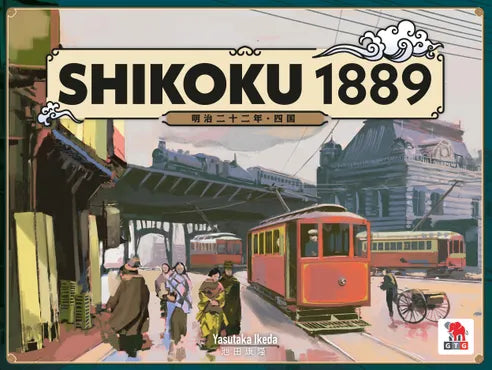
The Mechanical Identity: Review of Shikoku 1889
The silence that falls across the table during a game of Shikoku 1889 isn't the absence of noise, it's the sound of six brains calculating the breaking point of a simulated economy.
We're on the island of Shikoku, during the Meiji period. But forget the romantic vision of cherry blossoms. Here, we're faced with a titan of the 18xx genre, condensed into an accessible yet lethal form. Shikoku 1889 , magnificently re-edited by Grand Trunk Games, is a game of financial manipulation disguised as a railroad game. The target audience? Not those looking for a carefree evening. It's for the analyst, the strategist who enjoys watching an opponent's stock price plummet because of a single, imperceptible decision made three turns earlier.
Unlike heavyweights that require eight hours, this system offers the full experience of predatory capitalism in about 180 minutes. It's a closed system, an ecosystem where every yen spent changes the balance of power. We're not moving pawns; we're moving capital.
/pic9275393.jpg)
The Architecture of Conflict: An Analysis of Shareholding
In this game you don't own the trains; you own the souls of the companies that run them, and sometimes it pays to sell them to the devil.
The key mechanic here is Stock Holding . In many management games, if you buy an asset, you use that asset. In Shikoku 1889 , owning 60% of a railway company isn't a badge of honor, it's a legal responsibility. You're the President. And as President, you have to decide whether the profits should be divided among the shareholders (dividend payments) or kept in the company's coffers to buy better trains.
This is where psychological friction comes into play: if you pay dividends, the stock price rises, and you, as the majority shareholder, become personally rich. But the company remains poor, unable to grow. If you withhold the money, the company becomes an industrial powerhouse, but the stock price stagnates and your personal wealth doesn't grow. It's a constant dilemma between personal greed and corporate health. And beware: if an adversary buys your company's shares, every time you distribute dividends, you're literally pouring money into the enemy's pockets.
The Relentless Engine: How the Gears of Shikoku 1889 Turn
Under the hood, the game runs like clockwork, driven by network building and train management mechanics. Trains in Shikoku 1889 aren't eternal. They follow a brutal, planned obsolescence logic. When the first level "4" train is purchased, all level "2" trains instantly rust and are removed from the game.
This creates a devastating ripple effect. Imagine you've just founded a company, spending all your capital on two small trains that generate a modest income. Another player, sitting across the table, decides to accelerate the technology and buys the first train, "4." Your trains vanish into thin air. Your company now has zero trains, zero revenue, but must own a train to operate. What if the company coffers are empty? You have to pay out of pocket. What if you have no personal money? Sell shares. What if that's not enough? Bankruptcy. Game Over.
Anatomy of a Fatal Mistake: The Move That Dooms You
The tragedy in Shikoku 1889 did not occur with an explosion, but with a miscalculated bank transfer.
The most common and deadly mistake is ignoring the "Certificate Limit" (share certificate limit) in combination with liquidity. An experienced player sees a novice invest heavily in a solid company but neglect liquidity for the trading round. What does the veteran do? He manipulates the market.
He sells off shares in a rival company en masse, causing their market value to plummet. The novice, who was counting on that capital to finance the forced purchase of a permanent train (the dreaded Diesel), suddenly finds himself with a portfolio worth half as much. He's forced to sell off everything he owns to save the company, destroying his own stake. It's a lesson in financial cruelty: solvency is more important than profit.
/pic9089362.jpg)
A Turn in the Mud: Impossible Choices and Consequences
Let's analyze the opening: the Auction (Bidding) for Private Companies. Unlike many games where the auction is a simple exchange of resources, here the Private Companies grant asymmetric powers that shape the map. Some people are after the "Sumitomo Mine Railway" not for the money, but for the ability to lay tracks in difficult terrain.
During the Operation Round, tensions rise. "Should I place this green tile here to connect Kotohira City?" If you do, you increase your company's income by 30 yen. But beware: by opening that route, you've inadvertently created a perfect connection for your opponent's company, who will use your tracks to earn 50 yen on their turn. You've worked for them. Every piece of Tile Placement is a double-edged sword.
The System Anomaly: The Rule That Breaks the Pattern
Shikoku is not a plain: it is a topographical nightmare that devours capital.
The feature that sets Shikoku 1889 apart from its older siblings is its geography. The map is narrow, mountainous, and expensive. The land costs for tile placement are prohibitive. Building on a mountain or crossing a river can cost you your entire turn's profit.
This geographic "anomaly" forces players to unwittingly collaborate. No single company has the financial strength to dig all the necessary tunnels. Silent alliances form: "I'll build the northern access, you pay for the southern tunnel." Until one of the two decides the alliance is no longer profitable and builds a checkpoint (Token), cutting off their former partner from the network they've built together.
Psychology at the Table: What Happens Between Players
You don't look at the board, you look at the others' eyes. When a player picks up the stack of banknotes to make exchange, you notice the tremor. He's counting whether he'll have enough money to defend his presidency (Stock Protection) in the next round of stock bidding.
The language at the table changes. They don't say, "I'll play a card." They say, "I'll devalue Awa Railroad." You hear phrases like, "If you buy that train, you'll kill the market." It's a game of credible threats. The psychology of dumping (selling all the shares of a company at once to make it collapse in turn order) turns friends into Wall Street sharks. Trust is a scarce resource, scarcer than diesel trains.
The Player's Metamorphosis: From First Game to Advanced Strategy
In the first game, the novice player focuses on making beautiful tracks and running trains. This is the "Railwayman" phase. He falls in love with his company and wants to see it prosper.
By the fifth game, the metamorphosis occurs. The player becomes a "Speculator." He understands that companies are merely empty shells to be exploited. He learns the art of founding a company, emptying its coffers to buy permanent assets for another of his companies, and then dumping the empty hulk (without trains and full of maintenance debt) on an unsuspecting opponent. From empire builder to financial parasite: this is the evolution required to win at Shikoku 1889 .
The Verdict: Pros, Cons, and Final Thoughts
Shikoku 1889 is a masterpiece of gameplay engineering, but it is not without its friction.
- PRO: The short length (for an 18xx) makes it suitable for playing even on weekday evenings.
- PROS: The interaction is brutal and direct, zero downtime except for analysis paralysis.
- PROS: Grand Trunk Games' production is sumptuous, making a complex map readable.
- CONS: The learning curve is steep. A mistake on the first turn can ruin a three-hour game.
- CONS: Requires a thick-skinned gaming party; "bad" actions are necessary to win.
- CONS: Constant arithmetic (calculating the returns of complex paths) can be tiring for those who don't like numbers.
The Final Imprint: Why Shikoku 1889 Remains in the Heart
At the end of the game, looking at the map full of intertwined tracks and the devastated stock market, you feel the satisfying weariness of someone who has built and destroyed empires.
Shikoku 1889 isn't just a game about managing Japanese railways. It's a simulator of consequences. It teaches that every economic action has social and strategic repercussions. It stays with you because it doesn't give you anything for free. Every yen earned has been snatched by the teeth of a hostile market and ruthless opponents. It's the elegance of mathematics applied to trade warfare. If you're looking for an experience that will leave you mentally exhausted but exhilarated, a trip to Shikoku is a must.
Are you ready to take on the Japanese stock market?
Find out more on Frogames.it


 https://frogames.it
Share:
Vicious Gardens: When Gardening Becomes Psychological Warfare
Nippon: Zaibatsu - The Art of Economic Warfare in Meiji Japan