
Orlando Sá was born in Porto in 1982. His first published game, Porto, came out in 2019 and is a love letter to the city where he studied — one he described as "painfully beautiful" every time he sat by the river knowing he would one day have to leave it. Pessoa, in 2022, was a game about the most schizoidly prolific poet in Lusitanian literature. Rossio, Celtae, Adamastor: every title by Orlando is rooted in something Portuguese, historical, and identity-driven.
Then came Ofrenda — and Orlando built an altar for the Mexican dead.
With André Santos — a younger designer who only started making games in 2020 and comes from the world of Papercraft — they had already collaborated on Neotopia in 2023, an abstract game about building futuristic cities. The Ofrenda prototype had no theme: it was a tableau of cards with adjacency conditions. It worked, but remained cold. Then, as Orlando recounts in the design diary published by Osprey, an image arrived — an altar with portraits, candles, marigolds — and everything changed shape.
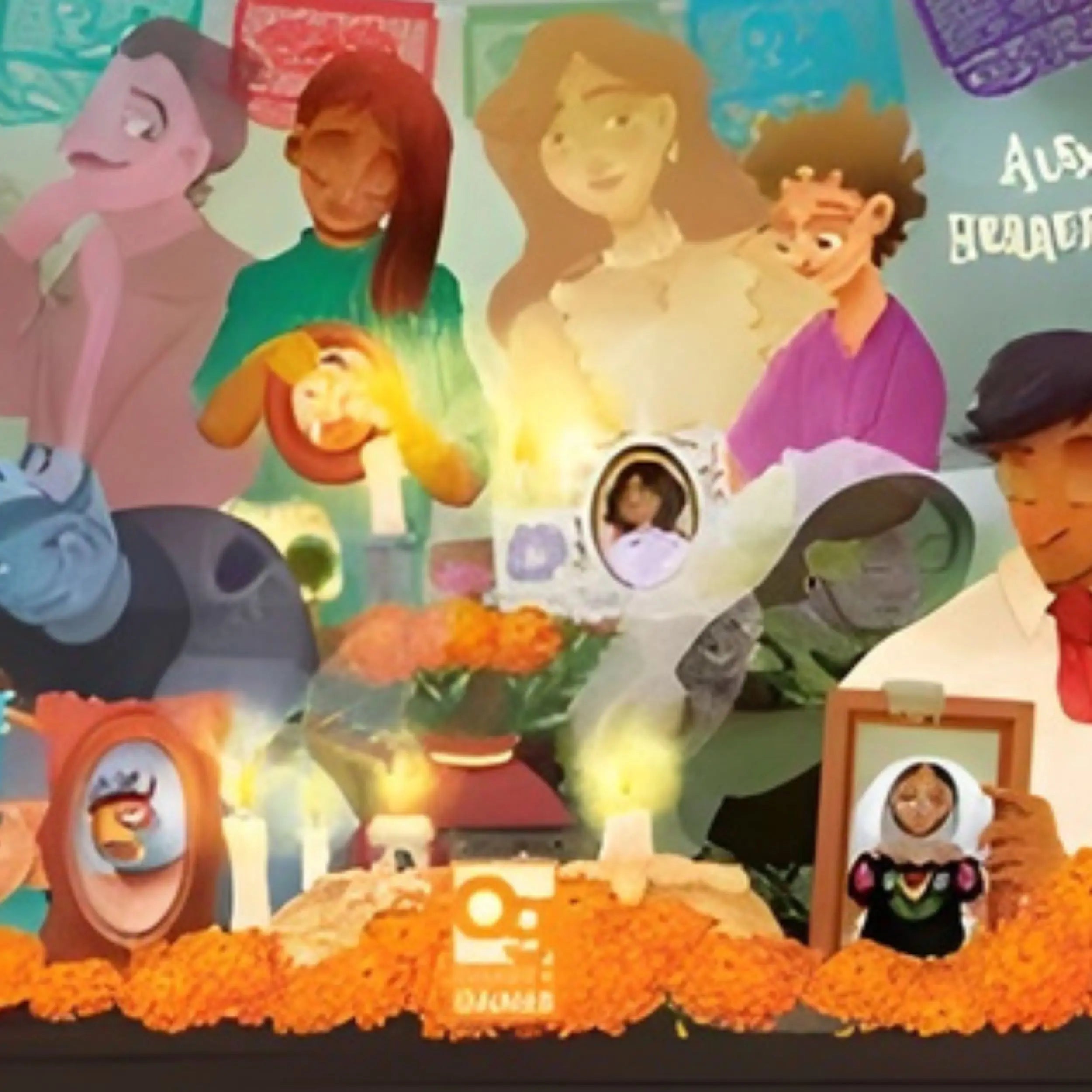
Osprey Games hired a Mexican cultural consultant and chose Álex Herrerías — a Mexican illustrator — to ensure that every portrait, every symbol, every detail of Día de los Muertos was treated with authentic respect. Herrerías designed a different portrait for each of the 80 cards in the game.
Every figure on the altar has a story. A violinist, a luchador with his mask, a man with his animal. They are not decorations — they are people.
Orlando received the first physical copy of the game the day before someone important to him died. In the design diary, after pages of mechanics and playtests, there is only one line in Portuguese: Tucha, este jogo é dedicado a ti. A game about the dead dedicated to a dead person. It's hard to imagine a theme chosen with more specific weight.
Every card in Ofrenda enters the game with a dim face — the portrait in its ghost version, with the conditions it must meet in the bottom left corner. That grandmother wants to be flanked by at least two purple cards. That old man cannot stand salt near him. That child must be surrounded by at least three portraits with the same symbol.
When all spaces around a card are occupied, and the conditions are met, the card flips over. It becomes illuminated — full colors, vivid portrait. Only illuminated portraits score points. Dimmed ones remain dim, forever, scoring nothing.
The game lasts 12 turns. In each turn, you draw a card from the common row and place it on your personal altar. Cards have adjacency conditions — color, symbol, offering — and only "illuminate" when the space around them is completely occupied and the conditions are met.
The crucial point: you can illuminate every card. The game explicitly offers you this possibility. And then it builds everything around the certainty that you won't succeed.
Candles and marigolds add a second layer: they can only be placed at the exact moment a space is surrounded by three portraits. If you don't have a candle at that moment, you've missed the window. Forever.
"The central premise remained unchanged throughout development: to give players the tantalizing possibility of scoring every single card, knowing it will be practically impossible."
— Orlando Sá & André Santos, Osprey Games Design Diary
The altar you build is never what you had in mind at the beginning of the game. It is always a compromised, partially illuminated version, with some ancestors remaining in darkness. Exactly like in real life, one might say — but in Ofrenda, this feeling has a precise name.
At the start of the game, every card seems manageable. You look at the conditions, mentally build the sequence, and convince yourself that this time you can keep them all under control. It's a precise feeling: not optimism in a general sense, but the intuitive certainty that the final outcome will be exactly what you imagined.
It almost never is. And the feeling when a card remains dim — or when it unexpectedly illuminates on the last turn — is always more intense than you predicted.
| Psychology |
Affective Forecasting Error Psychologists Timothy Wilson and Daniel Gilbert documented a systematic pattern in 2005: people are wrong in predicting the emotional intensity of future events. We overestimate how happy we will be with victories, underestimate how much we will suffer from losses — and in both cases, reality surprises us. In Ofrenda, this mechanism is not accessory — it is structural. The card you place on the third turn seems like a neutral choice: you'll satisfy it later, it's not a problem now. But when, on turn eleven, you realize that space will never be available, the frustration is disproportionate to the objective magnitude of the loss. Conversely, when a card illuminates in a cascade — dragging two candles and a marigold with it — the satisfaction is physical, unexpected, difficult to explain to those who weren't watching. The card flip — that physical act of turning the portrait from its ghost side to its illuminated side — is the moment when prediction collides with reality. The game knows this. It was designed precisely so that this moment always comes as a surprise. Wilson, T.D. & Gilbert, D.T. — Affective Forecasting — Advances in Experimental Social Psychology, 2005 |
Ofrenda is a game about the dead. But what stays with you at the end of the game is not the melancholy of the theme — it's the discovery that you still don't know, after years of experience, how things will make you feel before they happen. The altar you build is not for your ancestors. It is a mirror of how well you know yourself.
Ofrenda is available at Frogames.
Build your altar.
1–4 players · 60 minutes · 14+ · Osprey Games


 https://frogames.it
Condividi:
The pig who didn't want to make it — but did
Two friends, a Polish basement, the most beautiful miniatures of the decade