
Justin De Witt never wanted to work for someone else more than necessary. After years between animation studios and e-learning companies, in 1999 a friend handed him Settlers of Catan. His brain started working again. Evenings with friends became playtest sessions. Prototypes piled up. And at some point, friends stopped asking him "what are we doing tonight" and started asking him to bring "that castle game."
Castle Panic stems from a specific obsession: that moment in competitive games when players stop fighting each other and team up against someone. De Witt wanted to make an entire game out of that moment. In 2009, together with his wife Anne-Marie, he founded Fireside Games to publish it. The distributor estimated seven hundred copies sold in the first year. They printed thirty-five hundred. They sold out in ten weeks.
Sixteen years later, Fireside Games is still Justin and Anne-Marie. He handles the creative side, she the management. No investors, no large offices, no team of twenty people. An editorial philosophy that hasn't changed since 2009: accessible, cooperative or almost cooperative games that finish in less than an hour and leave you wanting to play again.
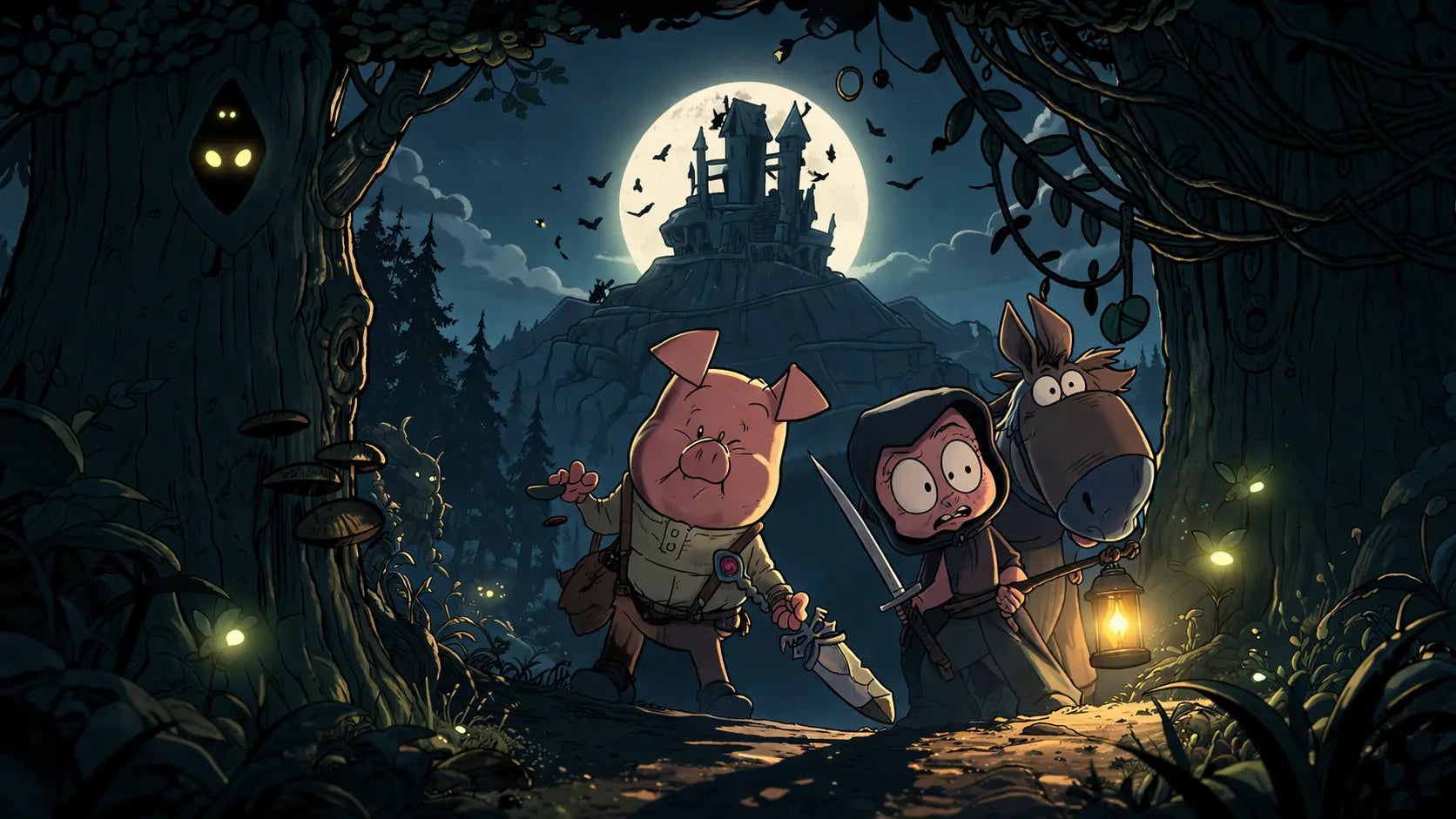
Ham Helsing is based on the graphic novel series of the same name by Rich Moyer — a syndicated cartoonist and animator, in his first graphic novel. Three volumes published by Penguin Random House between 2021 and 2023. The board game's artwork is entirely his: same characters, same palette, same style.
The pun in the title is intentional and immediate: Ham is the pig, Helsing is the family of vampire hunters everyone knows from Bram Stoker. The protagonist preferred to paint.
Ham Helsing is the game where De Witt brings that philosophy into the comic book territory — an already built universe, with characters that existed before the game, and a new mechanic to graft onto it. The result is a cooperative game that works even if you've never heard of the graphic novel. And it becomes more fun if you do know it.
Classic deck-building works like this: you draw cards, use them, buy better cards, put them in your deck, and wait for them to come around again. Your character improves abstractly — stats change, options increase, but the card in your hand is always a card in your hand.
Ham Helsing does something different. The upgrade cards are transparent — thin acetates with symbols printed on them. When you buy one, you don't put it in your deck: you slip it into the sleeve of the base card. Physically inside. If the symbol fits into the available space, the upgrade is valid. The card grows in your hand — it becomes a stack of overlapping layers, thicker, more readable, unequivocally yours.
Card crafting with transparent cards. Each character starts with an asymmetric deck. During the game, players buy transparent upgrade cards at the market — the Rat Market — and physically insert them into the sleeves of existing cards. Symbols overlap and combine: a card that initially allowed movement now teleports an ally and adds damage.
The physical constraint is part of the design: an upgrade only fits if the symbol finds space on the base card. You can't add everything — you have to choose which direction to grow each card. And that card, once built, is visibly different from the others.
"Peel back the layers, and you'll see that each player really only gets five turns the entire game — which makes action efficiency the core puzzle."
Kevin Brantley · Meeple Mountain, 2025
Five turns each in the entire game. Every card built counts double — because you use it now, and because it determines what you can do next turn. The pressure doesn't come from a timer or a round mechanic: it comes from the fact that every unbought upgrade is an opportunity that disappears when someone else gets it first. The Rat Market waits for no one.
At some point in the game, something happens that the rules didn't explicitly foresee. Someone suggests you pass an upgrade to a teammate — it would be the right move, the combo would work better on that character. And you hesitate. Not because you don't understand the logic. But because you built that card, layer after layer, and your brain has already decided that it's yours — even if technically it never really was.
It's not greed. It's that the sense of ownership works even without a legal title.
| Psychology |
Psychological Ownership In 2003, Jon Pierce, Tatiana Kostova, and Kurt Dirks described a precise phenomenon: people develop a genuine sense of ownership over objects they do not legally own, whenever they invest time, attention, or physical labor in them. This is not a metaphor — the brain treats those objects exactly as it treats things that are truly its own. It defends them, protects them, and finds it difficult to give them up. Ham Helsing is one of the few games where this mechanism is physically and visibly activated. Inserting an acetate into a sleeve, seeing the symbols overlap, holding a card that has become thicker than when it started — these are concrete actions that trigger that sense of belonging. The card is not yours in any real sense. But the brain doesn't make that distinction. The cooperative tension arises exactly there: between what benefits the group and what you already feel is yours. And it's a tension that the game never resolves — it leaves it in your hands, along with the card. Pierce, Kostova & Dirks · "The State of Psychological Ownership" · Academy of Management Review, 2003 |
The games you remember aren't the ones you won. They're the ones where you built something with the right people — and then had to decide whether to keep it or give it away.
Ham Helsing is on Frogames. It's in English, easy to understand, and works well with the right people around the table.
Direct import · English only · Fireside Games, 2025

 https://frogames.it
Share:
When discounts become a habit, the market stops functioning
An altar for those who are no longer with us — and to understand who you are