
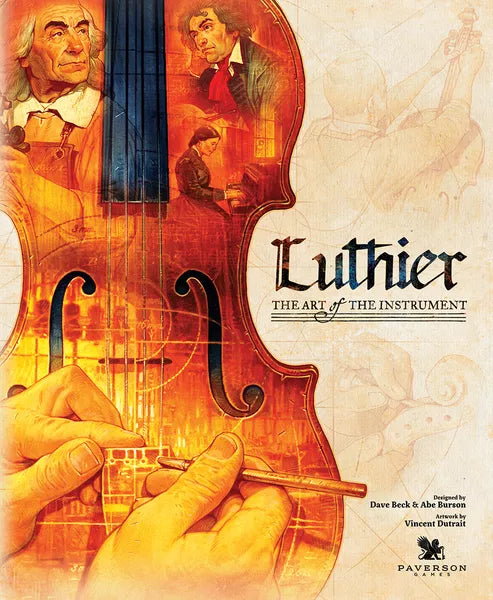
A journey inside Luthier , where the dice don't make noise: the soul does.

There's something magical about the moment the bow touches the string for the first time. A subtle, invisible vibration that shakes the silence like dust on the table. If you've ever loved a board game for what it doesn't say, but what it makes you feel, then Luthier will enter you like the scent of seasoned wood.
And no, it's not a game about violins. It's a game about the act of making them , about what it means to dedicate your life to them. About seeking perfection in a gesture repeated a thousand times, about that small imperfection that makes a sound unique. About what you put into the world when no one's watching.
But who the hell is a luthier ?

He's someone who lives between music and silence. Who knows the anatomy of instruments better than the human one. Who knows that an extra millimeter on the neck changes a concert.
The luthier is that ancient soul who builds violins, violas, cellos and double basses — by hand, with the slowness of a gesture passed down through generations.
When an instrument sounds perfect, the luthier is invisible. But if he makes a mistake, you can hear him.
In Luthier , you are this figure. But you don't have to know how to carve: just get excited about trying.
A project that started before FroGames was born (seriously)

In 2009, while we were playing Dominion thinking it was the pinnacle of deckbuilding,Abe Burson already had an idea in mind. A workshop. A worker. A half-finished harp. But it took time.
Sixteen years old , to be precise.

And in the meantime, Luthier had transformed into a symphony. He met Dave Beck , who with Distilled had already demonstrated his ability to blend deep mechanics and narrative choices. Together, they began to refine this idea, layer by layer, like red pine before gluing it to a neck.
Sixteen years for an idea, not for a regulation.
Luthier doesn't explain himself, he listens (even with his hands)
What Luthier does on the table is like a chamber quartet. Each player has their own studio, their own time, their own commissions. But everything plays together.

There is a blind auction , like an audition: everyone offers their talent, but no one knows who will get the commission until the curtain rises.
There's a planned worker placement , which isn't just strategy: it's time management, workshop management, and inspiration management. Every action must be chosen in advance , like a score to be interpreted at the right moment.
Building instruments isn't just crafting: it's a declaration of intent. Each completed piece brings you prestige, but also responsibility. Because a poorly made instrument lingers in the memory of those who listen to it.
And then there are the dice , but they're used to give voice to the final performance. They're not chaos: they're interpretation. Have you built well? Your dice will sing.
In Luthier,
you don't win
you harmonize

A symphony even alone (but not empty for this)
Anyone looking for a deep and coherent solitaire board game will find a rare gem here.
Solo mode, curated by Richard Woods and David Digby , isn't a consolation prize. It's a dialogue with time. A silent confrontation with an automaton that never cheats, but forces you to give it your all.
Playing alone doesn't mean giving up. It means having a smart, consistent bot that's ready to make you sweat every deal.
Designers as rock stars (without glitter, but with chisels)
Dave Beck , besides being the mind behind Paverson Games, is also a professor of game design. Not the kind who explains tables: the kind who makes you imagine a contrabassoon while explaining the tension of the round.
Co-designer Abe Burson has made Luthier a lifelong project. He took the prototype to events like Stonemaier Design Day in 2019, and missed out on the overall win by just one vote . And honestly, we're even more sympathetic to this. Froggers love underdogs.
And behind the scenes, like a luthier who doesn't sign but tunes, there is Richard Woods : a silent developer, he has worked with passion and dedication on the solo mode, making it something that never seems like a sop, but a real concert for one.
Vincent Dutrait: When art also has a smell
It's not a metaphor.

When Vincent Dutrait illustrates a game, he does so with paper, brush, and pigments. Each of Luthier 's illustrations has a texture that seems to leap off the screen, like a hand-colored woodcut. Alongside him, Guillaume Tavernier drew the architecture of workshops, concert halls, and noble neighborhoods.
Looking at Luthier 's board is like opening an illustrated book on music history. But without the boredom.
The Silence Before Summer: Coming Soon to FroGames.it
Forget Kickstarter.
Luthier arrives on FroGames.it in August 2025 , and it will be one of those cases where an indie strategy board game takes center stage. For months now, the most attentive Froggers have been asking questions, trying the prototype on Tabletop Simulator, and being moved by the obsessive attention to detail.
And no, it's not for everyone. Like the harpsichord. But if it resonates with you, you won't be able to do without it.
The beauty of Luthier isn't just playing it. It's knowing it exists.
Then don't miss this little masterpiece!

And if you love modern board games with powerful art and an indie heart, also check out:

 https://frogames.it
Condividi:
The Lord of the Rings: The Fate of the Fellowship: Middle-earth has a new Plan B
Windmill Valley – The strategic board game that turns like a perfect wheel