
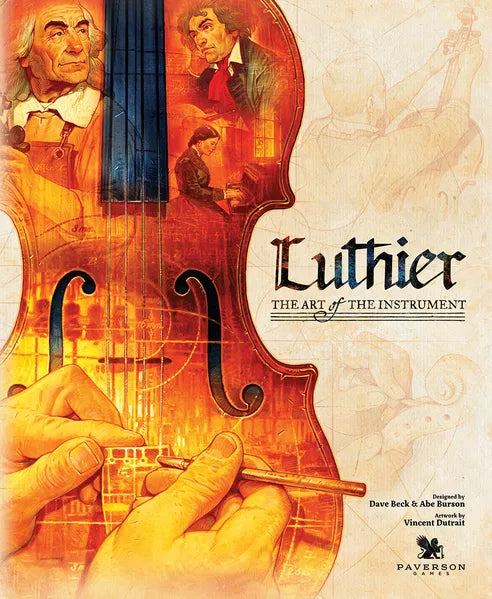
Luthier
The board game Luthier , released in the second half of 2025, boasts a rich and layered history, comparable to that of a treasured violin passed down through generations. This development diary offers an in-depth look at the title's genesis, told through the perspectives of two designers: Abe Burson , the original creator, and Dave Beck , who wrote and published the game with Paverson Games .
2008-2016: The Genesis of the Project
The idea for Luthier was born in 2008 from Abe Burson, a musician and son of a piano pedagogue. Inspired by the great Euro-style classics of the time such as Caylus , Agricola , and Puerto Rico , Burson wanted to create a game that combined resource management and worker placement with a strong theme related to the construction of stringed instruments. The pillars of his vision were clear: a competitive Euro-game of medium-high difficulty , for 2-5 players and a duration of 90-120 minutes .
In early prototypes (2015–2016), the game featured static stages and three main materials: maple, mahogany, and ebony . However, the design suffered from a certain rigidity, with an underdeveloped "client" system and mechanics that sometimes slowed down the flow of gameplay.
2017-2021: Chiseling and Assembly
The mechanical breakthrough came in late 2017. Inspired by Forbidden Stars , Burson merged two seemingly distinct mechanics into a single beating heart: worker placement combined with the hidden auction . This transformed the game round into two distinct phases: Planning (prioritizing) and Resolution , also introducing a variable phase order and fluctuating market costs.
In January 2020, at Protospiel MN , Dave Beck tried Luthier for the first time and was impressed by its strong thematic integration and unique hidden offer mechanic. After a period of online playtesting on Tabletopia and Tabletop Simulator during the pandemic, in 2021 Dave Beck approached Abe about not only publishing the game with Paverson Games but also becoming its co-designer.
The Influence of St. Cecilia's Hall and the Patrons
After signing the contract in 2022, Dave Beck visited St. Cecilia's Hall & Music Museum in Edinburgh, Scotland. This experience was crucial to the thematic evolution of the play. Looking at the collections of harpsichords and violins commissioned by royalty and virtuosos, Beck introduced the concept of Patrons .
In the final design, commissions are no longer simple financial transactions. Players must manage the patience of Patrons (represented by cubes) and fulfill their requests to obtain gifts and, ultimately, turn them into lifetime supporters, granting permanent upgrades to their game engine. This development phase also saw the crucial contribution of Richard Woods (developer), who introduced the use of dice in performance and skill tracks.
Artistic Production and Components
To visually capture the essence of classic craftsmanship, Paverson Games hired illustrator Vincent Dutrait . His "analog" style, based on hand drawing and painting, perfectly complemented the theme. The graphic design was handled by Matt Paquette & Co.
The game includes thoughtful details such as workers represented by chips that increase from three to five over the course of the game (symbolizing the growth of the "family" of artisans) and a cardboard conductor's baton used in the introductory mode called "The Rehearsal," co-written with Cody Reimer .
Only Fashion and Musical Authenticity
The solo mode was co-designed by David Digby and Richard Woods, creating an automaton that learns and evolves through an organic deck of cards. To ensure maximum historical and musical accuracy, the team consulted with musicologist Kevin Ngo , who also curated the official soundtrack, recorded by a quartet in British Columbia. Luthier is not just a game, but a tribute to the art of music making, brought to life by an international team of professionals.
In-depth video
Image Gallery
:strip_icc()/pic9339708.jpg)
:strip_icc()/pic9339715.jpg)
External Resources
Condividi:
Corps of Discovery: 2nd Edition Ultimate and Duo on Kickstarter
Metal Gear Solid: The Board Game - Review and Gameplay Analysis | Fgames.it