


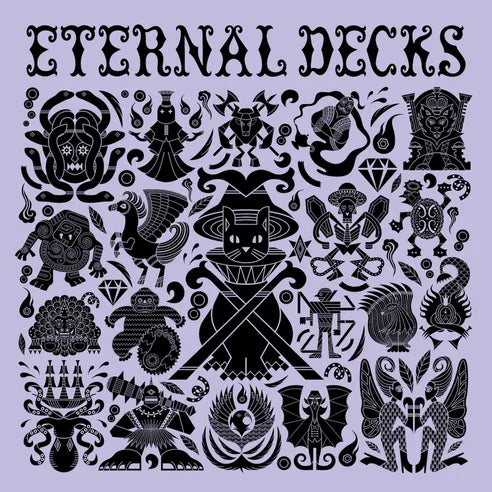
Mechanical Identity: Eternal Decks Review
There comes a point in every game of Eternal Decks when the silence at the table becomes heavier than the components themselves.Forget the classic cooperative games where you shout "miracle" while throwing dice at a plastic ogre. Eternal Decks , published by Tricktakers Games, is a different beast. It's a cooperative puzzle game for 1 to 4 players disguised as a card game, but hiding a ruthless probabilistic calculation engine. We're not talking about a narrative dungeon crawler, but an exercise in gaming engineering where survival depends on the group's ability to align their brainwaves. The target audience? Strategic couples, puzzle solvers, and anyone who considers "nonverbal communication" an art form.
The setting transports us to an abstract world plagued by a life-shortening curse, guarded by entities called "Eternals." But beware: here, the theme isn't literary frills; it's a functional metaphor. Every rule, every card played, simulates the struggle against entropy.
/pic9274298.jpg)
The Architecture of Conflict: Hand Management Analysis
The table is not a battlefield, it's a grid of logical switches that you must flip in the perfect sequence.At the heart of the system is a Hand Management mechanic fused with rigorous Numerical Sequencing . Imagine three rows of cards in the center of the table. You can't place cards randomly: you must respect color and number constraints that restrict your options from turn to turn. This isn't the simple "play a high card to win the trick" typical of Trick-taking , but a cooperative evolution of it.
The tension arises from the discrepancy between what you have in your hand and what the board requires. A red 7-value card could be your salvation now, but playing it could block the only row accessible to your partner, condemning him to "burn" precious resources. It's a system of communicating vessels where every move reduces the other players' room for maneuver.
The Relentless Engine: How the Gears of Eternal Decks Turn
The Eternals aren't bosses to be defeated with brute force, they're viruses that rewrite the game's source code while you're playing.The real technical genius lies in Evolutionary Deck Building . Unlike traditional deck building, where the deck simply gets stronger, here the system changes. Unlocking an Eternal means introducing a unique mini-deck into the game that alters the laws of game physics. An Eternal might suddenly ban certain colors, or force you to play in descending order.
This isn't a simple escalation in difficulty; it's a structural metamorphosis. The game you start at minute one isn't the same one you're playing at minute 30. The rules become distorted, forcing players to recalibrate their strategies in real time. It's like trying to build a house of cards during an earthquake that changes frequency every ten minutes.
Anatomy of a Fatal Mistake: The Move That Dooms You
Defeat in Eternal Decks doesn't come with a bang, it comes three turns after you've made the mistake, with the cold inevitability of a countdown.Let's talk about the Butterfly Effect applied to the gaming table. The typical mistake of the novice is to make an "efficient" play for themselves. "I have a Blue 8, I'll play it and free up my hand." Great, but by doing so, you've just raised the threshold for that row above the maximum value your partner has in his hand.
The consequence? On his turn, your partner won't be able to play legally. The system will punish him, forcing him to use a Gem or suffer a penalty. That Blue 8, carelessly played three minutes earlier, is the mathematical cause of your current defeat. In this game, tactical selfishness is a collective death sentence.
A Turn in the Mud: Impossible Choices and Consequences
Looking your partner in the eye knowing you have the card that would save him, but not being able to pass it, is pure playful agony.Communication Limits are like sand in the cogs. You can't say, "I have a Yellow 3." You can only make your intentions clear through the pace of the game or the haphazard use of Gems. A typical turn unfolds in an atmosphere of palpable tension: you draw, you look at the three rows, you look at your cards. Every option seems terrible.
If you play on row A, you close the door on the next player. If you play on row B, you waste a powerful card that was needed for the Eternal. Eventually, you decide to sacrifice a lesser resource to keep your options open (dynamic open drafting). You hear the sigh of relief from the table. You've cracked the unspoken code.
/pic9274294.jpg)
The System Anomaly: The Rule That Breaks the Pattern
Gems aren't coins, they're life preservers in a stormy sea, and you'll always have one less than you need.The Gem system introduces brutal Resource Management . These precious stones allow you to bend the rules: ignore a color constraint, modify a numerical value. But their scarcity creates a constant economic dilemma. Use a gem now to optimize a mediocre turn, or save it for the inevitable catastrophe the Eternal will unleash soon?
This is where the game shines. The gem is the only safety net in a deterministic system. When a player spends the group's last gem, the atmosphere at the table changes: from that moment on, any mistake is final. It's strategic permadeath.
Psychology at the Table: What Happens Between Players
Eternal Decks creates a form of telepathy induced by desperation.After the first few games, something fascinating happens: you start thinking as one. Talking is no longer necessary. You see your partner hesitate over a card, and you *know* it only has high stats. You see that he's held onto a specific card for three turns, and you *understand* that he's setting the stage for the final Eternal.
This neural synchronization is the game's true "loot." The satisfaction comes not from numerical victory, but from the feeling of having danced a perfect tango blindfolded and without music. Those seeking the "alpha leader" who commands everyone will be disappointed: here, information is partial, so no one can lead alone.
The Player's Metamorphosis: From First Game to Advanced Strategy
The game you discard after the first playthrough is not the one you'll love on the fifth.The six-level structure isn't a glorified tutorial. It's a modular campaign. It starts with a simple point collection, progresses to pure survival, and then progresses to labyrinthine scenarios and boss fights. Many players make the mistake of judging it by the first level. Wrong.
Eternal Decks truly blossoms when you unlock the advanced modes and understand the depth of the Eternals deck. As a newcomer, you play the cards you have. As a veteran, you play cards to manipulate the draw odds of the common deck three turns later. It's a shift from tactical to deep strategy.
The Verdict: Pros, Cons, and Final Thoughts
A raw jewel that requires patience to show its true neon shine.PROS:
- Evolutionary Depth: The system that mutates through the Eternals offers rare structural replayability.
- Premium Materials: The fabric mat and wooden tokens elevate the tactile experience.
- Real Co-op: Eliminate the problem of dominant players thanks to hidden information.
- Solitaire Mode: Solid, challenging, and not just filler.
AGAINST:
- Learning Curve: The first few games can seem punishingly abstract.
- Divisive Graphics: The dark/neon style is appealing to some, hard to read to others.
- Thematic Dryness: If you're looking for an epic story written on paper, you'll only find the emergent narrative of the mechanics here.
The Final Imprint: Why Eternal Decks Remains in the Heart
Because in the end, winning against a system that wants to see you fail, using only your intuition and blind faith in your teammate, is a thrill that few games can give.Eternal Decks is a game for those who love taking apart clocks to see how they work. It's a game that respects the players' intelligence, refusing to hold their hands. The arcane aesthetic, the feel of fabric under your fingers, and the mental tension create a hypnotic mix. This isn't a "one beer and go" game. It's a game of black coffee, silence, and knowing glances. If your group is looking for a challenge that grows with you, this is your ticket to eternity.
Are you ready to challenge entropy and synchronize your mind?
Discover Eternal Decks on Fgames.it


 https://frogames.it
Share:
Leviathan Wilds: An Impossible Climb Between Vertigo and Redemption
Harvest: When Agriculture Becomes a Cold War of Efficiency