
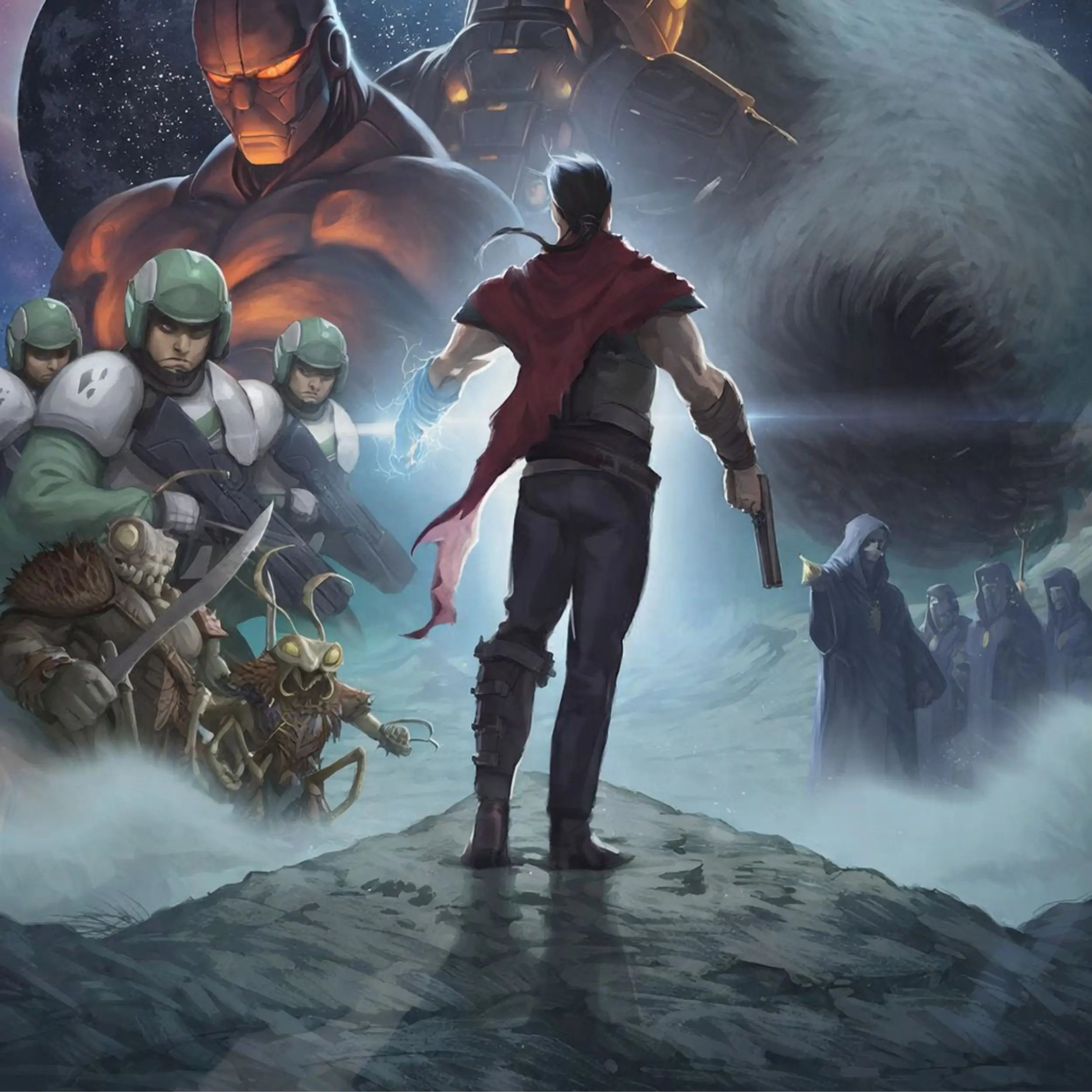
It was half past four in the afternoon. Luca had opened the box alone, without reading the manual all the way through, convinced that logic would be enough. By the third turn, he had a clean deck, two allies deployed, resources flowing in. Then he got stuck — not due to a lack of cards, but because he understood. He wasn't accumulating power. He was building speed. And they weren't the same thing.
The moment when
you stop playing
and start understanding
Every card you add to the deck changes how others activate – it’s an engine, not a collection.
The scalable threat system keeps you under pressure, even without opponents at the table.
Co-op works well, but the game is built around individual pace – better solo or with an experienced duo.
It's not for absolute beginners – those new to the genre will take longer to grasp the momentum.
Maximum two players – it’s not designed to work with larger groups.
Optimal runs require constant attention – it's not a twenty-minute filler between other activities.
The box is large, heavy, with that density you feel even before opening it. Inside are distinct decks for each hero, enemy cards with artwork that doesn't look like mass production, generous amounts of tokens, and a modular board that changes with each run. Card crafting – the ability to physically modify cards in your deck during the game – is the detail that separates Unstoppable from everything else like it.
The question this game asks isn't "how strong are you?" It's: do you understand the difference between having resources and having speed? Between a rich deck and a deck that moves? Almost no one understands it on the first try. And the system knows exactly how to punish those who don't.
Momentum is not a bonus — it’s the game's breath
Every action you take generates momentum. Momentum allows you to draw more cards, activate abilities, and chain effects. If the flow breaks — a wrong move, a card at the wrong time — your turn collapses on itself much sooner than you expect.
The real implication: building a slow deck with powerful cards is almost always worse than building a fast deck with mediocre cards.
Card Crafting changes the physics of the deck
You're not just adding cards to your deck — you can modify the ones you already have. A common card upgraded at the right moment becomes the piece that holds the whole system together. Ignoring this mechanic is possible. But it's like building a house without foundations: it holds, until it doesn't anymore.
The real implication: every card in your starting deck is already a raw resource waiting to be processed.
Threats don't wait for you to be ready
The enemy system scales automatically. As you build your hero, secondary threats accumulate on the board. The final boss is almost always a consequence of how you handled the first three waves, not a separate problem.
The real implication: every turn spent ignoring a threat is a debt that gets paid with interest.
UNSTOPPABLE
Now that you know its name, forget the name — what matters is understanding how your first attempt breaks.
- On your turn, you draw cards, generate momentum, and spend it to play actions: attack enemies, recruit allies, craft cards for your deck, or collect resources to power up your hero.
- Each enemy on the board automatically scales up if not eliminated. The final score depends on how many threats you contained and how many rounds it took to defeat the boss.
- The game ends when you defeat the boss — or when threats exceed the critical threshold. There are no draws: you either win or the system overwhelms you.
Luca arranges the cards carefully, as if order made a difference. Kael — an urban warrior with amplified five senses — has a promising base deck: two direct attacks, a movement ability, a resource card. The first threat on the board is a minor patrol. Luca eliminates it, collects resources, adds an ally card to his deck. He feels in control. He is in control.
Two threats arrive simultaneously. Luca decides to craft his basic attack card — he adds an effect that generates additional momentum. The choice is good, but it costs a full turn's worth of resources. Meanwhile, one of the two threats scales up. Not by much — one notch, almost nothing. But it's the first time the board has outpaced him instead of waiting.
The boss enters the board. Luca has fourteen cards in his deck, but he draws them in the wrong order. Momentum zeroes out mid-turn. Luca looks at the table and understands, for the first time truly, that his deck is too slow. Not too weak — too slow. The difference, now, is crystal clear.
Luca removes two useless cards from his deck — a painful choice, like tearing out pieces of a plan that seemed solid. The deck thins, becomes denser, faster. Momentum flows in sequence. Kael attacks the boss, recruits a second ally, contains the last secondary threat in one fluid turn. It's not victory — but it's the moment Luca understands how the game truly works.
Luca had put everything back in the box without saying anything. Then, ten minutes later, he started over — same hero, same scenario. Not to win: to understand. The second game isn't harder than the first, but it has a different quality. You already know that momentum stalls, that the boss always arrives sooner than expected, that every card removed from the deck is an investment and not a loss. The first run teaches the vocabulary. The second puts the right phrases in your mouth.
You build your deck as if it were a backpack
Adding powerful cards without thinking about the flow creates a rich but stagnant deck. Momentum runs out mid-turn, the best cards arrive out of sync, threats scale while you're standing still.
Remove at least one card for every two you add — keep the deck lean and fast.
You ignore secondary threats to focus on the boss
The boss is scary, but minor threats are what slowly suffocate you. Each ignored wave scales up and consumes future actions. When the final moment comes, you're already exhausted.
Treat every threat as a debt: deal with it immediately, before interest accrues.
You never craft because "it costs too much"
Crafting seems like a luxury in early runs. In reality, it's structural: a card modified at the right turn can generate twice the momentum of a newly purchased card.
Plan a crafting action every three or four turns — even a small improvement changes the equation.
Yet even those who avoid all three of these errors, at some point, find themselves still in front of a choice they already knew how it would end.
73%
of initial runs conclude without reaching the boss — not for lack of power, but because the deck was too slow when speed was needed.
Defeat in Unstoppable doesn't take the form of a final blow. It takes the form of a turn that ends too soon — momentum at zero, unusable cards in hand, threats already scaled up a level while you were busy fixing your plan. The system doesn't beat you with brute force. It beats you with rhythm. And that's exactly why the brain struggles to accept it: you don't see defeat coming, you only recognize it when it has already happened.
The sacrifice of the deck
- Sara is on turn six. Her deck has sixteen cards — well-built, balanced between attack and resources. She has already crafted two cards and recruited three allies. She feels ready for the boss.
- The system spawns a critical threat on the east node of the board. Eliminating it requires four concentrated actions. Sara has them — but to use them, she must skip planned crafting and leave the boss unattended for an entire turn.
- Sara decides to deal with the boss directly. She attacks, generates momentum, but the cards arrive in the wrong order — the key ally is at the bottom of the deck. The boss absorbs the hit and scales up. The east threat meanwhile levels up.
Sara had the game in hand until that turn. She hadn't made any mistakes — she had simply encountered the moment when the game stops being patient with you. She put the boss back in the bag, looked at the table, and said: "next time I'll craft earlier."
An Unstoppable run has three distinct temperatures. At the beginning, the board is empty, the deck is small, every choice seems manageable — there's almost a sense of calm. Then the system starts to accelerate: threats overlap, crafting creates new dependencies, momentum becomes the currency that's never quite enough. In the final phase — with the boss active and two waves in parallel — the tension doesn't rise gradually: it arrives all at once, like a room filling with water while you're still searching for the light switch.
Setup and construction
Small deck, manageable threats. Time to experiment.
Growing pressure
Waves accumulate. Momentum becomes the bottleneck.
Active boss + threats
Everything happens at once. Every wrong move is paid immediately.
Luca, in his second game, was already in phase three when the board still seemed to be in phase one. The system knew. He didn't.
Sunk Cost Fallacy
The more resources you invest in a deck, the harder it becomes to abandon it — even when it's clearly too slow. The crafting system amplifies this effect: each modification creates an attachment to the current configuration, making the choice to remove cards psychologically costly even when it's strategically necessary. Kahneman and Tversky documented how losses weigh approximately twice equivalent gains — in Unstoppable, removing a card from the deck always feels like a loss, even if it's the only correct move.
Source: Kahneman & Tversky — Prospect Theory (1979) · EconometricaYou crafted that card for three turns. You built half your system around it. Taking it out now feels wrong — even if the momentum clearly tells you the deck is already too heavy to withstand the final confrontation.
The 11 PM solitaire
You have an hour free, you don't want to coordinate anyone. You set up the board, choose your hero, start playing. The first run ends badly — you reset the cards, change your crafting approach, start over. You leave the table at 00:45 with a clear idea of what to do differently next time.
The couple with different expectations
One wants to win, the other wants to understand the system. The co-op game works precisely because the two goals don't contradict each other. The point of friction arises when one crafts a card that the other would have used differently. That discussion is often the best part of the evening.
The player who won't accept defeat
He comes after a failed run, puts everything back in place, says "this time I've got it." The second game goes better until turn five. This person will play four runs in one evening and will be the last to leave — not angry, just convinced they almost understood.
John D. Clair
Game Designer · USA · Deck Building & CraftingClair is known for Space Base and Mystic Vale — the latter introduced physical card crafting to mainstream deck building. Unstoppable is his most ambitious attempt to merge crafting with a roguelike pressure system: the momentum mechanics were developed over three years of playtesting, with over forty variants tested before the final version.
The Optimizer
Reads the manual twice before touching the cards. In the first run, he already has a sheet with momentum values. He often wins — but needs three games to stop playing the theory instead of the actual game.
The Instinctive Fighter
Attacks everything that moves, crafts for pure aesthetics, ignores secondary threats. Loses the first four runs. By the fifth, he has an insight into momentum that no optimizer ever earned by reading a manual.
The System Builder
He's not interested in winning — he's interested in understanding why the deck works. He's the player who eventually knows exactly why you lost, even if he was sitting on the other side of the table.
- Setup takes between fifteen and twenty minutes the first time — it's not a game to pull out at the last minute. Cards are separated by deck, tokens by type, the board is configured according to the chosen scenario. Those with little physical space on the table will struggle.
- With groups not used to deck building, the learning curve is real: the first run is almost entirely dedicated to understanding momentum, not really playing. This should be communicated before sitting down.
- The game is optimized for solo play. Co-op works, but it requires explicit communication about who crafts what and when — without coordination, the two decks risk developing in directions that don't complement each other.
PROS
Momentum is a real mechanic
It's not a decorative bonus — it's the game's circulatory system. Building a deck that maintains flow is a genuinely interesting problem to solve.
Structural replayability
Modular scenarios, different heroes, and boss variants ensure different runs even after ten games with the same player.
Integrated card crafting
Modifying your deck's cards has a direct impact on the activation chain — it's not an additional layer, it's the core of progression.
High-quality solo play
Few deck builders offer this quality of experience for a single player. The pressure system works even without human opponents.
CONS
Long setup for short sessions
Twenty minutes of setup for a thirty-minute run is an awkward ratio. Those with limited time will often postpone playing.
Steep entry curve
The first run is almost always a learning game — acceptable for experienced players, but it can discourage those who expected to play immediately.
Co-op is not designed for just any two players
The cooperative mode works well only with partners accustomed to thinking in terms of systems. With a casual second player, decks evolve in incompatible directions without anyone noticing. Unstoppable is, at its core, a solo game with a co-op option — not the other way around.
Luca, on his fourth run, had finally won. Not with a perfect deck — but with a fast deck. He had removed six cards in two turns, crafted the right one at the right time, contained the boss in the final round with exactly two momentum points to spare. When he put everything back in the box, he just said: "now I know what 'unstoppable' means." He wasn't referring to the game. He was referring to the moment you stop building and start flowing. Now that you know it too — can you truly stop accumulating, when needed?
Unstoppable is excellent solo — the scalable pressure system and variety of scenarios make it one of the most solid solo deck builders in recent years. The co-op mode works, but requires explicit coordination between the two players: without prior agreement on who handles what, decks tend to develop in directions that don't support each other.
It's not mandatory, but it helps. Those unfamiliar with the genre will spend the entire first run understanding momentum — which is the central mechanic of the game. This isn't a structural problem, but it must be taken into account: it's not a title that's grasped instantly in the first session, and this is part of its character.
A complete run with an experienced player lasts between forty-five and sixty minutes. Early games can easily reach ninety — not due to rule complexity, but the time it takes to deliberate over each crafting decision. Initial setup adds another fifteen-twenty minutes, to be considered in the total.
Yes, for two structural reasons. Modular scenarios change the board's composition and the boss's difficulty. Different heroes have distinct starting decks and abilities enough to change the problem to be solved — not just the skin. For most players, it will take many sessions before replayability feels exhausted.

 https://frogames.it
Share:
Botswana: The Ruthless Elegance of the Savannah in a Box
Do you have strength or do you have a system? It's not the same thing