
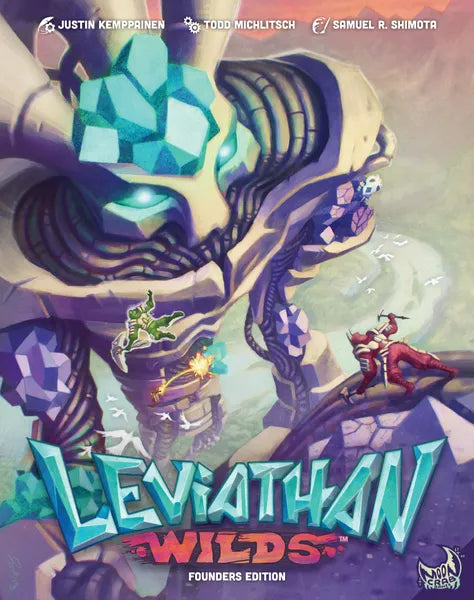
Mechanical Identity: Leviathan Wilds Review
It's not a dungeon you explore, it's a body you climb while screaming.Imagine opening a spiral-bound book. Not to read a story, but to walk through it. The pages aren't paper; they're skin, rock, and muscles contracted by pain. Leviathan Wilds , published by Moon Crab Games and designed by Justin Kemppainen, presents itself as an anomaly in the landscape of modern board games. Technically, it can be classified as a cooperative game for 1-4 players, but calling it a simple Boss Battler would be an engineering misjudgment.
This title's target isn't the world-destroyer accustomed to rolling dice to inflict massive damage. It's aimed at the tactical analyst, someone who sees Hand Management not just as a logical puzzle, but as a simulation of physical survival. Here, gravity is a rule written into the game's code, and the map is a vertical, breathing enemy.
The Architecture of Conflict: Hand Management and Movement Analysis
Forget about spread-out game boards. The beating heart of Leviathan Wilds is the scenario book. Each double-page spread represents the body of an infected Leviathan. The core mechanic that governs the experience is a refined hybrid of Grid Movement and brutal Hand Management .
Players don't have traditional hit points. They have "Grip." The cards in your hand represent your kinetic energy and muscle power. Want to climb three spaces toward that pulsating corruption crystal on the beast's shoulder? You have to spend cards. Want to land a blow to purify it? More cards.
The technical genius lies in converting the abstract resource (the card) into a physical sensation (fatigue). When your deck dwindles, you don't just feel the lack of tactical options: you feel your fingers slipping. It's a modular deck-building system where pre-game deckbuilding determines your nimbleness or endurance, but it's your turn-by-turn execution that decides whether you stick to the wall or fall.
The Relentless Engine: How the Gears of Leviathan Wilds Turn
The Leviathan doesn't wait. The game's AI system is driven by a specific event deck for each creature. We're not talking about generic attacks. If you're climbing a rock Leviathan, you might encounter rockfalls or seismic tremors. If the creature is aquatic, pressure and currents will become variables to calculate.
The game engine uses a disguised Action Point system. Cards offer a numerical value that translates into movement or ability activation. However, the real friction comes from the interaction between the corruption crystals and the creature's "Rage" level. The longer you spend purifying the crystals, the more unstable the Leviathan becomes. It's a race against entropy: you must remove the infection before it removes you from the playing field.
Anatomy of a Fatal Mistake: The Move That Dooms You
Believing that the deck is infinite is the mistake that turns a climber into a stain on the ground.Picture the scene: you're two spaces away from the last crystal. Your hand has three cards. You could use two to dash up and one to strike. It seems like the perfect heroic move. But you've ignored the "Grip" mechanic.
If your draw deck is empty and you need to draw (or take damage that forces you to discard), you lose your grip. In game terms, your marker plummets, resetting minutes of painstaking tactical planning. The fatal mistake in Leviathan Wilds is almost never a miscalculated damage, but a misjudgment of your stamina. You've spent all your energy (cards) to reach the top, but you've kept none to hold on when the beast shakes.
A Turn in the Mud: Impossible Choices and Consequences
We're on turn three against a gravity-manipulating Leviathan. The player to my right, who controls a character specialized in aerial mobility, is stuck in a "difficult terrain" zone. His best cards have been discarded to absorb a previous hit. Now it's my turn.
I can use my unique Player Variable Powers ability to throw him a rope and stabilize him, but that would cost me the card I need to achieve my goal. If I don't help him, on Leviathan's next turn, the "Violent Shake" event will knock him to the ground, costing us precious time. If I help him, I'm left exposed. The silence at the table is heavy. I can hear the mental noise of gears turning. I choose to help him. I burn my best card. He remains hanging. I'm vulnerable. It's a "muddy" turn—dirty, inefficient, but absolutely vital to the group's survival.
The System Anomaly: The Rule That Breaks the Pattern
Here lies the beating heart of Kemppainen's design. In almost all themed games of this type, the goal is to suppress the threat. In Leviathan Wilds , the goal is healing. You're not inflicting wounds; you're extracting splinters. You're applying balm to a gaping wound the size of a building.
This narrative inversion has a devastating mechanical impact: there's no sadistic satisfaction from a "critical hit." Instead, there's the tension of emergency surgery under extreme conditions. Victory isn't seeing your enemy fall dead, but watching them calm down. It's a paradigm shift that influences every decision: you act not out of hatred, but out of empathy, even if that "empathy" is trying to crush you against a rock face.
Psychology at the Table: What Happens Between Players
Cooperative play in Leviathan Wilds almost completely eliminates the problem of "Alpha Leader" (that one player telling everyone what to do), thanks to the chaotic and reactive nature of the system. Information is open, but there are too many variables for a single mind to calculate them all.
A "climbing safety" dynamic is created. Phrases like "I'll hold you," "Go, I'll cover you if you fall," or "I don't have enough grip to hold you" become common parlance. The ability to play cards during someone else's turn to offer support creates a continuous flow of interaction. You don't passively wait your turn; you're always hanging on the same metaphorical rope.
The Player's Metamorphosis: From First Game to Advanced Strategy
On your first game, you'll be awkwardly maneuvering. You'll try to climb in a straight line, ignoring the Mushroom Pads that allow you to retrieve cards. You'll run out of grips halfway up and fall, frustrated.
From the fourth game onward, the metamorphosis occurs. You begin to see the board as a musical stave. You combine the character class (the skill deck) with the character itself (the passive ability) in synergistic ways. Learn to exploit gravity and the Leviathan's involuntary movements to transport you wherever you want to go, saving cards. You become beneficial parasites, dancing on the monster's skin instead of fighting it.
The Verdict: Pros, Cons, and Final Thoughts
A masterpiece of vertical design that transforms paper into gravity.Leviathan Wilds isn't a perfect game, but it is a brave one. It's a system that dares to ask players to save what they fear.
PRO
- Total Thematic Integration: The deck's mechanics as physical resistance are ingenious and intuitive.
- Cinematic Flow: Turns are quick and out-of-turn reactions keep the tension high.
- Quick Setup: Spiral-bound book eliminates hours of board preparation.
- Scalability: It also works beautifully in solo play, keeping the logical challenge intact.
AGAINST
- Initial Learning Curve: The first scenarios may seem too easy, misleading about the real future difficulty.
- Abstractness of Components: Some players may wish for more detailed miniatures instead of standees, even if the functionality is impeccable.
The Final Footprint: Why Leviathan Wilds Remains in Your Heart
When you close the spiral book after saving the twentieth Leviathan, you don't feel like a conqueror. You feel like a survivor. Leviathan Wilds succeeds where many games fail: it creates an emotional connection through pure mechanics. You've shared the creature's pain, you've risked falling into the void alongside your companions, and you've transformed the mathematics of a grid into a story of redemption.
It's Shadow of the Colossus on your tabletop, but with an ending where no one has to die to win. And in a world of games based on destruction, this is the quietest and most powerful revolution of all.
Ready to scale the impossible? The Leviathan awaits.
Find out more on Frogames.it

 https://frogames.it
Condividi:
Corps of Discovery: Duo – When the Map is the Enemy
Eternal Decks: Technical Analysis of a Game Evolution