
Oranges & Lemons
🐸 Details from BoardGameGeek
Consiglio BGG sul numero di giocatori
Categorie
Meccaniche
Design & Art
Lingua

Si abbina bene con
FroGames — Moments You'll Remember
You start with a wheelbarrow. You end with a ship. In between: an evening of risky loans, well-timed pancake sales, and a race against those who figured out where the money was flowing before you did.
WHAT IT IS ABOUT
An economic eurogame set in 18th century London
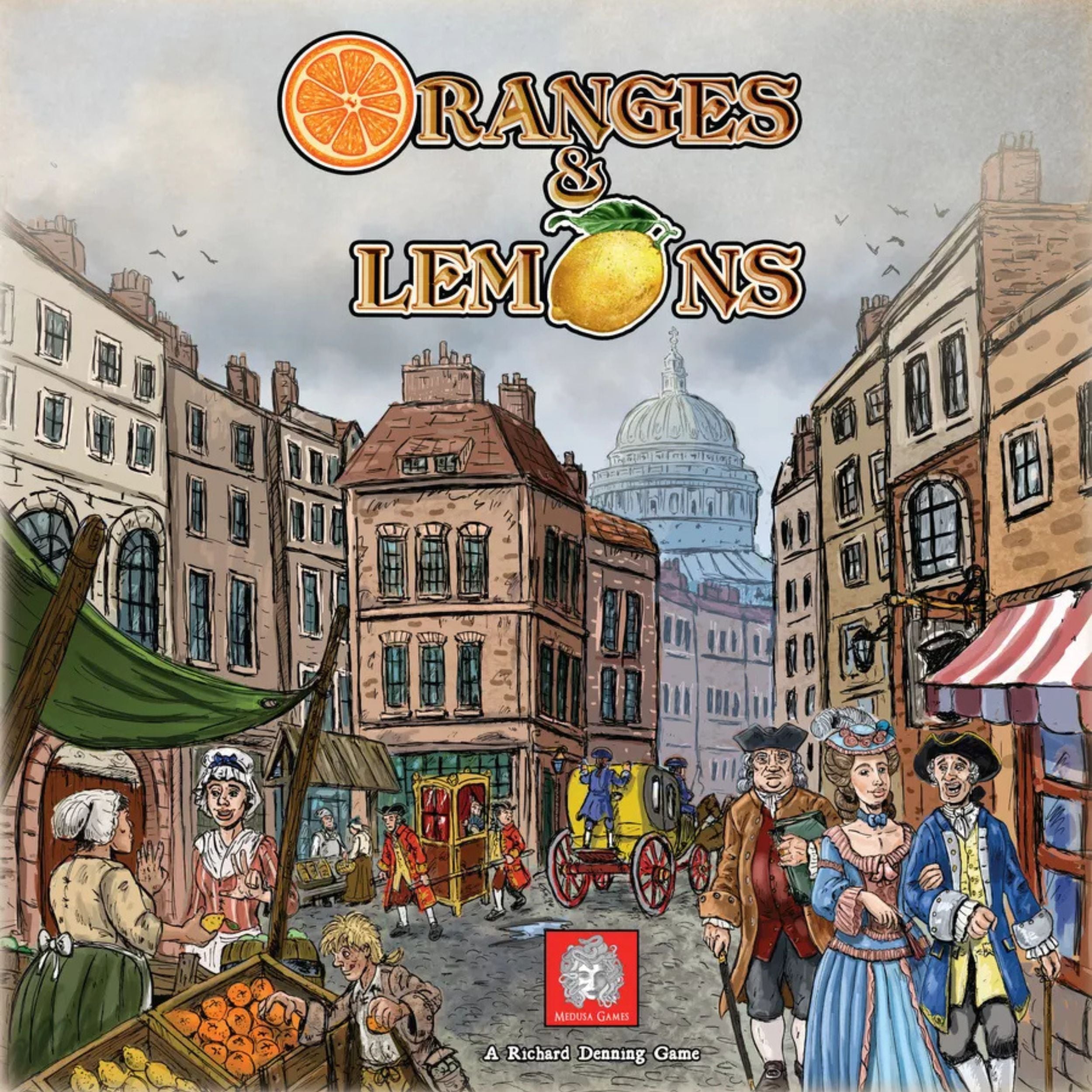
Richard Denning (The Great Fire of London) builds a worker placement game around the English nursery rhyme Oranges and Lemons, which names London's churches and their bells. It's the early 18th century: Indian trade, early stock markets, colonial expansion. Andree Schneider dresses it all with clean, cartographic illustrations that keep the game readable even when the board is full.
You start with two workers and a ridiculous carrying capacity. You have to buy goods (lemons, bricks, pancakes, pots), transport them where they're needed, sell, and reinvest. The game offers multiple paths: you can be a moneylender, speculate on the stock market, export from the docks, enter politics, or finance risky expeditions to the East. Every choice has a heavy opportunity cost, and whoever combines strategies best wins.
What they say abroad
It's not a game that holds your hand. You need to quickly understand where the money is flowing.
— FroGames
The theme is more closely tied to the mechanics than it seems: every location from the nursery rhyme makes sense within the game's economic system.
— FroGames

Oranges & Lemons
FrogScore · FroGames editorial rating · based on rules, international reviews, and play sessionsWhat you put into play
Your tools to get rich
Workers
You start with two. You add a maximum of three. Each turn you place them in the nursery rhyme locations: buying, selling, politics, stock market, expeditions.
Means of transport
Hand wheelbarrow (capacity 1), then cart (capacity 3), finally ship (capacity 5). Without upgrades, you can't transport enough goods to compete.
Goods
Lemons, pancakes, bricks, pots. Each good has fluctuating prices. Buy low, transport, sell high. Or use goods to complete export contracts.
Loans and shares
You can go into debt to accelerate. Or invest in the stock market: buy shares, wait for them to rise (or fall), and cash in. High risk, high reward.
In the end, you count the money. But during the game, you count your moves, transports, contracts, and how many times you cursed whoever stole the action space you needed. That's how commerce works.
Come si gioca
Video dimostrativo di gameplay.
A game in five acts
What happens at the table
Not the rules. The experience.
Initial Investments
You place your two workers on the first locations. Someone buys goods, someone immediately takes out a loan to speed things up. Some aim straight for the horse-drawn cart, others accumulate money. No one knows yet which strategy will pay off.
First Bottlenecks
You realize that transporting one good at a time is economic suicide. Those who already have the cart start moving fast. You have to decide: do I chase after transport or focus on the stock market and loans? The table splits into different strategies.
Saturated Market
Everyone wants the same goods, the same contracts. Action spaces get blocked. Those who planned their turn order win key spaces, others fall back on B choices. Tension rises: every action counts double.
The Final Acceleration
Someone buys the ship. Suddenly they can complete huge contracts and score massive points. Others desperately accelerate: some invest everything in the stock market, some enter politics for final bonuses. Every choice is a mortgage on the outcome.
Point Count
You tally money, completed contracts, political bonuses, stocks, funded expeditions. Those who diversified well often surprise. Those who put all their eggs in one basket either win big or crash. The winner is the one who wasted the fewest turns.
How to play
The flow of each round
Classic worker placement turns: place, resolve, repeat. Variable order each round based on roles.
Players secretly choose a role (each with unique play order and power). They reveal, then order the sequence.
In turn, you place a worker on an available location. Some locations get blocked, others accept multiple workers but at an increasing cost.
You buy goods, transport them, sell them, complete contracts, take out loans, invest in the stock market, fund expeditions to the Indies, or engage in politics. Every action has immediate consequences on money and position.
You retrieve workers, some prices fluctuate, new contracts appear. A new round begins until someone achieves the title of Master of Commerce or the allotted rounds run out.
Why it's different from others
Six mechanics that make a difference
Asymmetrical transport progression
Not everyone buys in the same order. Those who immediately focus on the ship can dominate exports, but they invest capital that isn't circulating elsewhere. Those who stick with the cart save money for the stock market and loans. The choice changes the game.
Functional stock market
It's not decorative. Buying and selling stocks can turn the game around. Prices rise and fall based on player investments. Those who time it well score massive points, those who enter late lose everything.
Loans without automatic penalty
You can get heavily into debt. You don't lose points at the end of the game if you pay it back. Loans are a legitimate strategy, not a desperate choice. Those who use it well accelerate, those who waste it drown.
Variable export contracts
Different contracts come out each game. Some require specific goods, others combinations. You adapt your strategy to the available contracts, you don't always play the same way. High replayability.
Politics as an optional engine
Investing in politics gives you final bonuses and in-game advantages. It's not mandatory, but those who ignore it miss a path to victory. Politics is a multiplier, not a thematic filler.
Nursery rhyme integrated into mechanics
Every location on the board corresponds to a verse of the nursery rhyme. It's not cosmetic: each church/location has a precise economic function in the system. The theme holds up, it's not glued on.
How it ends
How to win and how to lose
You accumulate prestige (hidden victory points) through money, contracts, stocks, expeditions, and politics. Whoever has the most wins.
Victory
- You diversified: money, completed contracts, stocks sold at the right time, some funded expeditions
- You optimized transport: every movement of goods generated value, no empty trips
- You read the market: bought low, sold high, exploited the best contracts before others
Defeat
- You invested everything in one strategy (only stock market, only export, only politics) and someone blocked your spaces
- You bought the ship too late: very high cost, few turns to amortize it
- You ignored loans or got into debt without a repayment plan: money burned in interest
Oranges & Lemons is an eurogame for those who want to optimize economic paths, not for those looking for narrative plot twists. It works.
Frequently Asked Questions
FAQ about Oranges & Lemons
How heavy is it compared to Agricola or Caverna?
Lighter. The structure is classic worker placement, actions are clear. The complexity lies in economic timing: when to buy the ship, when to invest in the stock market, when to take out loans. If you're familiar with medium-light eurogames, you'll learn it in one game.
Does it work well with two players or do you need a full table?
With two players, it's tactical but less competitive: there are more free spaces, fewer blocks. The game shines with 3-4 players, where competition for locations and goods becomes fierce. With five, it slows down a bit, but remains solid.
Is the nursery rhyme theme just cosmetic?
No. Every location named in the nursery rhyme has an economic function in the game (St. Martin's for loans, Shoreditch for bells/politics, etc.). The theme is integrated, not glued on. If you know the nursery rhyme, you'll enjoy it more, but it's not mandatory.
Is there a dominant strategy or can you win in multiple ways?
You can win in multiple ways. Massive export with the ship, stock market speculation, aggressive usury, politics + mixed contracts. Those who diversify usually win, but we've also seen victories with extreme focus on one path. It depends on how others play.
Is it available in Italian?
No, this edition is in English. Rulebook, contract cards, location names, and nursery rhyme references are in English. The text on the cards is present but limited: with a translation of the rulebook, you can play without major problems.
Oranges & Lemons is an economic worker placement game for 2-5 players, lasting 90-120 minutes, recommended for ages 12+, designed by Richard Denning and published by Medusa Games. Set in 18th century London, the game integrates mechanics of resource management, dynamic market, pick-up and deliver, contracts, loans, and a stock exchange. Players start with two workers and minimal transport capacity, progressively expanding from wheelbarrow to ship. The theme is linked to the English nursery rhyme Oranges and Lemons: each location on the board corresponds to a church or place named in the rhyme. The game offers multiple paths to victory (export, speculation, politics, expeditions to the Indies) and focuses on optimization and timing. Available on FroGames.it.
Oranges & Lemons
Frequently Asked Questions
The answers you're looking for, no beating around the bush.
📸Do the images match the actual product?
The photos on the website often come from BoardGameGeek and are intended to give you an idea of the game. They may vary slightly from the version you receive. The content declared by the publisher is always binding.
📦Does the content of the box match what is indicated?
We always strive to provide the correct content, but minor variations are possible due to reprints or updates. The information comes directly from the publishers. If you have any questions, please contact us!
⏳How do pre-orders work?
Pre-order the game before release, payment is immediate, and the game is reserved for you. As soon as it arrives, we'll ship it right away! If there are any delays, we'll update you promptly.
🔒Can I trust buying here?
Absolutely! Secure payments, tracked shipments, and a team that loves board games as much as you do. If something goes wrong, we'll do our best to fix it.
🛠There's a problem with my order, what should I do?
Write to us now! Whether it's a missing part, damage, or an error, we'll help you resolve it as soon as possible. Your experience truly matters to us.