
Dice Miner
🐸 Details from BoardGameGeek
Consiglio BGG sul numero di giocatori
Categorie
Meccaniche
Design & Art
Lingua
Si abbina bene con
The FroGames Review
You roll the dice on the mountain. You pick the blue one, then the red one nearby. Now you have two gems and a pickaxe: you can draw again. You do. A skull appears. You've lost everything. At the end of the round, you're still in second place.
WHAT IS IT
Dwarves returning to the mines, dragons returning to burn it all down
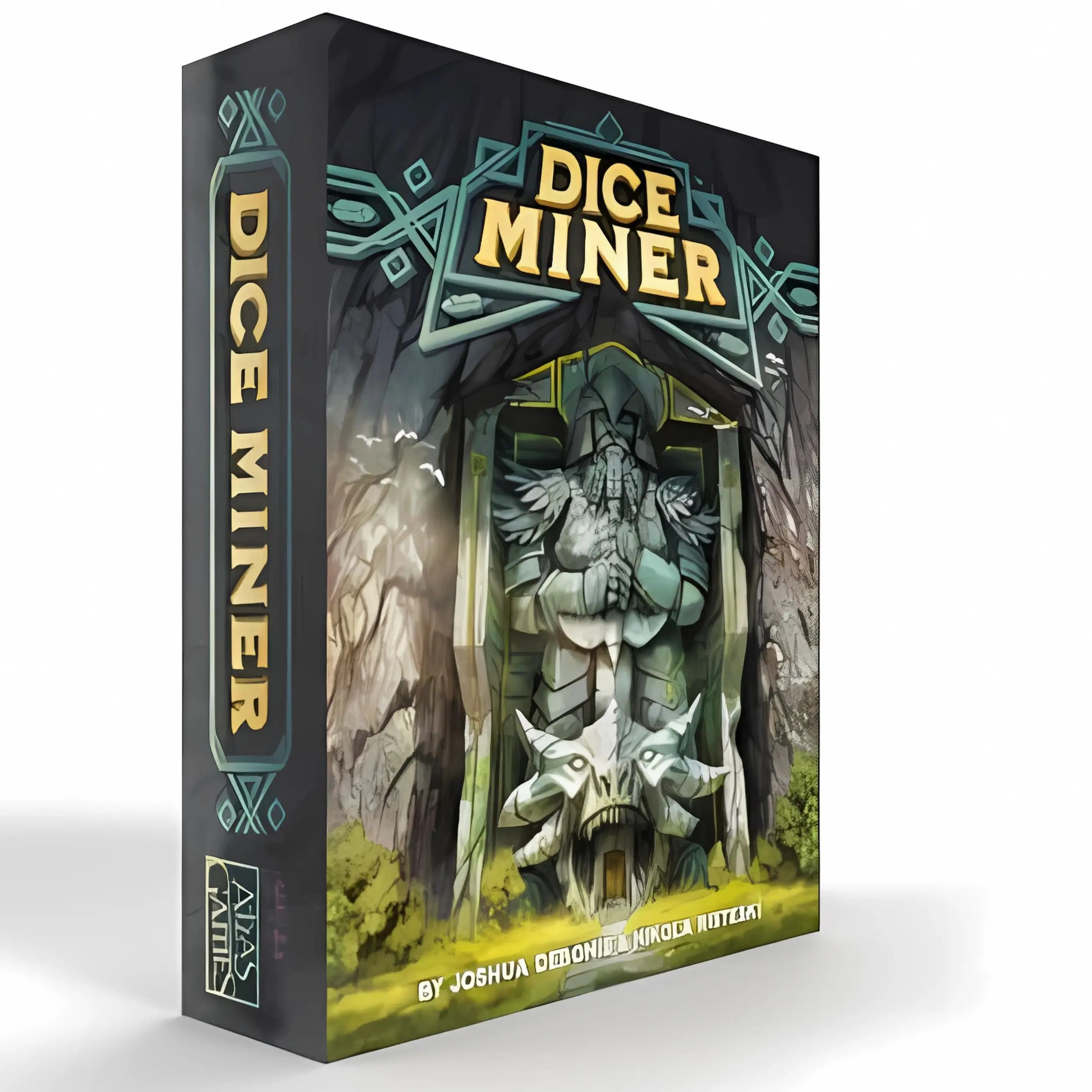
Dice Miner is a game by Joshua DeBonis and Nikola Risteski, published by Atlas Games in 2021. The theme is classic fantasy: dwarves lived under three mountains, defeated the dragons, and went to the surface. Now the dragons are back, and the dwarves must reclaim the old tunnels. The setting is a pretext to roll dice on a cardboard mountain and choose them in turns.
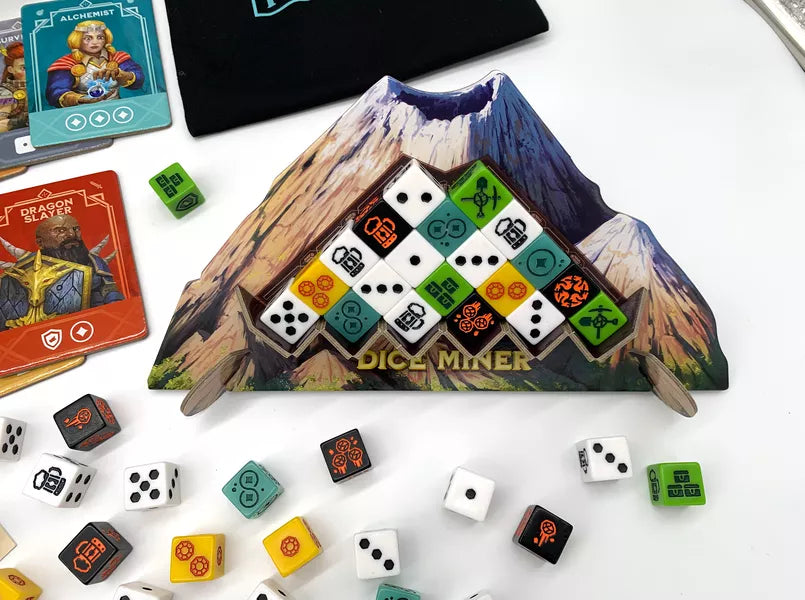
Every round, you roll custom dice on the three-dimensional mountain. In turn, you draft one, add it to your treasure, and try to build combos between symbols. Gems, pickaxes, beers, dragons, skulls: every face is worth points or unlocks other choices. After three rounds, whoever has the most points wins. The rules can be explained in 10 minutes, and your first game starts right away.
What the international press says
"A delightful little filler with just enough crunch to keep you coming back."
A delightful filler with just enough crunch to keep you coming back.
— Meeple Mountain
Rolling dice on the mountain is satisfying even when you leave empty-handed. Building the right combo — gems that unlock pickaxes that unlock beers — is the moment you realize you played your previous two rounds poorly.
— FroGames

Dice Miner
The solo mode uses a deck of cards that simulates an opponent: it drafts dice according to fixed rules and takes choices away from you. The experience is complete, all the combos work, but you lose the tactical reading of the table (understanding what others need). Excellent for learning or filling 20 minutes.
FrogScore · FroGames editorial rating · based on the rulebook, international reviews, and gameplay sessionsWhat's in the box
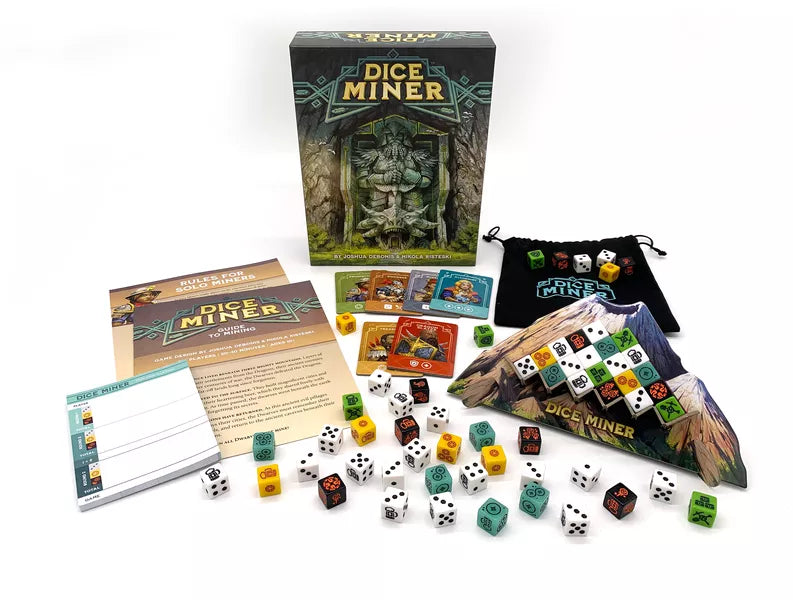
Simple components, immediate impact
3D Mountain
A three-tier cardboard stand onto which you roll the dice. It's not just scenery: dice on the higher tiers are worth more, while those on the bottom are more accessible. The mountain changes the draft.
Custom dice
15 dice with different faces: gems (fixed points), pickaxes (draw again), beers (end-game points), dragons (multipliers), skulls (lose everything in the turn). Each color has a different distribution.
Hero Cards
Each player chooses a dwarf with an asymmetric power. Some count red gems double, some ignore skulls, some draw two dice at a time. The powers change the strategy.
Scorepad
A disposable sheet to note down points at the end of the round. No individual boards, no miniatures: Dice Miner is all about choosing your dice and the risks you take.
Come si gioca
Video dimostrativo di gameplay.
🎲How to playThe rules in four moves▼
How to play
The flow of each round
Three identical rounds. Each round: roll, take turns drafting until the mountain is empty, count points.
The first player rolls all the dice onto the three-dimensional mountain. The dice are distributed across the three levels. Those at the top are worth more points, those at the bottom are easier to pick (adjacency rules).
In turns, each player chooses an available die (following the position rules) and adds it to their hoard. Some dice (pickaxes, dragons) allow you to immediately pick more dice. If you pick a skull, you lose all the dice you took in that turn.
After each die you pick, you can stop (keep everything) or continue (if you have pickaxes or powers that allow it). The risk is picking a skull and losing your entire turn. The more you pick, the higher the risk, the higher the potential points.
When the mountain is empty, everyone counts their dice. Gems give fixed points (higher if they were on the top levels), beers are only worth points if you have at least three, dragons multiply the gems of their color. You record the score, re-roll the dice, and start the next round.
⏱️Your first gameThe story, moment by moment▼
A game in five moments
What happens at the table
Not the rules. The experience.
The roll on the mountain
Someone rolls 15 dice onto the cardboard mountain. They roll, stop on the three levels, some fall off. Everyone looks at the distribution: how many gems, how many pickaxes, where the skulls are. No one knows what to pick yet, but everyone knows that purple gem on top is worth double.
The first conservative drafts
First turns, safe choices: gems that give fixed points, a few pickaxes to keep drafting. No one exposes themselves. The table is calm. Then someone takes a red die from the top level, triggers a combo, and scores 8 points in one turn. The mood changes.
The push your luck you didn't want to take
You have two gems and a pickaxe. The pickaxe allows you to draft again. On the mountain there are three blue dice (which you need) and two skulls (which would wipe out your turn). You do the math: 3 out of 5, 60%. You pick. A skull comes out. You lose everything, you skip your turn in silence, the others giggle.
End of round, counting points
The mountain is empty, everyone counts their dice. Beers are only worth points if you have at least three. Dragons multiply gems of their color. Someone built a perfect combo and scores 25 points. Someone else has 9. Scores are recorded, you move to round two with different awareness.
Third round, everything counts
Last roll, last drafts. Now everyone knows which combos to look for and how much the others are risking. Every die counts triple because there are no more rounds to catch up. Someone finishes with a 30-point combo, someone else plays it safe and stops at 18. The three rounds are added up. Whoever scored the most wins. Someone immediately asks to play again.
🐸Know before you goThree honest things, from friends▼
Know before you go
Three things a friend would tell you
Luck is heavy
The dice decide what is on the mountain. You could play perfectly and end up with a distribution that doesn't allow any combos. Or you could pick a skull at the wrong time and lose an entire turn. If you are looking for total control, this is not the right game for you.
Powers are not perfectly balanced
Each hero has an asymmetric power, but some are objectively stronger in certain configurations. First-time players don't know what combos to look for and start at a disadvantage. After two games the gap closes, but the first one is almost always a lesson.
Downtime increases with 4 players
With 4 people at the table, you wait three turns between your choices. The mountain changes, opportunities disappear. In 2-3 players the pace is perfect; in 4, it works but loses some of its bite. Solo mode, on the contrary, is very fast.
🏆Winning and losingWhat counts at the end▼
How it ends
How to win
After three rounds, scores are added up. Whoever scored the most wins.
Winning conditions
- Build combos between gems, dragons, and beers to maximize points
- Use your hero's asymmetric power to specialize in one type of die
- Manage risk: keep picking when you have pickaxes, but stop before hitting a skull
How to lose
- Pick skulls and lose entire turns without accumulating dice
- Fail to build combos (e.g., beers without having at least three, dragons without gems of their color)
- Leave key dice for your opponents that complete their strategies
Dice Miner is a perfect gateway game: immediate rules, fast games, enough strategy to keep it interesting, enough luck to level the playing field. It also works great solo.
💬Frequently asked questionsQuick answers before checkout▼
Frequently asked questions
Dice Miner FAQs
What mechanics does Dice Miner use?
Open drafting (choose dice from a common pool), push your luck (decide whether to pick more or stop), combo building (symbols that boost each other), and asymmetric powers. The complexity is low (1.6 on BGG), and the rules can be learned in 10 minutes.
Does it work well solo?
Yes. The solo mode uses a deck of cards that simulates an opponent: it picks dice according to fixed rules and takes choices off the board. The experience is complete, games last 15-20 minutes, and it is one of the best fast solo games on the market. You don't get the tactical interaction of multiplayer (reading what others need), but all the combos work.
How much does luck count?
A lot. The dice decide what is on the mountain each round, and picking a skull at the wrong time wipes out your turn. However, it is not a game of pure luck: you choose which dice to take, manage risks, and build combos. Over three rounds, those who play better win more often, but a single game can turn on an unlucky roll.
Is it suitable for children?
The recommended age is 10+, and that is accurate. The rules are simple, but you need the ability to evaluate probabilities (how many skulls are left? Is it worth the risk?) and plan combos mid-term. It is an excellent game for families with middle or high schoolers. With younger children, the game works, but they won't grasp the tactical depth.
Is the edition on sale in Italian?
No, this edition is in English. The game is almost entirely icon-based: the dice have symbols (gems, pickaxes, beers, skulls, dragons), the hero cards have text in English but the powers are intuitive. The rulebook is in English. If you know basic English or can find a fan-made translation of the rules online, the game is fully accessible.
The people behind the game
Who invented it, who illustrated it, who publishes it — and what else they have done.
Dice Miner is a dice-drafting board game designed by Joshua DeBonis and Nikola Risteski, published by Atlas Games in 2021. For 1-4 players, ages 10+, duration 20-30 minutes. Mechanics: open drafting, push your luck, combo building, asymmetric powers. Fantasy theme: dwarves returning to the mines to fight dragons. Each round you roll custom dice onto a three-dimensional mountain, choose which to take, and build combos between gems, pickaxes, beers, and dragons. Includes official solo mode. Immediate rules, fast games, excellent as a gateway game or strategic filler. Available on FroGames.it.
Dice Miner
Frequently Asked Questions
The answers you're looking for, no beating around the bush.
📸Do the images match the actual product?
The photos on the website often come from BoardGameGeek and are intended to give you an idea of the game. They may vary slightly from the version you receive. The content declared by the publisher is always binding.
📦Does the content of the box match what is indicated?
We always strive to provide the correct content, but minor variations are possible due to reprints or updates. The information comes directly from the publishers. If you have any questions, please contact us!
⏳How do pre-orders work?
Pre-order the game before release, payment is immediate, and the game is reserved for you. As soon as it arrives, we'll ship it right away! If there are any delays, we'll update you promptly.
🔒Can I trust buying here?
Absolutely! Secure payments, tracked shipments, and a team that loves board games as much as you do. If something goes wrong, we'll do our best to fix it.
🛠There's a problem with my order, what should I do?
Write to us now! Whether it's a missing part, damage, or an error, we'll help you resolve it as soon as possible. Your experience truly matters to us.