
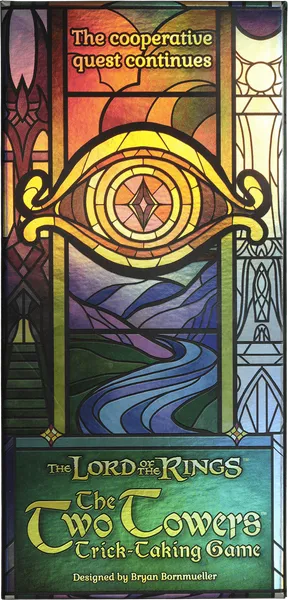
The soul of The Lord of the Rings: The Two Towers – Trick-Taking Game: Beyond the Box
There's a precise moment in the second volume of Tolkien's work when hope seems to thin like butter spread on too much bread. The Fellowship is divided, the shadow of Isengard looms over Rohan, and two little Hobbits trudge toward Mordor. This is the atmosphere that The Lord of the Rings: The Two Towers – Trick-Taking Game surprisingly manages to capture with a deck of cards. We're not talking about a simple reskin of a traditional trick-taking game; here, every card played is a laborious step toward salvation or a fatal mistake that brings the Eye of Sauron closer. Forget the competitive frenzy: here, sitting at the table means sharing the burden. The soul of the game lies in the silent tension between players, forced to coordinate in a mechanical ballet where the error of one individual dooms the group.
/pic9274194.jpg)
Asmodee's Signature
When we see the Asmodee logo (often in tandem with specialized design studios like Office Dog for this line), we know we're dealing with a product that leaves nothing to chance in terms of ergonomics and readability. In a trick-taking game , where immediate recognition of suits and values is vital, graphic clarity is everything. The publisher has chosen to honor the license not with opulent miniatures, but with a functional design that supports the gameplay. The key here is balance: a rulebook that eliminates the ambiguities typical of complex card games and materials that withstand the wear and tear of frequent shuffling. It's the touch of those who understand that a small game in the box must be a giant experience at the table.
The Beating Heart: Mechanics and Strategy
Let's get to the heart of the matter, the engine room of this title. If you think you know trick-taking (tricks like "Busche" or "Briscola"), prepare to reset your parameters. This is a pure cooperative game . The core mechanics revolve around managing your hand to meet specific scenario objectives, not to accumulate individual points.
The system stands out for its Communication Limits . As in other modern titles of this genre (think The Crew , but with a stronger emergent narrative), you can't tell your companions what you have in your hand. You have to deduce it. You have to intuit that if Aragorn has played that low card now, he's trying to signal a void in another suit or set the stage for a later trick.
Technically, the game introduces the concept of a Scenario/Mission/Campaign Game in a card-based format. You're not playing random hands: you're playing Helm's Deep or crossing the Dead Marshes. The mission cards dictate the rules of engagement: who must win the trick? Which cards must be "sacrificed" ( tucking or strategic discard) to advance? The tucking mechanic is particularly sophisticated: you'll often have to decide whether to use a powerful card to win the current hand or tuck it into the bottom of the mission deck to fulfill a long-term requirement. It's a constant risk management.
The Solo/Solitaire Game also deserves a technical mention. It's not a simple "beat your score" game, but a logic puzzle where you manage an automated companion (often simulating the actions of an ally or the unpredictability of Gollum) that requires even more careful planning.
/pic9274195.jpg)
Overview: The Creative Team
- Category: Cooperative Card Game / Trick-Taking
- Theme: High Fantasy, Tolkien Literature
- Mechanical Focus: Hand Management, Limited Communication, Scenarios
Spotlight: Let's see it in action
At the end of the game, when the last card is played, what remains isn't the mathematical calculation of points. What remains is the feeling of having narrowly escaped danger. The Lord of the Rings: The Two Towers – Trick-Taking Game reminds us that great stories are not made of omnipotence, but of small choices, silent sacrifices, and blind faith in those sitting next to us. It's an experience that unites the table, transforming each hand into a chapter in a story you've written together.



 https://frogames.it
Condividi:
The Sheep: When the Flock Becomes a Nightmare
Hercules and the 12 Labors: When Myth Becomes Pocket Strategy