


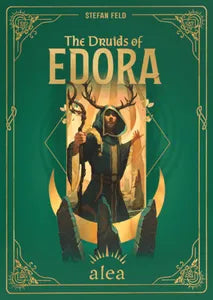
The Soul of The Druids of Edora: Beyond the Box
There's something hypnotic about watching a forest take shape on the table. The Druids of Edora doesn't simply ask you to play; it asks you to decipher an ecosystem. Imagine the fog rising between ancient dolmens and paths that change every time you sit down at the table. This isn't your typical Eurogame, where the theme is a vague pretext; here, the idea of being a druid manipulating the energies of nature melds surprisingly well with the need to manage scarce resources and capricious dice.
The atmosphere is that of an ancient ritual: silent, cerebral, yet deeply satisfying. It's the kind of game that captivates you not with explosions or giant miniatures, but with the perfect ticking of a clockwork mechanism that, turn after turn, reveals its complexity. If you love feeling your brain gently sizzle as you search for the perfect fit, you're right at home.
/pic9201654.jpg)
AleaRavensburger's Signature
When we see the Alea logo (Ravensburger's expert division) on the box, we already know what to expect: substance over form, solid mechanics, and that beige cardboard that's as reassuring to us gamers as a warm blanket. Alea isn't trying to sell you smoke; it's selling you a well-oiled engine.
In The Druids of Edora , this legacy is palpable. The production is geared towards readability, a crucial aspect when the board fills with tokens and meeples. Ravensburger confirms its philosophy here: the graphic design must serve the gameplay. You won't find unnecessary overproduction, but solid components designed to be manipulated hundreds of times. It's the German guarantee: a game you can play even ten years from now and it will still work perfectly.
The Beating Heart: Mechanics and Strategy
And here we are in the hunting ground of master Stefan Feld . If you know the author, you know that "victory points" and "painful choices" are his daily bread. But how does all this translate into Edora?
Dice Placement and Tactical Movement
The heart of the game is a dice placement system inextricably linked to movement. It's not enough to have the right die; you have to be in the right place to use it. Players move their druids between clearings (paying precious supplies for each step) and spend dice to activate shrine actions. This creates constant tension: moving far costs food, but standing still limits your options.
Modular Board and Replayability
The real gem is the Modular Board . With 17 tiles forming the forest, each game presents a different geography. The distances between sanctuaries vary, forcing you to adapt your network and route building strategy each time. You can't learn a "standard opening"; you have to read the terrain.
Point Salad and Set Collection
Yes, it's a Feld, so expect a glorious Point Salad . Everything you do, if done well, generates prestige. You have several paths to victory:
- Construction: Erect Menhirs and Steles for area control and majority.
- Set Collection: Collect medicinal herbs, mistletoe, and gems to craft potions and amulets.
- Tracks: Progress on the knowledge and sickle tracks for multipliers and bonuses.
Area Majority 's mechanics are subtle but vicious: placing your markers isn't just for immediate points, but also to block or make your opponents' actions more costly. And let's not forget the Dolmens at the edges of the map: connecting them requires long-term planning but pays off with massive points.
/pic9167572.jpg)
Overview: The Creative Team
Author: Stefan Feld (The Victory Point Master)
Publisher: Alea / Ravensburger
Players: 2-4 (The "sweet spot" is often 3 to balance control and chaos)
Duration: 60-90 minutes of intense brain-squeezing
Spotlight: Let's see it in action
At the end of the game, when the last stele has been erected and the dice are put away, The Druids of Edora leaves that feeling typical of great works of gaming engineering: the satisfaction of having built something that works. It's not just having scored more points than the others; it's having navigated the chaos of the forest, having optimized every single resource, and having transformed the uncertainty of the dice into a winning strategy. It's a game that rewards mental flexibility and reminds us that, even in a cardboard forest, every step counts.

Share:
Tenby Review: Strategy and Colors from Cosy Cub Games
Dewan: Review and Analysis of the New Game Space Cowboys