
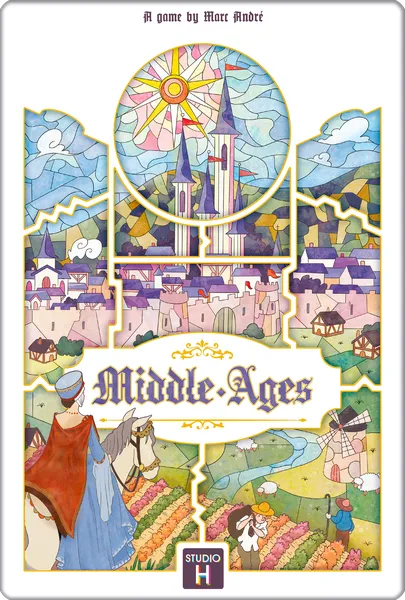
The Mechanical Identity: Review of Medioevo - The Last Lords of the Earth
In the deafening silence of modern hype, sometimes the only winning move is to rewrite your own history.Imagine a table where wood and cardboard weigh more than plastic. There are no miniatures screaming for attention, nor rulebooks as thick as encyclopedias. There is only the pure essence of European game design . Medioevo - The Last Lords of the Earth (internationally known as Middle Ages ) is a statistical anomaly: a successful self-reboot. Marc André, the architect behind the behemoth Splendor , has done what few dare: he took his 2017 Majesty , dismantled it piece by piece, and rebuilt it after seven years of analysis.
Published by Studio H, this game for 2-5 players fits into the critical market segment I'd call "Family Plus Aggressive." It's not a group solitaire game. It's a pocket civilization compressed into 30 minutes of tactical decisions, where the white and gold aesthetic—a risky and counter-market color choice in an era of dark fantasy—hides a ruthless mathematical engine. The feeling at the table is immediate: this isn't a reprint, it's the definitive version of an idea that needed time to mature.
/pic8792655.jpg)
The Architecture of Conflict: An Open Draft Analysis
The center console is not a market, it is a timeline where the future is paid for with the present.The beating heart of Medioevo - The Last Lords of the Earth lies in its Open Drafting and Tile Placement mechanics. Unlike traditional static markets, here the position of the tile determines the next turn order. Taking the most coveted tile, the one that completes your strategy, will often force you to play last in the following round. This dynamic compensation system eliminates dead time: while one player calculates, the others are already planning their countermoves based on what remains available.
The technical innovation lies not so much in the mechanics themselves, but in the ergonomics of the selection. The shaped tiles—a production nightmare that increases cutting costs and waste—aren't an aesthetic quirk. Their irregular shape guides the eye and creates a satisfying physical fit on the personal board, making the game (for you and your opponents) crystal clear. Each tile removed isn't just a resource gained, but an explicit negation for the opponent to your left.
The Relentless Engine: How the Gears of the Middle Ages Turn
Under the hood, the game runs on an exponential pattern building algorithm. Every time you place a tile in your fiefdom, you activate all the tiles of the same type already there. If you place your third miller, you produce resources not for one, but for three. This creates a vertical growth curve that players must ride. The system rewards specialization, but drafting forces you to diversify.
The interaction between the rows (the different types of buildings) is subtle but crucial. Building walls doesn't immediately give you points, but it does protect your villages from outside attacks. Yes, because unlike Splendor , here the engine can stall due to the actions of others. You're not just building your score; you're trying to do it faster than others can sabotage it.
Anatomy of a Fatal Mistake: The Move That Dooms You
Greed is a slow poison that manifests itself when you no longer have the coins for the antidote.The most common mistake observed when analyzing early games is underestimating liquidity. In Medieval Times: The Last Lords of the Earth , coins are both victory points and currency. Spending everything on a powerful tile on the first turn can leave you "naked" in subsequent turns, forced to take other players' discards because you can't afford to skip positions on the draft track.
This is where the game's engineering really comes into its own. A single reckless move on turn three can create a domino effect (the Butterfly Effect) that prevents you from defending against a turn six attack, costing you not only resources but the momentum you need for the endgame. Cash flow management must be surgical.
A Turn in the Mud: Impossible Choices and Consequences
Let's imagine turn 4. You need a Barracks tile (Red) to activate your knights and attack the leader, who is accumulating too many points with the (Green) fields. The Barracks is available, but it's far away on the track. To reach it, you must spend 3 coins. Look at your supply: you have a square and a triangular token. That's not enough. Or it's enough, but it will leave you with zero.
Feel the tension? A player at the table mutters, "If you take that, you'll open the way to the Palace." It's true. Every denial you make opens up an opportunity for a third player. In this tactical muddle, you must decide whether to play to win or play to prevent your opponent from winning. And with coins of different physical shapes, the payment has a real psychological weight: you're literally giving away pieces of your treasure.
/pic8792656.jpg)
The System Anomaly: The Rule That Breaks the Pattern
Marc André inserted a dagger into a velvet game.We're used to "Euro" games where everyone cultivates their own little garden. Not here. The anomaly is the explicit Destructive Interaction . It's a clear deviation from the author's portfolio. In Splendor , at most you stole a card someone wanted. In Medioevo , your soldiers physically attack your opponents, forcing them to lose troops or resources if they're undefended.
This rule breaks the mold of "multi-solitaire." It forces players to constantly look at each other's boards. You can't ignore your neighbor who's accumulating swords, or you'll be taxed every turn. This constant threat turns a mathematical puzzle into a cold war of stares and deterrence.
Psychology at the Table: What Happens Between Players
Nonverbal language dominates the game. When a player moves their hand toward a "Castle" tile, the others hold their breath. A group dynamic is created where the table temporarily rallies against the player with the advantage, only to betray themselves an instant later. "Don't take that, I need it to stop Marco!" is a recurring phrase.
The clean, innocent white and gold graphics create a cognitive contrast to the brutal mechanics. Players sit down expecting a relaxing experience and find themselves caught up in a struggle for economic survival. It's reverse psychology applied to game design.
The Player's Metamorphosis: From First Game to Advanced Strategy
In the first game, the average player focuses on the Set Collection : trying to have a little bit of everything to get the diversification bonuses. It's a valid but basic strategy. The metamorphosis occurs around the third game.
The experienced player stops looking at his own board. He begins to calculate the "opportunity cost" of his opponents. He understands that placing a tile he doesn't need, only to take it from someone who has three copies, is mathematically worth more than his own immediate gain. The game transforms from management to tactical-aggressive. The realization that the rules (surprisingly short for a game with eight types of tiles) hide a chess-like depth is the moment when you fall in love with the system.
The Verdict: Pros, Cons, and Final Thoughts
As a technical analyst, I have to weigh the elegance of the design against the reality of the market. Here's the balance:
-
PROS:
- Closed and Refined Design: A rare case of a game that comes complete, with no need for patches or expansions.
- Tactile Production: Die-cut cards and differentiated coins offer a premium plastic-free experience.
- Total Linguistic Independence: Perfect iconography that breaks down every barrier.
- Depth in 30 Minutes: Very high decision density for the duration.
-
AGAINST:
- Generic Title: "Middle Ages" or "Middle Ages" are weak keywords that don't do justice to the game's uniqueness.
- White Box: Beautiful, but gets dirty and damaged much more easily on the shelf or during transport.
- Unexpected Nastiness: Direct interaction may annoy players seeking a zen experience.
The Final Imprint: Why the Middle Ages Remain in the Heart
Medioevo - The Last Lords of the Earth is destined to remain on the shelves when dozens of plastic-filled Kickstarters have ended up in flea markets. The choice of the "Splendor" box is no coincidence: Studio H is making a statement that this is the new standard for mid-range games. It's an exercise in style that demonstrates how pure gameplay, supported by intelligent production (stamped gold, cut-to-size cardboard), can still triumph over excess.
If you're looking for a game that respects your time and intelligence, offering an aesthetically satisfying and strategically brutal experience, this is the 2024 title to beat.
Are you ready to reclaim your fiefdom with elegance and ruthlessness?
Find out more on Frogames.it

 https://frogames.it
Condividi:
Feya's Swamp: Technical Analysis of a Ruthless Gaming Ecosystem
Arkham Horror LCG Core Set 2.0: Technical Analysis of a Necessary Evolution