
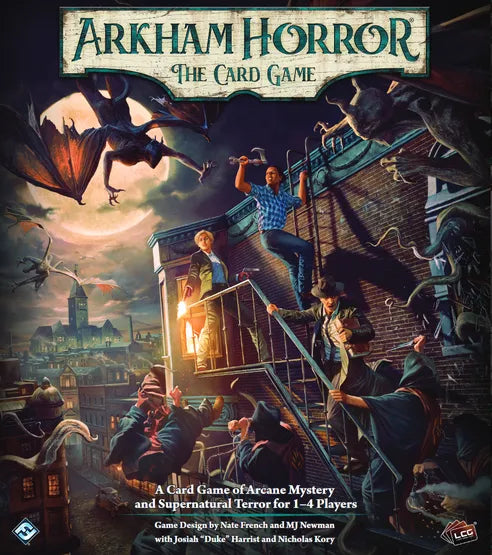
The Mechanical Identity: Arkham Horror LCG Core Set 2.0 Review
Under the incessant rain of Arkham, the silence at the table isn't concentration, it's pure mathematical terror. Arkham Horror: The Card Game LCG Core Set 2.0 , localized in Italy by Asmodee, represents an anomaly in the modern gaming landscape. It's not just a board game; it's a cooperative Living Card Game (LCG) that blends Lovecraftian storytelling with brutal engineering rigor. For years, players have experienced expansive narrative cycles; today, we find ourselves facing what Fantasy Flight Games calls "Chapter Two." But beware: this isn't a second edition that erases the past. It's a new ground zero, a side entry into a building we've known for a decade, designed for one to four players who must balance resource management with the sanity of their alter egos.
The Architecture of Conflict: Analysis of Action Point Management
The game's beating heart beats to the rhythm of three. Three actions. Not one more, often a few less if panic takes over. The Action Point Management mechanic is ruthless in its simplicity: Investigate, Move, Fight, or Draw. In this Core Set 2.0, the architecture of the choices remains unchanged, but the context has changed. Imagine having to decide whether to use your last action to reload a .45 or decipher an ancient tome, knowing that an abomination awaits you in the encounter deck.
The tension comes not from the complexity of the rules, but from the limited action economy. Every move is a losing investment in a stock market about to collapse. The new set introduces investigators who manipulate these actions in new ways, but the fundamental law remains: time is the game's most limited resource.
The Relentless Engine: How the Gears of Arkham Horror Turn
As players build their defense, the game builds their end. The Agenda system (evil's plan) advances inexorably as fate tokens accumulate. In this "Core Set 2.0," the engine's fluidity has been improved thanks to the conceptually integrated FAQ 2.5. There are no new rules that overturn the game's physics, but rather a streamlining of processes. The encounter deck acts as an analog AI, programmed to strike precisely where your Deck Building is weakest.
Anatomy of a Fatal Mistake: The Move That Dooms You
There's a precise moment in every game when defeat becomes inevitable, ten minutes before it actually happens. In Arkham Horror, this moment is often linked to the "Bag of Chaos." Instead of dice, players draw tokens that modify their abilities. It's a system of weighted probability that can be manipulated, but never fully controlled. The fatal mistake isn't drawing the "Auto-Fail" token (the red tentacle), but putting yourself in a position where that single token could destroy the entire strategy. Set 2.0, with its new introductory scenarios, teaches this lesson in blood much faster than its predecessor.
A Turn in the Mud: Impossible Choices and Consequences
Let's analyze a typical turn in the new ecosystem. You have three cards in your hand, and your hand management is critical. One investigator is busy with a monster, while the other must find the final clue. Do you use an event card to evade the enemy, or save it for a future test of willpower? This is where the concept of "Environment," introduced with this redesign, comes into play. The cards you play today are part of the "Current Environment," but they must interact with a decade of "Legacy." The impossible choice isn't just tactical, it's structural: are you optimizing your deck for the current scenario, or are you trying to make it resilient for a campaign now comprised of shorter modules?
The System Anomaly: The Rule That Breaks the Pattern
The real breakthrough of this Core Set 2.0 isn't on the table, but on the shelf. The release model has changed radically. No longer monolithic 8-scenario campaigns, but mini-campaigns and standalone modules. This creates an anomaly in the narrative pacing we were accustomed to. Technically, it reduces bloat (content overload) and allows for a smoother entry. Mechanically, it shifts the game's focus from pure roleplaying to competitive deckbuilding against the system. The unlockable reward cards in the new Core are proof of this increased gamification: the game rewards you for technical performance, not just narrative survival.
Psychology at the Table: What Happens Between Players
When your investigator's sanity drops to zero, the patience of the player sitting next to you often begins to fray as well. Arkham Horror is a punishing cooperative game . It requires constant communication, but prohibits sharing the exact numerical information of the cards in your hand (technically). This verbal "fog of war" creates delicious social tension. In the new 2.0 setup, with five new investigators designed for specific synergies, the need for coordination is absolute. You can no longer be a lone hero; if your deck specializes in combat, you must blindly trust your partner to find the clues. And when they fail, the table shakes.
The Player's Metamorphosis: From First Game to Advanced Strategy
Initially, the Arkham player is subjected to the game. They draw cards, react to events, and die badly. With Core Set 2.0, the learning curve has been engineered to transform the victim into a hunter more quickly. The emphasis on deck building is massive: with over 120 player cards (many previously unreleased), the set immediately invites you to dismantle and reassemble. It's no longer "play the story," it's "solve the logistical puzzle." The player evolves: they stop staring at the horrifying illustration and start calculating the probability curves of the chaos bag and the efficiency of resource costs.
The Verdict: Pros, Cons, and Final Thoughts
After a cold analysis of the technical data and the experience at the table, here is the balance of this editorial engineering operation:
- PROS: Total accessibility. It's the best starting point ever created for the line.
- PROS: Complete compatibility. It's not a reboot, all the old stuff works.
- PRO: The new investigators offer fresh mechanics and powerful synergies right out of the box.
- CONS: The reduction in the narrative component (fewer scenarios per year) could disappoint those looking for interactive novels.
- CONS: Product fragmentation (mini campaigns, deck expansions) can confuse the distracted buyer.
The Final Imprint: Why Arkham Horror Remains in Your Heart
Arkham Horror LCG Core Set 2.0 is a structural rescue operation. FFG understood that to keep the game alive for another ten years, they needed to lighten its specific weight. They sacrificed the length of the campaigns to ensure the system's sustainability. At the table, the dark magic still works. When you draw the last token from the bag, with only one life remaining and the fate of the world hanging on a -1 modifier, you forget about market logic, editions, and controversies. Only the horror remains, pure and crystalline. And the immediate desire to start again.
Are you ready to challenge the unknown with the new 2.0 setup?
Find out more on Frogames.it


 https://frogames.it
Condividi:
The Middle Ages - The Last Lords of the Earth: The Brutal Elegance of Marc André
Heat: Legends - When AI Stops Faking and Starts Winning
1 comment
Questo articolo è illeggibile ed è chiaramente scritto da chatGPT o simili.
Non si capisce proprio nulla è una assoluta monnezza