


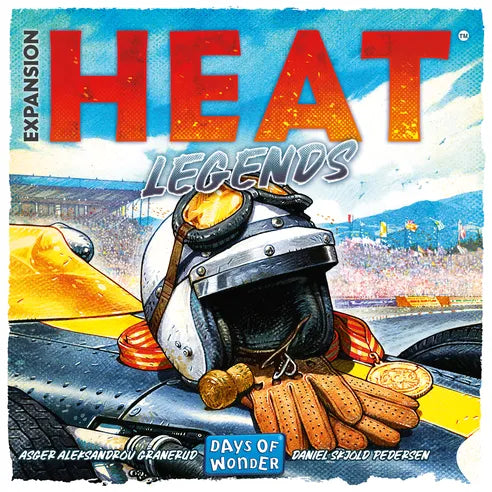
Mechanical Identity: Heat: Legends Review
The silence at the table is broken only by the rustle of a card: it's not a human player who has just closed the curve, but an algorithm that has decided to kill you.
Heat: Legends (distributed in Italy by Asmodee) isn't a box that simply adds plastic to your table. It's a firmware update for your favorite racing game. If the base game of Heat: Pedal to the Metal redefined the racing simulation genre with its fluid and intuitive hand control , this expansion—composed exclusively of cards—has a surgical goal: to eliminate the concept of "filler bots." We're not talking about automatons that move randomly for bulk; we're talking about a system designed for the discerning solo player and for groups who want a full grid of 12 cars without sacrificing tactical depth.
/pic9373818.png)
The Architecture of Conflict: An Analysis of Modular Artificial Intelligence
The true engineering revolution of Heat: Legends lies in its Automated Opponent mechanic. Until recently, Heat's bots were functional: they served to generate traffic. Today, thanks to this module, the six colors introduced in the various expansions become "Legends" with their own distinct algorithmic personalities.
We're no longer dealing with static movement based solely on position. The system introduces aggressive behaviors: defending the line, exploiting slipstreams, and calculating overtaking. This dramatically changes Risk Management (Push Your Luck) for the human player. Knowing that the green car won't just move seven spaces, but could trigger a special effect that cuts you off, forces you to reconsider every single Heat card you decide to keep in your hand.
The Relentless Engine: How the Gears of Heat Turn: Legends
There's a perverse beauty in watching a deck of cards steer better than a human being.
The game's engine remains Hand Building , but interacting with Legends adds a previously nonexistent layer of "table reading." Each Legend is controlled by a specific deck that defines their driving style. Some AI drivers will tend to push hard on the straights, overheating their engines, while others will be conservative in the corners and then explode on the exit.
This opponent pool construction system allows you to scale the difficulty. It's not a monolithic AI: you can add more or less aggressive pilots depending on your experience. The game flows smoothly because the bots' turn management has been kept streamlined, despite the increased strategic complexity. There's no tedious bookkeeping ; you flip a card, apply the effect, and curse because someone just stole your rope.
Anatomy of a Fatal Mistake: The Move That Dooms You
In a standard Heat match, the classic mistake is misjudging your speed on a turn and spinning out. With Legends , the fatal mistake is arrogance. You're first, you've managed the heat well, the finish line is near. You think, "The bot can't catch me."
And this is where Legends' Dynamic Catch-Up mechanic punishes you. You draw the Legend's activation card behind you: not only does it match your speed, but it activates an "Aggressive Pass" ability that throws it in front of you, blocking your access to the ideal racing line for the next turn. You played a technically perfect game, but you ignored the AI's aggressiveness variable. Result: seconds, with your engine on fire.
A Turn in the Mud: Impossible Choices and Consequences
The rain is beating down on your visor, but the real problem is that legendary driver sandwiching you against the guardrail.
Imagine this: you're on your third turn. Your hand is filled with two Heat cards and one Stress card. Normally, you'd take a conservative turn to cool down your engine ( Resource Management mechanic - Cooling). But to your right is a Legend, and you know his deck still contains the "Final Sprint" card.
If you cool down now, the Legend will pass you and take the slipstream bonus, becoming unreachable. If you push, you risk going off the track at the next corner. Legends eliminates rest periods. It forces you to play at the limit of your car's mechanical capabilities, because your opponent isn't afraid of dying: he's a piece of cardboard programmed to win.
The System Anomaly: The Rule That Breaks the Pattern
What really sets this expansion apart isn't just the bots, but the introduction of the "Sponsor" module. Until now, Heat was a pure competition: first place wins. Sponsors introduce secondary objectives and bonuses, a sort of Variable Contracts .
This "anomaly" changes the structure of the race. You might find yourself sacrificing track position to please a sponsor who guarantees you a crucial upgrade for the season finale. It's a positive disruption that breaks the linearity of the race and adds a layer of emergent narrative: you're not just a driver, you're the manager of your own career.
Psychology at the Table: What Happens Between Players
"That's impossible, he's cheating!" is a phrase you'll often hear, referring to an inanimate deck of cards.
In multiplayer, the presence of the Legends creates a common enemy. The atmosphere at the table changes: it's no longer just "me against you," but "us against *them*." When a Legend pulls off a spectacular maneuver, outplaying both human players, a moment of paradoxical solidarity is created. The psychological tension rises because losing to a friend is acceptable, but losing to the system, designed by Asger Harding Granerud and Daniel Skjold Pedersen to humiliate you, is unacceptable.
The Player's Metamorphosis: From First Game to Advanced Strategy
In your first few games with Legends , you'll suffer. You'll treat the bots like the ones in the base game and be punished. The metamorphosis occurs when you start memorizing the patterns of the Legend cards. You start card counting the opponents' decks. "The Red Bot has already played its aggressive card, now I can try to overtake." From simple pilots, you become strategists analyzing the AI's telemetry. The game stops being a race and becomes a 300-mile-an-hour chess match.
The Verdict: Pros, Cons, and Final Thoughts
Heat: Legends doesn't add tracks, it doesn't add car physics, but it adds brains. It's the expansion that completes the creators' vision, taking the game to its peak competitive simulation potential.
- PRO: Modular AI turns solitaire into a brutal and rewarding challenge.
- PRO: Allows you to play with 12 cars (if you own the other expansions) with a lively and combative grid.
- PRO: Full integration with any existing map or weather setup.
- CONS: Requires the base game and, to take advantage of all the colors, the previous expansions (the total economic investment is not trivial).
- CONS: No new physical tracks in the box (might disappoint those looking for geographical variety).
The Final Touch: Why Heat: Legends Remains in Your Heart
This expansion is proof that a board game can grow. Legends takes an already excellent system and elevates it, transforming colorful toy cars into opponents with soul. If you love Heat, this isn't an option; it's the final piece that was missing to make every race epic. You're no longer playing alone; you're racing against history.
Want to challenge the Legends on the track?
Find out more on Frogames.it



 https://frogames.it
Share:
Arkham Horror LCG Core Set 2.0: Technical Analysis of a Necessary Evolution
Rumble Nation: Technical Analysis of the Blitzkrieg in Feudal Japan