


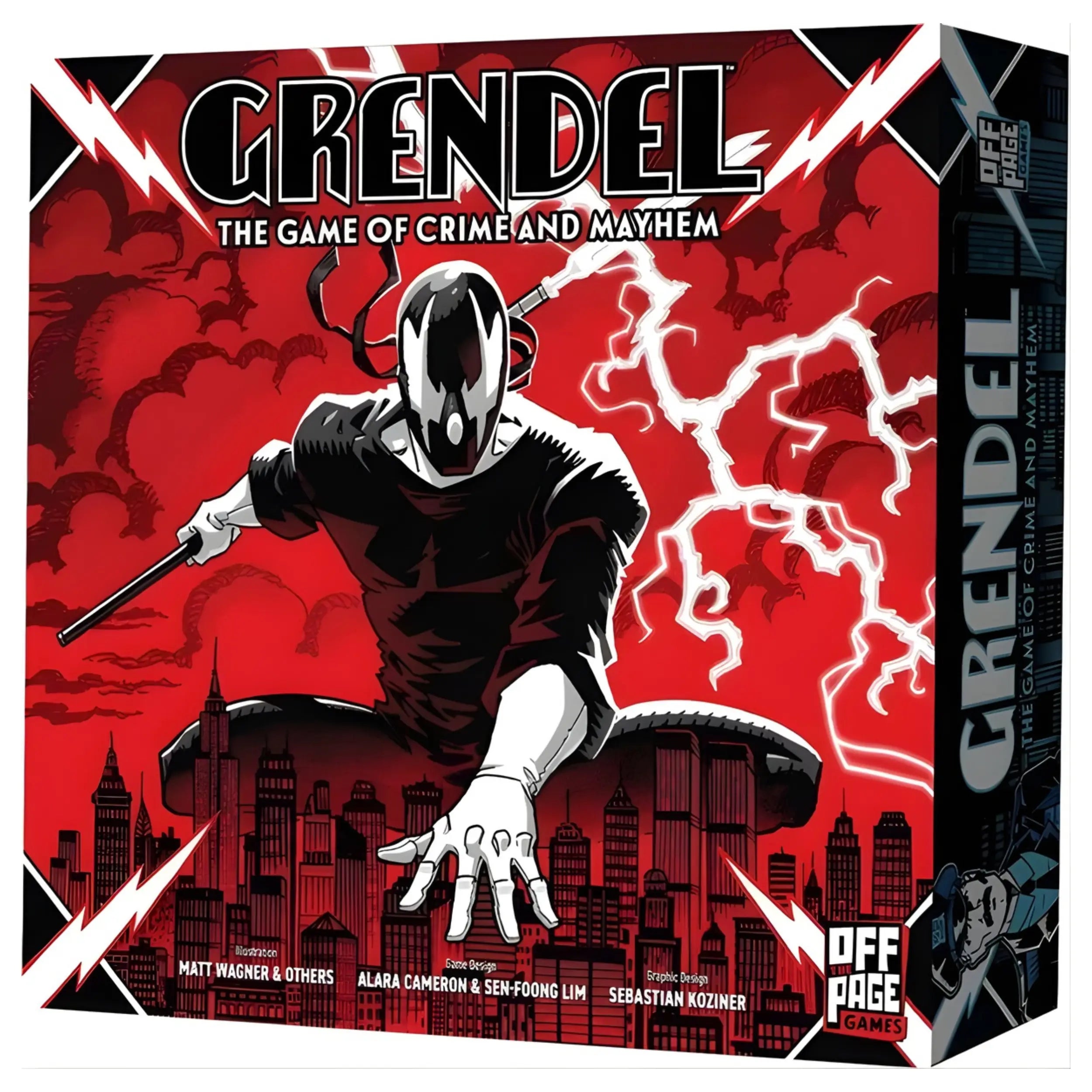
The Mechanical Identity: A Review of Grendel
There is a precise moment, towards the end of the second act, when the table stops breathing to listen to the sound of a single plastic token falling.Imagine a New York emptied of its criminal hierarchy. Hunter Rose, the original Grendel, has eliminated the heads of 23 mafia families, leaving behind a power vacuum that human—and gaming—nature abhors. Grendel: The Game of Crime and Mayhem , published by Off The Page Games , is not your typical commercial adaptation of a comic book. It is an experiment in narrative engineering applied to Territorial Control .
We're looking at a game for 2-4 players that lasts about 120 minutes, but it seems to compress an entire night of urban warfare into a series of excruciating tactical choices. Matt Wagner, the creator of the 1982 cult comic, worked closely with authors Alara Cameron and Sen-Foong Lim. The result? A system where the noir atmosphere isn't just "color," but is embedded in the game's mathematical engine.
/pic8966368.jpg)
The Architecture of Conflict: An Analysis of Total Asymmetry
In many modern board games, asymmetry is a flavoring: everyone does the same thing, but some do it better. Here, asymmetry is structural. If you decide to sit down at the table, you're not simply choosing a color, you're choosing a different set of rules.
The beating heart of Grendel lies in a Total Asymmetry that forces players to think on parallel tracks that only intersect on the Manhattan, Queens, and Brooklyn maps. One faction manages its actions through Bag Building , blindly extracting resources to plan its turn. Another operates through Dice Allocation , transforming probability into deterministic actions. A third uses a Rondel , cycling through available options, while the fourth lives on the razor's edge with Push Your Luck mechanics.
This mechanical diversity turns every game into a clash of different management philosophies. It's not just "my soldier versus yours"; it's "my statistical efficiency versus your risk management."
The Relentless Engine: How Grendel's Gears Turn
Violence in this game has a specific weight, measurable in grams.The most visually striking and technically fascinating feature is the Mayhem Towers . These aren't just aesthetic flourishes, but physical timers that dictate the pace of the game. Players place "Aggression" tokens inside these three-dimensional structures. There's no abstract turn count: time is dictated by gravity and friction.
When the accumulated weight exceeds the structural tolerance threshold, the tower collapses, scattering tokens across the table. This event triggers "Mayhem," a turning point that advances the game-ending condition. After three collapses, the night ends. This Physical Dexterity system integrated into a heavy strategy game creates palpable tension. You're not just calculating victory points; you're considering whether that last token will be the straw that breaks the camel's back (and your strategy).
Anatomy of a Fatal Mistake: The Move That Dooms You
The most common mistake I've observed during testing is treating the map like an Excel spreadsheet. A player figures they have Area Majority in the financial district and moves their resources to consolidate, completely ignoring the shaky Chaos Tower to their right.
The opponent, noticing the unstable structure, doesn't attack the territory. He attacks the tower. Placing a token with excessive force or at a critical point causes a premature collapse. This collapse ends the era, freezes the score, or triggers penalties before the first player has had a chance to convert their positioning into victory points. In Grendel, tactical efficiency is useless if you don't respect the physics of the table.
/pic8980006.jpg)
A Turn in the Mud: Impossible Choices and Consequences
Sometimes winning a district means losing the psychological warfare.Imagine a mid-turn. You're the Rondel faction. You desperately need to recruit new units, but the recruit action is three spaces ahead on your wheel, costing you precious resources to skip the intermediate steps. Your opponent, playing with Dice Allocation , looks at you with a toothy grin: he's just rolled two 6s and is about to flood Queens with criminals.
You have a choice: spend everything to block him now, weakening your future economy, or leave him Queens and focus on Brooklyn? While you hesitate, another player gently adds a token to the tower. Click . The sound echoes. The tower hasn't fallen, but it's tilted. Your hand trembles as you move your token onto the wheel. You've chosen to attack, but now you know that any subsequent move could end the game before you can cash in.
The System Anomaly: The Rule That Breaks the Pattern
There's one detail that will drive lore purists crazy and delight the designers: you can play "Grendel" without Grendel. The titular character, Hunter Rose, is a playable faction, but the game works perfectly without him.
This is possible because Grendel, in this design, isn't just a person, but a concept: the pinnacle of violence and control. If Grendel isn't at the table, his presence is still felt in the void he's left. If he's present, however, it becomes a de facto "one-for-all," as everyone knows they must take down the apex predator. This flexibility in setup drastically alters the metagame: a game with Grendel is a manhunt; one without is a civil war between equals.
Psychology at the Table: What Happens Between Players
The Grendel table quickly falls silent, but not out of boredom. It's the silence of calculation and paranoia. Alliances in this game are as fluid as mercury. Since the scoring system is tied to area control and Mayhem events, players are constantly stuck in a "crab in a bucket" situation: as soon as one tries to escape to victory, the others will pull them down.
I heard one player exclaim, "I don't care if I lose, as long as he doesn't win with those damned dice." This is the triumph of Off The Page Games' design: creating a genuine, thematic resentment that perfectly mirrors the feuding criminal gangs in the comic.
The Player's Metamorphosis: From First Game to Advanced Strategy
The first game of Grendel is a barroom brawl; the tenth is a game of knife chess.Initially, players focus exclusively on their own engine (their own mini-game). "How do I optimize my bag draw?" is the novice's question. But after a couple of sessions, a metamorphosis occurs. The experienced player no longer looks at their own board, but at their opponents'.
He realizes that to stall the Rondel faction, he must force them to make suboptimal moves by occupying specific spaces on the map that trigger their weaknesses. The strategy evolves from introverted resource management to aggressive manipulation of game time, using Chaos Towers as an offensive weapon to cut off opponents' turns at their most vulnerable.
The Verdict: Pros, Cons, and Final Thoughts
Grendel: The Game of Crime and Mayhem is a bold product that doesn't try to please everyone. It's the "muscle car" of board games: loud, powerful, and a little dangerous to drive.
- PROS: Total Asymmetry offers four distinct gaming experiences in one box.
- PROS: Towers of Chaos masterfully integrates physical and thematic tension, avoiding the tedium of Analysis Paralysis.
- PROS: Absolute fidelity to the original material, with a dark, adult tone that permeates every component.
- CONS: The learning curve is steep; explaining the rules takes time because each player must understand four different systems.
- CONS: If you're looking for a calm, 100% controllable Eurogame, the randomness of the towers' collapse will infuriate you.
The Final Imprint: Why Grendel Remains in the Heart
Off The Page Games has proven once again, following the success of Mind MGMT, that adapting a comic doesn't mean pasting illustrations onto recycled mechanics. Grendel is a game that respects the intelligence of its players and the brutality of its inspiration. It remains dear to the heart because it captures the essence of organized crime: a precarious balance that can collapse at any moment, just like those towers full of tokens in the center of your table.
Are you ready to reclaim New York's criminal throne? Embrace the chaos.
Find out more on Frogames.it

 https://frogames.it
Share:
The White Castle: Duel - When Silence is Stronger than Dice
Corps of Discovery: Duo – When the Map is the Enemy