


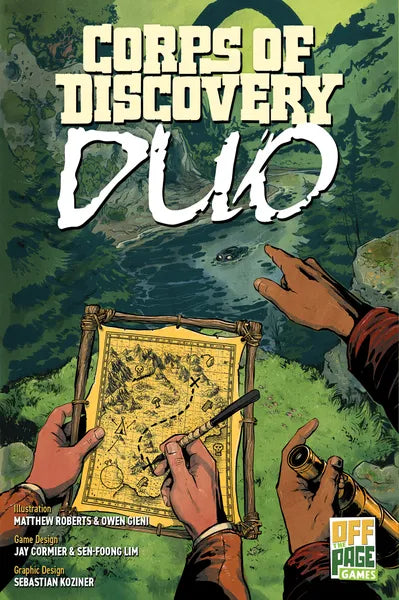
The Mechanical Identity: Corps of Discovery: Duo Review
This is not a survival game: it's a surgery on two-brain logic.Imagine removing the background noise. Gone is the resource management, gone are the dice rolling in the mud, gone is the fear of starvation. What's left? The bare structure of reality. Corps of Discovery: Duo , published by Off the Page Games and designed by Jay Cormier and Sen-Foong Lim, is a bold feat of game engineering. It's not a "lite" version of its four-player bigger brother, but a genetic mutation of the very concept of exploration games.
This is a cooperative deductive game designed exclusively for two players. The target audience isn't a rowdy group of friends, but rather an analytical couple, those who find satisfaction in watching two pieces of a mental puzzle snap into place with a "click" audible only in their minds. Here, you're not Lewis and Clark battling bears; you're architects of nature trying to justify the existence of a river where logic suggests a mountain. This is a Pattern Building and Grid Coverage game that transforms the tabletop into a silent battlefield.
The Architecture of Conflict: An Analysis of Spatial Deduction
Here, victory is not measured in kilometers traveled, but in structural coherence.The core mechanic that governs the experience is Spatial Logical Deduction . Unlike the original game, where the unknown is revealed, here the unknown must be determined. Each turn is an exercise in triangulation. Players must place elements on the map within strict constraints, not to discover what is there, but to establish what must be there.
Imagine holding a fragment of partial information. Your partner has the other half. You can't simply show it to each other (that would be trivial), but must deduce the correct position by interacting with the grid. This creates a system of Limited Communication that isn't punitive, but structural. The conflict isn't between you and the game, but between what you know and what you assume. If you place a forest on C4, you're implicitly telling your partner, "I know there can't be water here." It's a silent dialogue made up of tiles.
The Relentless Engine: How the Gears of Corps of Discovery: Duo Turn
The game flow is a tight feedback loop. You draw, you analyze, you place. But under the hood, the engine runs thanks to a constant tension given by the scenario's requirements. The rules change slightly between missions, introducing variables that force the entire game heuristics to be recalculated. There's no classic resource management of "do I have enough wood?", but rather a management of spatial probabilities .
Observing a game from the outside, you notice a mental choreography. The players don't frantically move pieces. They pause. They stare at the grid. One player reaches for a tile, hesitates, and looks at his partner. His partner's eyes widen slightly: an imperceptible signal. The hand withdraws. This is the engine of the game: the constant validation of hypotheses.
Anatomy of a Fatal Mistake: The Move That Dooms You
The apocalypse in this game comes not with an explosion, but with an inconsistent third-round placement.In Corps of Discovery: Duo , the law of dominoes reigns supreme. A mistake made in the first few minutes of the game is often invisible. You place a hill tile where, according to a logical rule you won't discover for ten minutes, there should have been a plain. The game continues. Everything seems to flow smoothly. Then, towards the end of the game, you realize that the last piece of the puzzle, the one crucial to completing the scenario, cannot be placed legally.
You've created a geographical paradox. That moment of realization is devastating and sublime. "We entered the valley the wrong way twenty minutes ago," one of the players whispers. It's the punishing essence of logic puzzles: the game is unforgiving of a lack of rigor. Each tile placed narrows the scope of future possibilities; a miscalculation at the beginning turns the ending into a mathematical dead end.
A Turn in the Mud: Impossible Choices and Consequences
We're halfway through the game. The board is half full. The obvious options are exhausted. Now the real work begins. It's your turn. You hold a tile that could solve two objectives, but it would block a vital corridor for your partner. The silence at the table is thick.
"If I put this here..." you think, mentally simulating the grid, "...you'll never be able to close the river's path." But you can't say it explicitly. You have to trust your partner to understand why you're not making the apparent optimal move. You decide to make a suboptimal move to leave a glimmer of opportunity open. Your partner exhales loudly. He understands. In that moment, in the muddy waters of difficult decisions, a bond is created that no competitive game can offer.
The System Anomaly: The Rule That Breaks the Pattern
Duo commits an act of betrayal towards its own franchise: it eliminates adventure in favor of abstraction.Typically, a spin-off seeks to replicate the father's emotions in a smaller format. Here, the opposite happens. The anomaly is the removal of the emergent survival narrative (typical of the main game) in favor of an abstract procedural narrative. You're no longer an explorer fearing the cold; you're a cartographer fearing inconsistency.
This design choice is risky but brilliant. It transforms the thematic setting (nature, expedition) into a mere set of textures for a pure intellectual exercise. "Survival" becomes metaphorical: surviving one's inability to see the full pattern. It's an anomaly because it requires players to completely shift their mindset: stop feeling the cold, start seeing the matrix.
Psychology at the Table: What Happens Between Players
Co-op in Corps of Discovery: Duo is "dialogical." There's no alpha leader telling you what to do, because information is fragmented. This eliminates the classic "quarterbacking" problem (one player playing for two). Here, you're forced to treat your partner as an extension of your cognitive processor.
At the table, you hear phrases like: "If I do this, what do you think I'm telling you?" It's a game of applied theory of mind. The frustration, when it emerges, is never with the game, but with the couple's inability to synchronize. But when they do synchronize, the dopamine rush is powerful. It's the satisfaction of having solved a puzzle in two different languages simultaneously.
The Player's Metamorphosis: From First Game to Advanced Strategy
In your first game, you'll be playing "Tree Tetris." You'll try to fit the pieces where there's space. You'll fail. Or you'll win by luck, without understanding why. From the third game onward, the metamorphosis occurs.
You'll begin to see the grid not as empty spaces, but as nodes in a logical network. You'll stop looking at your hand and start looking at your partner's eyes and the configuration of shared goals. Advanced strategy requires sacrificing safe points or positions to maintain the map's long-term structural integrity. You'll become less of a player and more of a programmer of a biological algorithm.
The Verdict: Pros, Cons, and Final Thoughts
Corps of Discovery: Duo is a surgical product. It doesn't try to please everyone, but aims to capture a specific niche: couples who enjoy racking their brains.
- ✅ PRO: Pure deduction. Eliminates the unnecessary to focus on a crystal-clear puzzle.
- ✅ PROS: Perfect scalability. Being designed for 2 players, it has no special rules or lame variations.
- ✅ PRO: Zero Alpha Player. The hidden information structure forces true parity at the table.
- ❌ CONS: Thematic abstraction. If you're looking for the survival atmosphere of the base game, you'll find cold logic here.
- ❌ CONS: Analysis Paralysis. With the wrong partner, a turn can last forever.
The Final Imprint: Why Corps of Discovery: Duo Remains in the Heart
Because in the end, the map you've built isn't on the table, but in the shared space between your minds.This game leaves a mark because it redefines the concept of cooperative success. You haven't defeated a monster, you've defeated chaos. You've imposed order where there was nothing. In a market full of screaming games, Duo whispers, and its whisper is a riddle you'll want to solve again and again. It proves that to travel far, sometimes you don't need to move, but just think together.
Ready to map the unknown with logic?
Find out more on Frogames.it


 https://frogames.it
Share:
Grendel: The Game of Crime and Mayhem - When Chaos Becomes Game Engineering
Leviathan Wilds: An Impossible Climb Between Vertigo and Redemption