
Widget's Workshop
🐸 Details from BoardGameGeek
Consiglio BGG sul numero di giocatori
Categorie
Meccaniche
Design & Art
Lingua
Si abbina bene con
FroGames — Moments You'll Remember
Someone fishes with just one finger and finds the perfect gear. Someone curses because they chose the wrong bay. And in the end, everyone wants to photograph the robot they built.
WHAT IT'S ABOUT
A chaotic lab where you build creatures with your hands in the pile
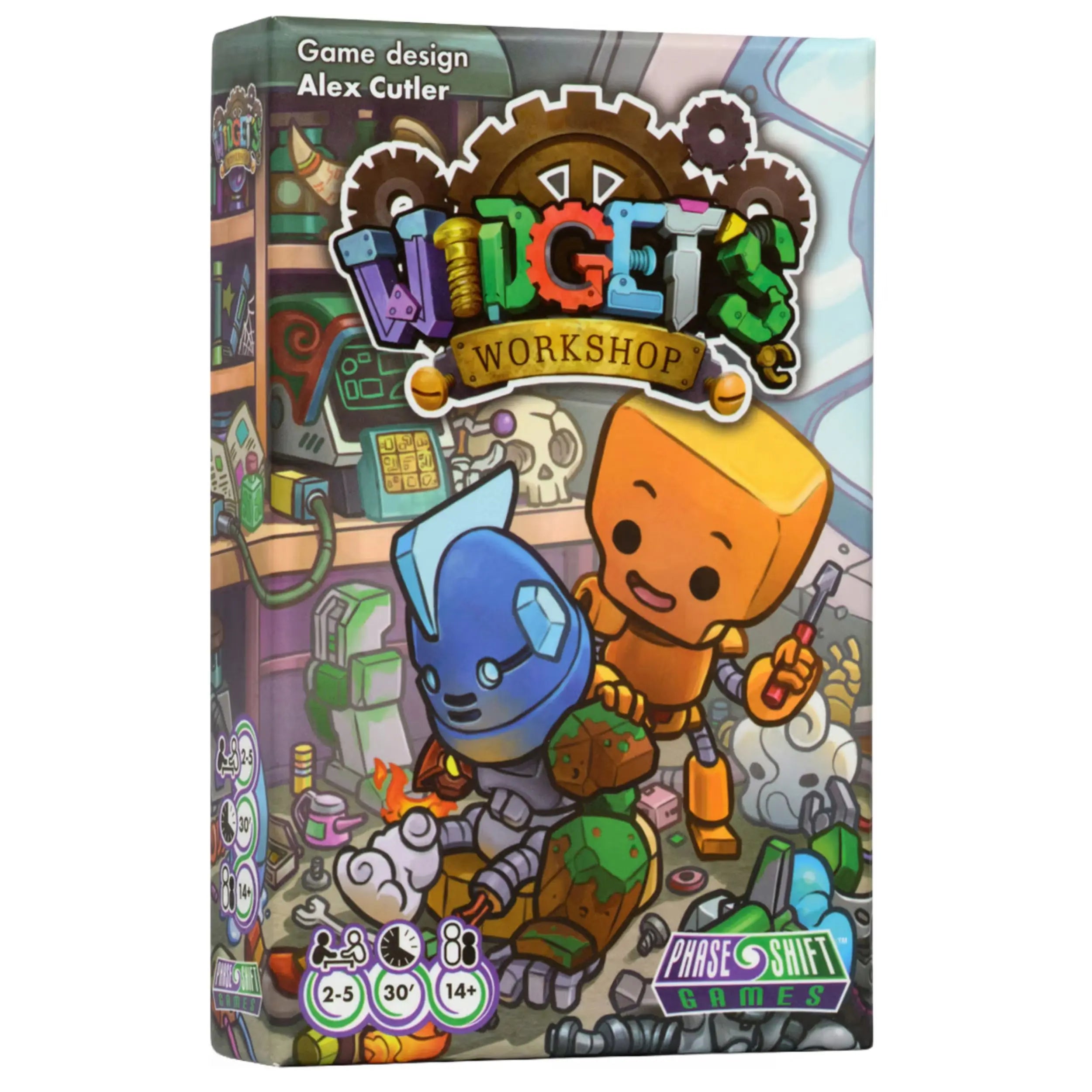
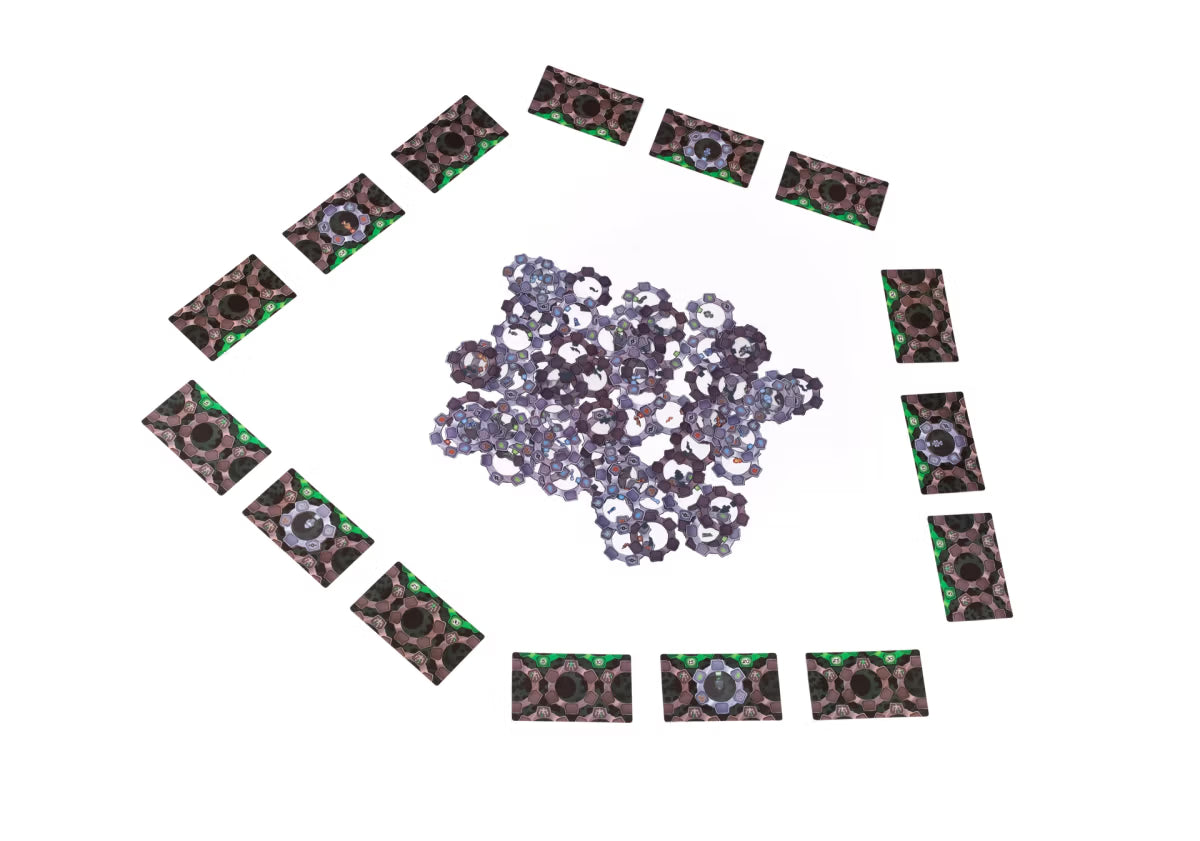
Designed by Alex Cutler and illustrated by Gong Studios, Widget's Workshop belongs to the Dungeon Drop universe but flips it on its head: no dice to roll, but 80 component cards that you pour onto the table, creating a giant, messy pile. Fantasy meets robotics, golems meet gears.
Each turn you draw parts from the pile using only one finger, trying to assemble robots and golems in your three workbays. Each construct requires 5 specific pieces: head, body, arms, legs, energy. Once completed, you stack the transparent cards and discover the name of the creature you've assembled. The player who builds the most optimized set of constructs before the pile runs out wins.
What they say abroad
It's a game that builds itself as you play it, literally
— FroGames
The single-finger rule turns every draft into a physical micro-puzzle
— FroGames

Widget's Workshop
FrogScore · FroGames editorial rating · based on rules, international reviews, and gameplay sessionsThe workshop pieces
What you assemble in your bays
Robotic heads
Each head has an expression, a partial name, and is worth different points. The rarest ones have special abilities that modify the construct's final score.
Bodies and arms
The central parts determine the type of construct: mechanical robots, organic golems, magical hybrids. The combination influences the name that will appear on the finished construct.
Legs and bases
Wheels, paws, tracks. Bases stabilize the construct, and some unlock set bonuses when paired with compatible bodies.
Energy cells
Without energy, the construct won't activate. Some cells are worth more points, others allow you to reorganize the bays during the game.
In half an hour, you'll have three constructs with absurd names in front of you. And someone will have already asked to play again.
Come si gioca
Video dimostrativo di gameplay.
A game in five moments
What happens at the table
Not the rules. The experience.
The Pour
You throw 80 cards on the table and the pile forms chaotically. Someone is already laughing. You place your three bays in front of you, each empty, waiting. The first player drafts face-down with one finger.
The Chaos of the Draft
Drafting with only one finger is trickier than it sounds. Someone drags half the pile, someone picks the wrong card and curses. Face-up cards accumulate, revealing pieces everyone wants.
The First Constructs
Someone completes the first robot, overlays the five transparent cards, and discovers the name: Cogsworth the Relentless. Everyone gathers to watch. The pile thins out, choices become tenser.
The Final Rush
Few cards remain. Someone has two finished constructs and one half-full bay. Someone has three open bays and no completed constructs. Every draft is a gamble: close quickly or aim for the perfect construct?
Showcase and Scoring
The pile is exhausted. Everyone displays their completed constructs, adds up the base points, applies set bonuses. Someone assembled Tinker the Wise, someone else has Bolt the Destroyer. The highest score wins, but everyone wants to photograph the creatures.
How to play
The flow of each turn
Each turn is lightning fast: draft, choose, place. Then it's the next person's turn.
You draft from the pile using only one finger. You can choose: 1 face-down card, or 2 face-up cards (you keep one and return the other face-up to the pile).
Add the card to one of your three bays. Each bay can only contain one card per type (head, body, arms, legs, energy). If the bay already has that type, you must discard one of the two.
If a bay contains all 5 types, the construct is complete. Overlay the transparent cards in order, read the generated name, and move the construct to your showcase.
When a certain number of constructs have been completed (varies with the number of players), the game ends. Sum the points of your constructs plus set bonuses. The player with the highest score wins.
Why it's different from others
Six mechanics that make a difference
One-finger Draft
You can't use two hands, you can't move the pile. You have to draft with precision using only one finger. This physical limitation turns every draft into a tactile micro-puzzle and often a source of laughter.
Overlapping Transparent Cards
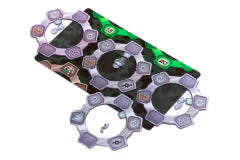
The five cards of each construct are transparent. When you overlay them in order, the designs combine and reveal the creature's name. Each combination generates a unique name (Cogsworth, Tinker, Bolt...) printed on the cards themselves.
Physical Pile and Visibility
The pile is not an orderly deck: it's a chaotic mound on the table. Some cards are face-up, others face-down. You can draft blindly or choose between two face-up, but every choice reveals information to others.
Three Simultaneous Bays
Manage three constructs in parallel, each in a separate bay. You can quickly complete simple constructs to accumulate points, or risk it and aim for rare combinations that are worth more but require specific pieces.
Set Optimization
It's not enough to complete constructs: you need to maximize your score. Some combinations of heads-bodies-legs unlock set bonuses, others have special abilities. The choice of which bay to feed is strategic.
Portable and Fast
The box is small, setup is pouring the cards on the table, games last 15-30 minutes. Perfect for filling breaks, casual evenings, or as a filler between longer games. It can be taken anywhere.
How it ends
How to win and how to lose
The game ends when a predetermined number of constructs has been completed by all players (the number varies based on the players).
Victory
- Sum the base points of each completed construct in your showcase
- Add set bonuses unlocked by compatible piece combinations
- Apply special abilities of rare heads or energy cells
- The player with the highest total score wins
Defeat
- You have incomplete constructs in your bays at the end: they are worth no points
- You completed constructs but with low-value pieces and no set bonuses
- You drafted face-down too quickly and accumulated incompatible pieces
- Others optimized their sets better and surpassed you
Widget's Workshop is a game that you touch, you see, you photograph. The rules are immediate, games are quick, and the final constructs are always surprising. Perfect for families and casual tables.
Frequently Asked Questions
FAQ about Widget's Workshop
How complicated is it to explain the rules?
Five minutes. The concept of one-finger drafting and bays is immediate. The longest part is showing how to overlay the transparent cards to complete the constructs, but that's also quickly understood as soon as you assemble one.
Does it work well with 2 players or do you need a full table?
It works very well with 2 players. The pile is more abundant relative to the number of constructs required, so there's more choice and less chaos. With 4-5 players, the pace is more frantic and face-up cards disappear quickly, but both experiences are valid.
Do constructs have special effects or does only the score count?
Some heads and energy cells have abilities that modify the final score (e.g., "worth +2 points if you have at least two golems"). Set bonuses are activated when you combine pieces of the same type (e.g., three constructs with mechanical bodies). There are no active powers during the game, only score optimization.
Can children play it or is it too optimized?
The recommended age is 14+, but the game is also accessible to 10-12 year olds if accompanied. The physical part of one-finger drafting is fun for everyone, set optimization is optional: children can play by completing random constructs and still have fun.
Is it available in Italian?
No, this edition is in English. However, language dependence is minimal: cards have clear symbols for component types, and construct names (generated by transparent overlays) are readable in English but gameplay does not require continuous reading. Rulebook in English.
Widget's Workshop is a competitive board game for 2-5 players, lasting 15-30 minutes, ages 14+. Designed by Alex Cutler and set in the Dungeon Drop universe, the game uses open drafting and set collection mechanics with a physical twist: you draft component cards from a chaotic pile using only one finger, assemble transparent robots and golems in your work bays, and complete constructs by overlaying five transparent cards that reveal unique names. Published by Phase Shift Games, illustrated by Gong Studios. Available on FroGames.it.
Widget's Workshop
Frequently Asked Questions
The answers you're looking for, no beating around the bush.
📸Do the images match the actual product?
The photos on the website often come from BoardGameGeek and are intended to give you an idea of the game. They may vary slightly from the version you receive. The content declared by the publisher is always binding.
📦Does the content of the box match what is indicated?
We always strive to provide the correct content, but minor variations are possible due to reprints or updates. The information comes directly from the publishers. If you have any questions, please contact us!
⏳How do pre-orders work?
Pre-order the game before release, payment is immediate, and the game is reserved for you. As soon as it arrives, we'll ship it right away! If there are any delays, we'll update you promptly.
🔒Can I trust buying here?
Absolutely! Secure payments, tracked shipments, and a team that loves board games as much as you do. If something goes wrong, we'll do our best to fix it.
🛠There's a problem with my order, what should I do?
Write to us now! Whether it's a missing part, damage, or an error, we'll help you resolve it as soon as possible. Your experience truly matters to us.