

Verdant Arizona
🐸 Details from BoardGameGeek
Consiglio BGG sul numero di giocatori
Categorie
Meccaniche
Design & Art
Lingua
Si abbina bene con

FroGames — Moments You'll Remember
Choose the card you want. Then look your opponent in the eye — because you've just decided what they get too.
What it's about
A cactus garden to build — and an opponent who wants exactly the same plants as you
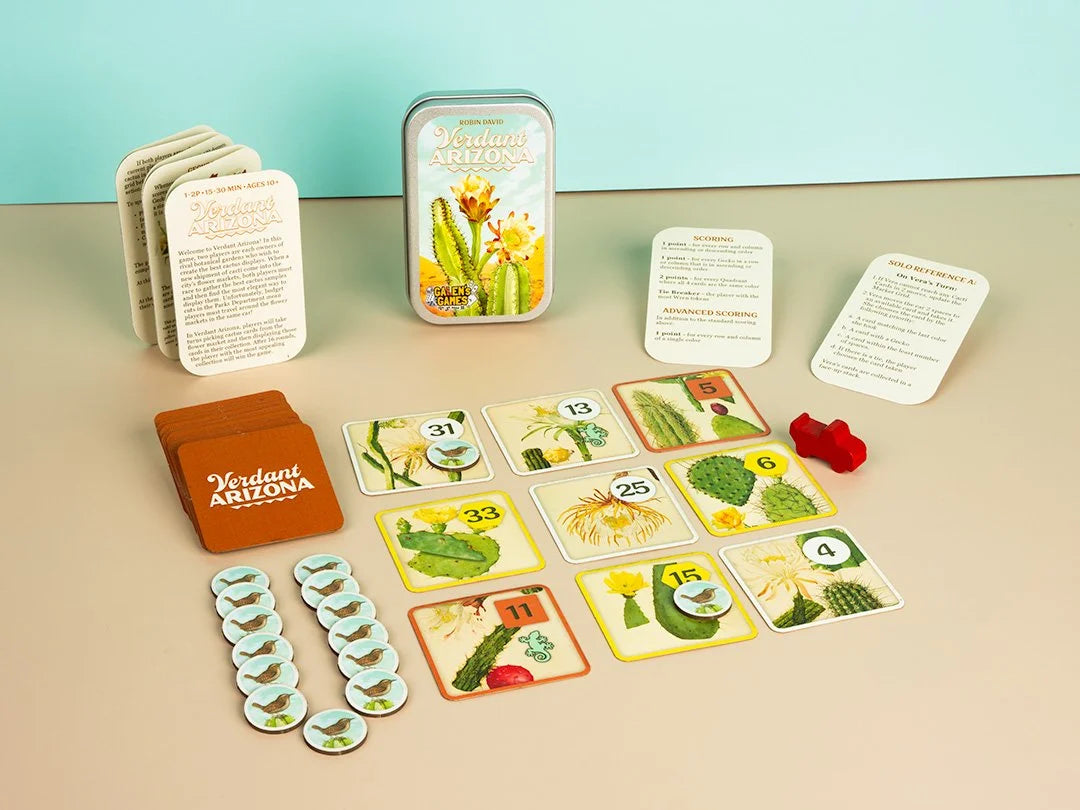
Verdant Arizona brings the Arizona desert to a small mint tin. Designed by Robin David with public domain botanical illustrations and graphic design by Jonathan Carnehl, it's a tactical drafting and set collection game for 1-2 players.
On your turn, you choose a card — but the mechanism is sharp: your selection also determines which cards remain available for your opponent. Every choice is a two-variable equation. Do you take what you want, or do you take what you want to prevent the other from taking? The right answer changes every round.
Then the cards go into your personal garden. Arranging them well is the second puzzle: combinations of cactus types and adjacencies determine points. A beautiful garden isn't enough — it has to be the most beautiful on the table.
From the table experience
The same card becomes excellent or terrible depending on where you place it in the garden — the placement puzzle is inseparable from the draft.
The secret of Verdant Arizona in one line
There are games where you leave your opponent the perfect card to unlock three sets for them. That feeling is exactly the heart of Verdant Arizona.
From gameplay experience

Verdant Arizona
The garden building puzzle works well even solo — but you lose the thrill of negative choice against a real opponent.
FrogScore · FroGames editorial rating · based on rules, international reviews, and play sessionsYour arsenal
What you build in each game
The cactus cards
Each card represents a different species. Types, colors, and symbols determine how they combine in the garden. It seems simple until you have three cards in hand and none fit where you thought they would.
The shared market
Available cards are visible to both players. Your choice redistributes them — or takes them out of contention. Every pick is a message to your opponent. Read it well before you move.
The personal garden
Cards must be placed in your private space. Adjacencies matter, sets matter, order matters. The organization puzzle is as important as the choice of what to take.
The shared vehicle
The narrative mechanic of the game: you go to the cactus market sharing a vehicle with your opponent. Who gets off first? Who decides the route? The metaphor works — and explains the draft in thirty seconds.
The most beautiful garden isn't the one with the rarest cacti. It's the one built by taking the right card from your opponent at the right time.
Come si gioca
Video dimostrativo di gameplay.
A game in five moments
What happens at the table
Not the rules. The experience.
At the cactus market
The cards are on the table. You both study them in silence. The market is the same for both of you — same visibility, same accessibility. You already know what the other wants. And they see that you've understood. It starts with that subtle pressure that will never let up.
The first choice — and what you leave behind
Take the card you want. Then observe the remaining market: you've just redrawn your opponent's options. Maybe you've made their life easier. Maybe you've unknowingly taken something fundamental from them. The first move already says everything about the kind of player you are.
The garden begins to take shape
The cards enter your space. You start to see possible sets, adjacencies that work, holes you need to fill. And simultaneously your opponent's garden grows next to yours — and you understand where they're going. Block their next card or take the one you need?
The card you shouldn't have left them
There's always a moment in Verdant Arizona. That card that seemed useless to your opponent — but it was exactly the missing piece of their most important set. They take it. Their garden completes itself in a way you didn't foresee. There are still a few turns left to remedy it. Perhaps.
Points are counted — and you realize where you went wrong
The game ends. The gardens are evaluated: completed sets, adjacencies, rare combinations. One point separates the winner from the loser. And you already know where you lost — that card on turn three. Everything is put back in the box — literally in a small box — and you start again.
How to play
The flow of each turn
Three quick, repeating actions. You learn in ten minutes, the first game is already full of choices.
Available cards are visible to both players. Before you move, evaluate not only what you want — but what your opponent wants and what becomes accessible after your choice. The market is shared: each pick redistributes it.
You select the card you want to add to your garden. The selection mechanism determines which cards remain within reach for your opponent — often blocking a card you don't need is the most powerful move of the turn.
The card enters your personal space. Where you place it determines adjacencies, sets that complete, and points you earn at the end of the game. Placement is the second layer of the puzzle — no less important than drafting.
When the cards run out, gardens are evaluated: completed sets, rare combinations, specific adjacencies. The one who built the most valuable garden wins. Usually by very little.
Why it's different from others
Six mechanics that make a difference
Dual-purpose drafting
Every choice has two simultaneous effects: what you add to your garden and what remains accessible to your opponent. There's no move that's just about you. Ever.
Set collection with placement puzzle
Collecting the right cacti isn't enough — they must be arranged in the garden so that adjacencies create winning combinations. Two overlapping puzzles that influence each other.
The shared vehicle metaphor
You go to the cactus market in the same vehicle as your opponent. Who decides the route? Who gets off first? The narrative mechanic explains drafting intuitively and memorably.
Interaction without aggression
You don't attack your opponent — you compete for the same resources. Interaction is continuous and ruthless, but not direct. Perfect for those who love tension without tabletop violence.
Truly pocket-sized
Everything in a mint tin. The PVC cards are water and bend resistant — it works for travel, camping, at the bar. No excuses not to play.
Solo mode included
Verdant Arizona also works solo: the garden building puzzle maintains its depth even without an opponent. A real option, not a fallback.
How it ends
One garden wins, the other learns
There are no ties in an Arizona cactus market. In the end, the points speak for themselves — and you can see exactly where you built well and where you left the wrong card for your opponent.
Victory
- At the end of the cards, garden points are counted
- The player who built the highest-scoring cactus garden wins
- Completed sets, correct adjacencies, and rare combinations determine the total
Defeat
- Your garden has fewer points — usually due to one or two wrong choices in the draft
- No elimination, no panic: play until the last card
- A rematch can be arranged in less than a minute — same market, new strategy
Verdant Arizona is one of the most tactically deep pocket-sized games available today. The dual-purpose drafting sets it apart from everything else in the format — in an elegant desert-themed tin.
Frequently asked questions
Verdant Arizona FAQ
Is it really "cutthroat" or is it a relaxing game about cacti?
The theme is peaceful, the drafting is ruthless. Every card you take changes the market for your opponent — and vice versa. You don't directly attack, but you continuously compete for the same resources. It's relaxing in aesthetics, tense in choices. A successful pairing.
Does it play better with 2 or solo?
With two players, it's the full experience: the dual-purpose drafting makes perfect sense with a real opponent reading your moves. Solo mode maintains the garden building puzzle but loses the tension of negative choices. Excellent in both cases — but the heart of the game is the duel.
Is it similar to Patchwork or Arboretum?
It has similarities to both. Like Patchwork, it's a pocket-sized duel with a shared market. Like Arboretum, it requires forward planning and reading your opponent. Verdant Arizona is generally quicker and easier to explain — and the shared vehicle mechanic adds a unique variable.
Do PVC cards really make a difference?
Yes, for a pocket-sized format, it's important. The cards are water, bend, and heavy-use resistant — perfect for a game that ends up in a bag, backpack, or pocket. They don't fray, they don't get soggy. For those who take games out of the house, it's a practical detail, not a frill.
Is it suitable for children aged 10 and up?
Yes, the minimum age indicated is 10 years. The rules are simple and the theme is accessible. Children quickly grasp the logic of the shared market. The garden organization puzzle requires a bit of attention, but it's nothing complex for a curious child.
Is it available in Italian?
This is the English edition. The text on the cards is minimal and the rules are simple — you don't need to know English to play, but the rulebook is in English.
Verdant Arizona is a pocket-sized board game of card drafting and set collection for 1–2 players (ages 10+, duration 15–30 min). Designed by Robin David with graphics by Jonathan Carnehl, published by Galen's Games (Eagle-Gryphon Games). Core mechanic: dual-purpose drafting on a shared market with a positioning puzzle in a personal cactus garden. Waterproof PVC cards are housed in a mint tin-sized container. Card selection simultaneously determines what the player adds to their garden and which options remain available to the opponent — continuous indirect interaction inspired by games like Patchwork and Arboretum. Official solo mode included. English edition. Available on FroGames.it.
Verdant Arizona
Frequently Asked Questions
The answers you're looking for, no beating around the bush.
📸Do the images match the actual product?
The photos on the website often come from BoardGameGeek and are intended to give you an idea of the game. They may vary slightly from the version you receive. The content declared by the publisher is always binding.
📦Does the content of the box match what is indicated?
We always strive to provide the correct content, but minor variations are possible due to reprints or updates. The information comes directly from the publishers. If you have any questions, please contact us!
⏳How do pre-orders work?
Pre-order the game before release, payment is immediate, and the game is reserved for you. As soon as it arrives, we'll ship it right away! If there are any delays, we'll update you promptly.
🔒Can I trust buying here?
Absolutely! Secure payments, tracked shipments, and a team that loves board games as much as you do. If something goes wrong, we'll do our best to fix it.
🛠There's a problem with my order, what should I do?
Write to us now! Whether it's a missing part, damage, or an error, we'll help you resolve it as soon as possible. Your experience truly matters to us.