
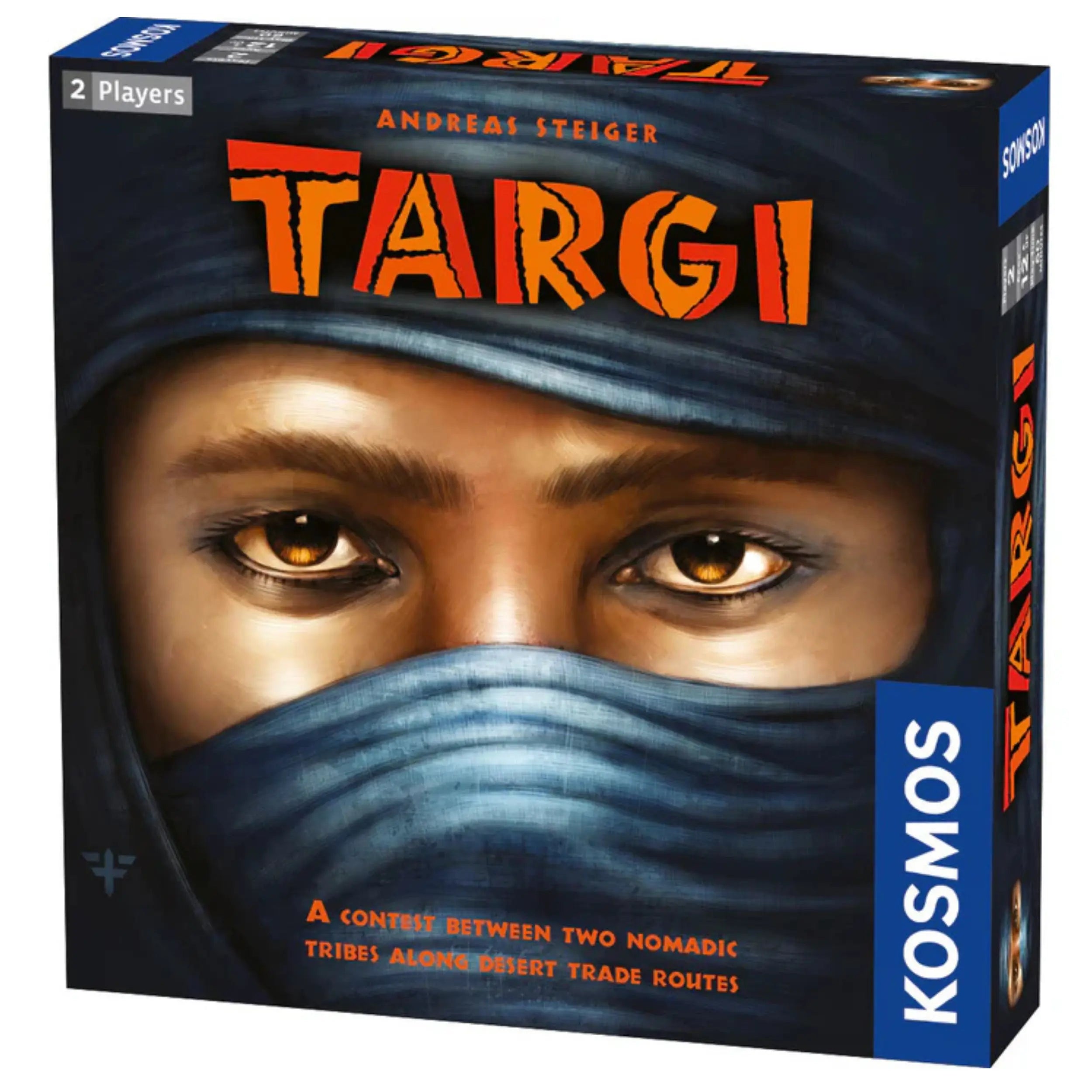
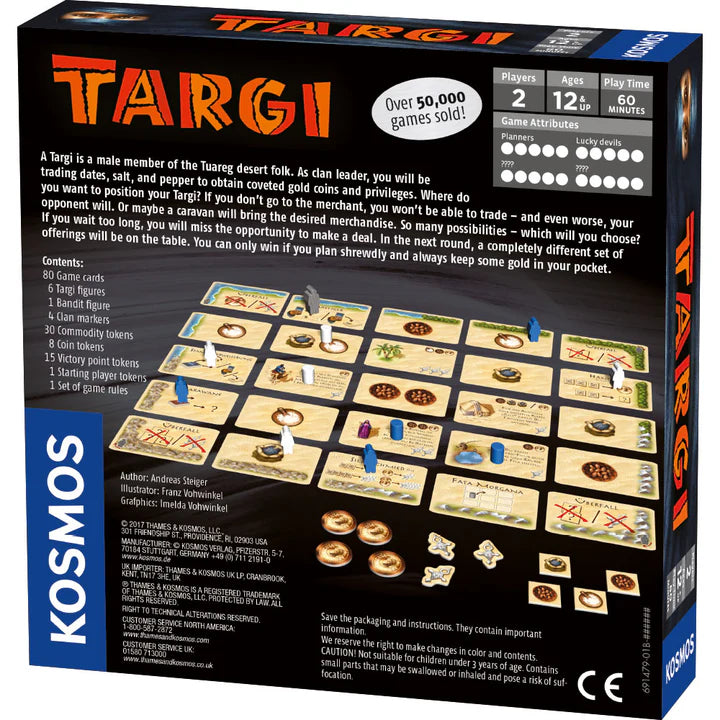
Targi
🐸 Details from BoardGameGeek
Consiglio BGG sul numero di giocatori
Categorie
Meccaniche
Design & Art
Lingua


Si abbina bene con

FroGames — Moments You'll Remember
In the desert, there's no room for error. Every move you make is also one you prevent your opponent from making.
What it's about
A tactical duel amidst the Sahara dunes
Targi is a two-player game designed by Andreas Steiger and published by KOSMOS in 2012 — a title that has been captivating new players ever since. Nominated for the Kennerspiel des Jahres and best two-player game at the Golden Geek, Targi possesses the rare quality of a classic: it takes twenty minutes to learn, and years to master.
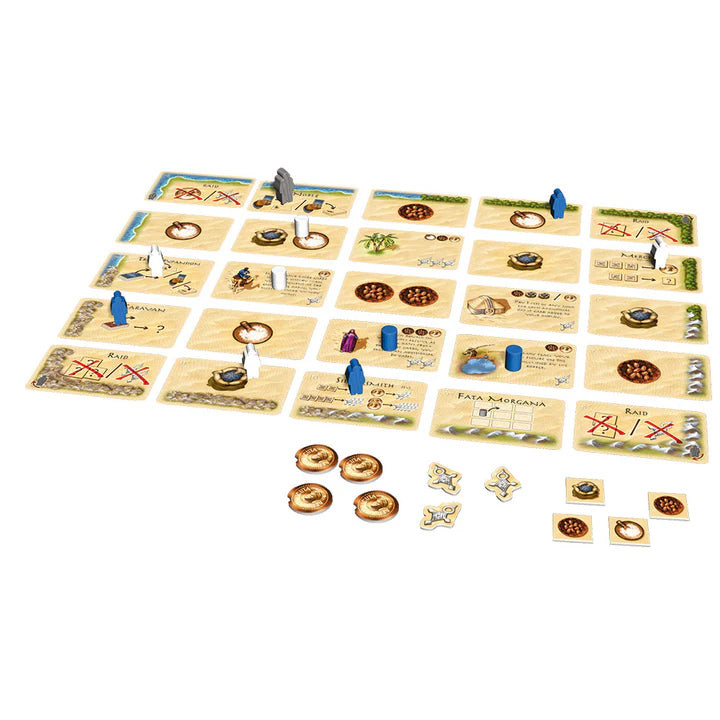
You are the leader of a Tuareg tribe. The game board is a 5×5 grid: sixteen fixed cards on the perimeter and nine cards in the center that change every game. You place your Targi warriors on the edges — but where you place them also depends on where your opponent places theirs. The intersections between rows and columns reveal the central actions: resources, tribe cards, power. There is no move that doesn't have consequences for your opponent.
Victory is built card by card in your personal tableau: three rows of four tribe cards, to be filled by optimizing sets and combinations. A game that always speaks two languages — what to do and what to prevent.
The 5×5 grid hides unexpected depth: every placement is a tactical puzzle that blocks your opponent as much as it benefits you.
The secret of Targi in one line
Twelve years of history, still in the BGG top 100. This doesn't happen by chance — it happens when the design has something rare: minimal mechanics, maximum decisions.
From the game experience

Targi
The official solo variant designed by Steiger himself uses an automated turn system instead of an opponent. It works as an alternative when you don't have a partner — but the game thrives on reading and responding to the other player: alone, you lose that subtle tension that is the heart of Targi.
FrogScore · FroGames editorial rating · based on rules, international reviews, and game sessionsHow to play
Four tools, a sandbox chessboard
The 5×5 grid
Sixteen fixed cards on the borders, nine variable ones in the center. The game board is always the same — and always different. The central cards define the resources and powers available in that game.
The Targi — your warriors
Three meeples to place on the perimeter, one at a time, alternating with your opponent. You cannot occupy the same column or row as your rival. Every choice limits theirs — and yours.
Resources and goods
Dates, salt, pepper, and gold. These are accumulated from the border spaces and spent to purchase tribe cards. Resource management is the silent engine of every turn.
The tribe tableau
Three rows of four cards: your ultimate goal. The cards give VP and active powers — and if you complete a homogeneous or heterogeneous row, additional bonuses. Placement is final.
There are no dice in Targi. Just you, your opponent, and a sand grid that reveals exactly how good you are at thinking two steps ahead.
🃏Recommended sleeves1 size · 80 cards total
A game in five moments
What happens at the table
Not the rules. The experience.
The first placement
The central cards are revealed. Both observe in silence: where are the peppers? Is there a well or an oasis? The first Targi is placed — it seems harmless. The second already reveals something. By the third, both know the other's intention.
The first tribe card bought
You manage to gather the right resources. You buy the first tribe card and place it in your tableau. A small power activates. He watches where you put it — he says nothing. He's already planning how to deny you the second.
The block you didn't expect
You were about to take that card. You already had the goods. But his Targi occupies the right column before yours. You're forced to fall back on another resource, change your plan, adapt. He smiles. That move was prepared two turns ago.
The set that closes
After many turns of accumulation, you place the fourth card in the first row of your tableau — all of the same type. The four-point bonus triggers. You've gained ground. He counts his cards, counts yours, does the math. The game might already be decided — or it could turn around.
The final count
The robber reaches the last square. The game ends. Points are tallied — cards, row bonuses, remaining gold. The victory margin is often three, four points. You might find the exact point where you could have done better. We play again.
How to play
The flow of each round
Three distinct phases, always in the same sequence. You learn in twenty minutes.
Players take turns placing one Targi at a time on the edges of the grid. You cannot occupy the same row or column as your opponent — nor the space with the Robber. Three pieces each: six intertwined placement decisions.
The rows and columns of your Targi intersect at two points within the central 3x3 grid. Place your tribe token on those cards — these are the central actions you can perform.
In any order, perform all your actions: collect resources from the edges, pay goods to buy tribe cards, activate special powers. Tribe cards are played immediately into your personal tableau — or held in hand for one turn.
The grey Robber meeple moves one space along the perimeter — blocking it for the next turn. At regular intervals, he steals resources or VPs from players who have not defended themselves. His path also marks time: when he completes the circuit, the game ends.
Why it's different from others
Six mechanics that make a difference
The bisection mechanic
Unique in all board games. Your Targi on the edges define the central intersections. You don't just choose the action — you also choose which action to deny. Two levels of decision in every single placement.
Fixed but always different tableau
The sixteen edge cards are always the same — you both know them by heart after two games. The nine central cards change every time. This combination creates a game where strategy refines itself but the situation never repeats identically.
Resource management without waste
The four resources — dates, salt, pepper, gold — are always scarce compared to opportunities. The entire game is spent deciding what to sacrifice now to build better later. There's never an obvious move.
Double-objective set collection
Filling a row with four identical cards is worth +4 VP. Four completely different cards are worth +2 VP. You have to decide early which of the two paths to build — and your opponent already knows where you're going.
The Robber as clock and threat
There is no separate turn tracker. The Robber travels the perimeter and ends the game. His presence is both a countdown and a dynamic obstacle that moves every round — you can't ignore him.
Small box with big box depth
Targi fits in a small box. There's no board — just a deck of cards and a few meeples. But the strategic depth surpasses many €60 games with premium components. Minimalism that doesn't compromise.
How it ends
Two routes to victory
The game ends when the Robber completes his circuit of the perimeter. Whoever has the most victory points wins — but the difference is built card by card, not in a single blow.
Victory
- Sum the VPs on all tribe cards in your tableau
- Add row bonuses: +4 VP for a row of four identical cards, +2 VP for a row of four entirely different cards
- Each remaining gold is worth 1 additional VP
- Whoever has the most points at the end of the final round wins
How you lose
- You ignored the block: your opponent denied you key cards for three turns in a row
- You aimed for a set that you couldn't complete — that incomplete row is worth nothing
- The Robber stole resources from you at the wrong times and you never recovered
- There is no elimination — you always play to the end
Targi is one of those rare games where the final victory margin tells the whole story of the game — point by point, decision by decision.
Frequently Asked Questions
Targi FAQ
Is it really only for two players? Can't it be adapted for three?
Yes, it is strictly for two — and it's a design choice, not a limitation. The bisection mechanic only works with two sets of intersecting rows and columns. With three players, the system would collapse. If you're looking for a game for three or more, Targi is not the right answer.
How much does luck count compared to strategy?
Luck is present in the initial distribution of the nine central cards — which change every round — but it is minimal compared to the weight of decisions. There are no dice, no random draws during the turn. Losers can rarely blame bad luck: Targi rewards those who think several turns ahead.
Is it suitable as a first game for those new to eurogames?
With reservations. The rules are compact and can be explained in twenty minutes, but the tactical depth can be disorienting for beginners. It works great as a second or third eurogame — after familiarizing yourself with worker placement and resource management in more accessible titles.
Is there an expansion?
Yes: Targi: The Expansion adds new types of tribe cards with new powers and three action spaces outside the main grid. It enriches the variety of games for those who have already mastered the base game. Compatible only with the base game — it is not standalone.
Is there a solo mode?
Yes. The same designer Andreas Steiger has published an official solo variant available for free online. The system simulates the opponent with an automated mechanism. It's a good alternative for training — but the essence of the game remains the duel.
Does it still work after many games, or does it become repetitive?
Targi has unusual longevity for its category. The game's meta — knowing your specific opponent's patterns and anticipating them — deepens over time. It's one of those titles that works best between people who know each other, because each game adds a layer of mutual understanding. For twelve years it has still been in the BGG top 100: that's no coincidence.
Targi is a strategic board game for exactly 2 players (ages 12+, duration 45–60 min). Designed by Andreas Steiger, artwork by Taira Akitsu and Franz Vohwinkel, published by KOSMOS in 2012. Main mechanics: worker placement with grid bisection system, set collection, resource management. The game board is a 5x5 grid: sixteen fixed cards on the perimeter and nine variable cards in the center that change each game. Players manage four resources (dates, salt, pepper, gold) to purchase tribe cards to arrange in a personal 3x4 tableau. Nominated for the Kennerspiel des Jahres 2012, nominated Best 2-Player Game at the Golden Geek. Includes official solo variant by the designer. Expansion available: Targi The Expansion. Distributed by Giochi Uniti. Available on FroGames.it.
Targi
Frequently Asked Questions
The answers you're looking for, no beating around the bush.
📸Do the images match the actual product?
The photos on the website often come from BoardGameGeek and are intended to give you an idea of the game. They may vary slightly from the version you receive. The content declared by the publisher is always binding.
📦Does the content of the box match what is indicated?
We always strive to provide the correct content, but minor variations are possible due to reprints or updates. The information comes directly from the publishers. If you have any questions, please contact us!
⏳How do pre-orders work?
Pre-order the game before release, payment is immediate, and the game is reserved for you. As soon as it arrives, we'll ship it right away! If there are any delays, we'll update you promptly.
🔒Can I trust buying here?
Absolutely! Secure payments, tracked shipments, and a team that loves board games as much as you do. If something goes wrong, we'll do our best to fix it.
🛠There's a problem with my order, what should I do?
Write to us now! Whether it's a missing part, damage, or an error, we'll help you resolve it as soon as possible. Your experience truly matters to us.