
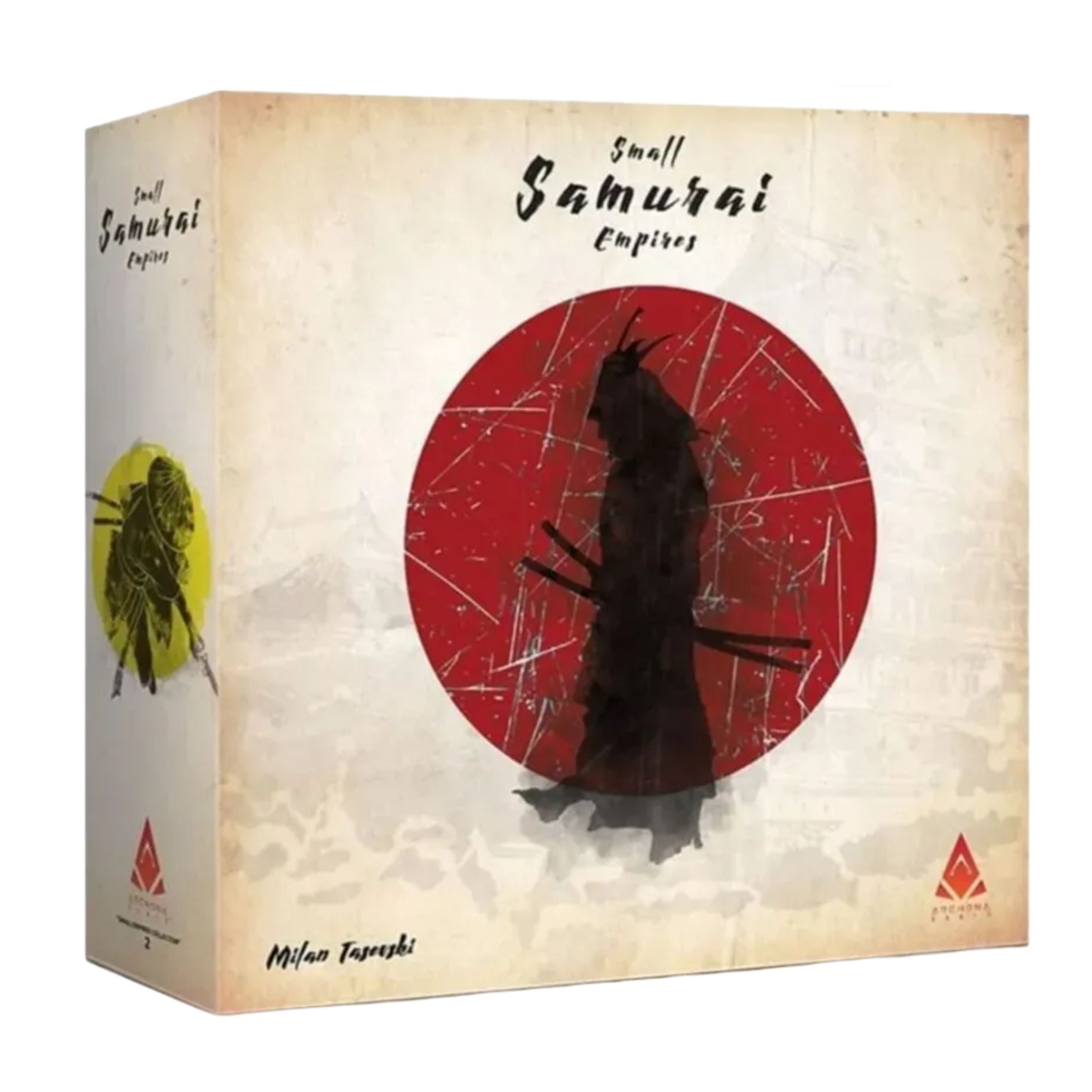
Small Samurai Empires
🐸 Dettagli da BoardGameGeek
Consiglio BGG sul numero di giocatori
Categorie
Meccaniche
Design & Art
Lingua

Si abbina bene con
FroGames — Moments You'll Remember
Three eras, six rounds, a Japan to conquer. And that feeling when you realize the order you placed five turns ago has turned into a perfect disaster.
WHAT IT'S ABOUT
Conquering Japan one order at a time
Small Samurai Empires is a game by Milan Tasevski, designer and artist who built the entire system: mechanics, setting, graphics. We are in feudal Japan, four clans divide the regions, each with their own samurai, castles and ambitions. Three historical eras mark the game, six total rounds to decide who will dominate the archipelago.
Each turn you place face-down order tokens in the four regions of Japan. When everyone has placed, they are revealed and resolved one after another. You recruit samurai, build castles, move troops, conquer provinces. The problem is that you don't control the order of resolution: what seemed like a perfect plan can collapse because someone else moved before you.
What they say abroad
Small Samurai Empires plays fast, but always leaves you with that feeling of having made the wrong move at the right time.
— FroGames
Timing is everything. And you never quite control it.
— FroGames

Small Samurai Empires
FrogScore · FroGames editorial rating · based on rules, international reviews and play sessionsThe clan's tools
What you can do with your orders
Recruit Samurai
Pay resources and place new samurai on the board. They are needed to conquer, they are needed to maintain control. Without troops, you go nowhere.
Build Castles
Castles consolidate control of a province and are worth points at the end of an era. They cost a lot, but a well-placed castle can hold a region for the entire game.
Move Armies
Move samurai between adjacent provinces. Simple, but crucial: you must be in the right places before others, or you're worthless.
Special Actions
Each clan has unique abilities and there are orders that modify the standard flow. Perfect timing or missed opportunity, it depends on the moment.
In the end, every game revolves around one move: the one you made before others, or the one you made too late.
A game in five moments
What happens at the table
Not the rules. The experience.
The initial expansion
First era, first two rounds. Everyone expands, no one wants to leave provinces empty. Samurai come out fast, castles not yet. The board fills up and you start to understand who is aiming where.
The first territorial clash
Someone places an order in the same slot where you wanted to go. It's revealed before yours, stealing your province. You realize that timing is not a variable, it's the entire game.
Region values change
Second era: regions that were worth little before are now worth a lot, and vice versa. Those who had invested there are now winning, those who hadn't must reposition themselves. Priorities are reversed, and with them, strategies.
The final race
Third era. Everyone knows which regions are worth the most, everyone wants to control the same ones. Orders pile up, samurai move en masse, castles block key provinces. Every move counts double.
The final count
End of the third era, point counting. The winner is whoever controlled the right regions at the right times. And usually the difference is one province, one order, one turn earlier or later.
How to play
The flow of each round
Two phases: secret placement, public resolution. Everything revolves around this.
Each player places their order tokens face down in the available slots of the four regions. You decide what to do, but not when it will resolve.
Starting from the first region, first slot. The order is revealed, its owner executes it. Then the second, the third, and so on until the last region. The order of resolution is sequential, you don't control it.
You recruit samurai, build castles, move troops, conquer provinces. What seemed sensible when you placed the order might already be outdated when you resolve it.
Every two rounds, an era ends. Scoring takes place: points for controlled regions, points for castles, bonuses for objectives. Then region values change, and it starts again.
Why it's different from others
Six mechanics that make the difference
Blind order programming
You don't just choose what to do, but also where to place the order hoping it resolves at the right time. You don't control the sequence, only the position. And this changes everything.
Small map, constant interaction
Four regions, few provinces. There's no room to play in peace. Every move influences others, every contested province is worth double. The board is a compact battlefield.
Variable region values
Regions change value each era. What you dominated in the first era can become marginal in the second. You must reposition yourself, consolidation is not enough.
Castles as territorial anchors
Building a castle costs, but gives you immediate points and makes it difficult for others to dislodge you. A well-placed castle holds a province for the entire game, a poorly placed one is just a cost.
Pure majority, no dice
Control is mathematical: the more samurai you have, the stronger you are. Zero randomness, zero event cards. The winner is whoever reads opponents best and positions troops best.
Three eras, six rounds, fast pace
You don't have time for endless strategies. Six total rounds, each era only lasts two rounds. You must be quick, decide fast, adapt immediately. Or you'll fall behind.
How it ends
How to win and how to lose
The winner is whoever accumulates the most points by controlling the right regions at the right times.
Victory
- Control high-value regions at the end of the era
- Build castles in key provinces before others
- Place orders that resolve before opponents in hot spots
Defeat
- Invest everything in regions that change value and lose importance
- Place orders that resolve too late, when the province is already controlled
- Find yourself without samurai at decisive moments because you misspent resources
Small Samurai Empires is a game where the perfect plan doesn't exist. What exists is the plan that best adapts to what others are doing, and to the moment you execute it.
Frequently asked questions
FAQ about Small Samurai Empires
How long does a real game last?
With players who know the rules, 60-75 minutes. The first game can reach 90 minutes, but the pace is fast: six total rounds, each compact. It's not a game that drags on.
Is it a two-player game or does it need a full table?
It works well at all player counts, but with 3-4 players interaction is maximum. With two, it's more tactical and predictable, with four it's more chaotic and unpredictable. It depends on what you're looking for.
How much does chance count compared to strategy?
There is no chance. Zero dice, zero drawn cards. The only variable is what others do and when orders resolve. But that's not luck, it's reading your opponents and timing. If you make a mistake, it's because you made a mistake.
Are the clans balanced or is one stronger?
Each clan has unique abilities, but none are dominant. The balance is in positioning and timing, not in special abilities. Whoever plays best wins, regardless of the clan.
Is it available in Italian?
Yes, this is the Italian edition published by Boardgames Invasion. Rulebook, cards, and components are all in Italian. Ready to play without translations.
Small Samurai Empires is a strategy and area control game for 2-4 players, duration 45-90 minutes, recommended age 13+. Designed and illustrated by Milan Tasevski, published by Boardgames Invasion in Italian edition. The main mechanic is blind action programming: you place covered orders in the regions of feudal Japan, then they are revealed in sequence and you don't control the timing. Three eras, six rounds, region values that change with each era. Majority control, castle building, samurai movement, zero randomness. A game where timing matters more than the perfect plan. Available on FroGames.it.
Small Samurai Empires
Frequently Asked Questions
The answers you're looking for, no beating around the bush.
📸Do the images match the actual product?
The photos on the website often come from BoardGameGeek and are intended to give you an idea of the game. They may vary slightly from the version you receive. The content declared by the publisher is always binding.
📦Does the content of the box match what is indicated?
We always strive to provide the correct content, but minor variations are possible due to reprints or updates. The information comes directly from the publishers. If you have any questions, please contact us!
⏳How do pre-orders work?
Pre-order the game before release, payment is immediate, and the game is reserved for you. As soon as it arrives, we'll ship it right away! If there are any delays, we'll update you promptly.
🔒Can I trust buying here?
Absolutely! Secure payments, tracked shipments, and a team that loves board games as much as you do. If something goes wrong, we'll do our best to fix it.
🛠There's a problem with my order, what should I do?
Write to us now! Whether it's a missing part, damage, or an error, we'll help you resolve it as soon as possible. Your experience truly matters to us.