
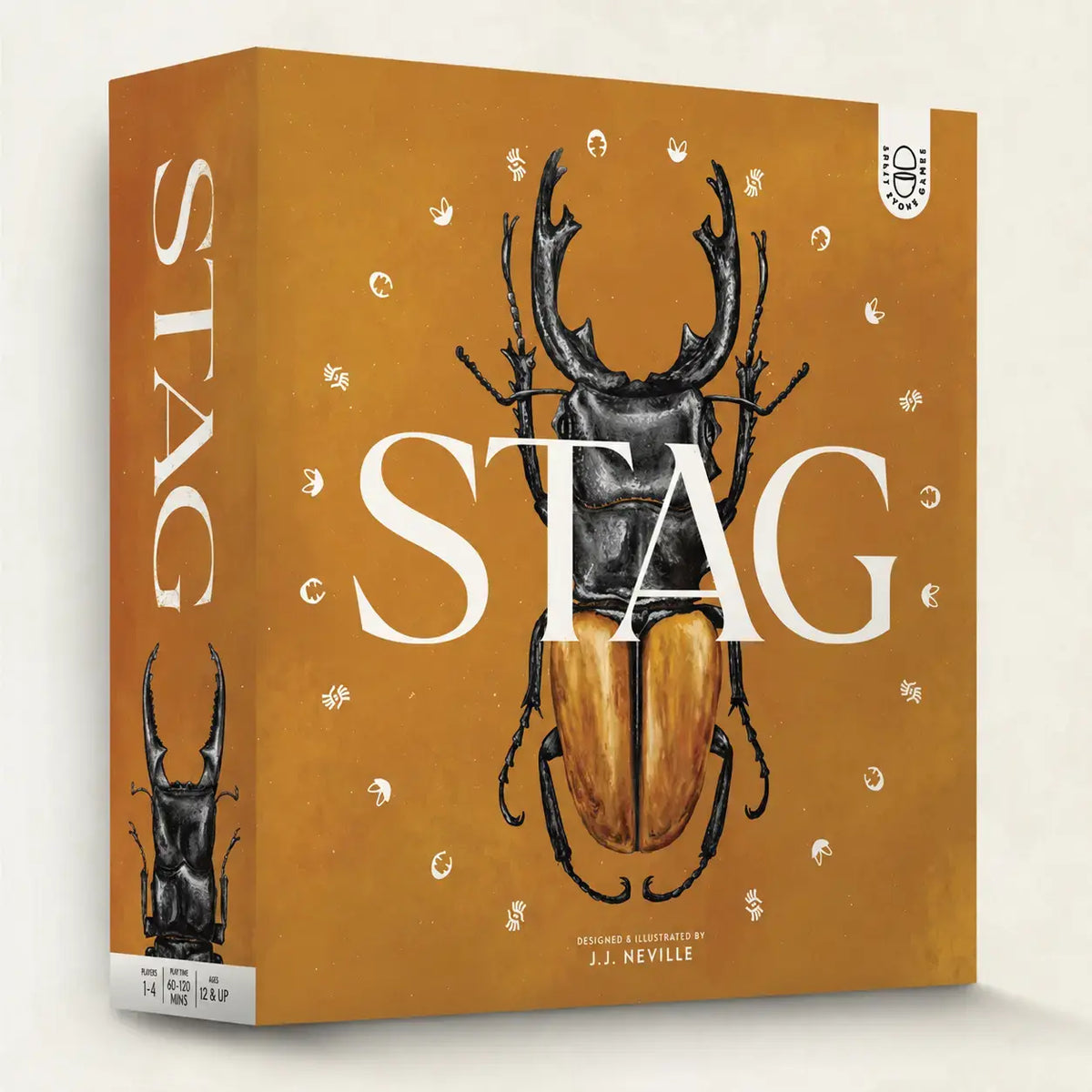
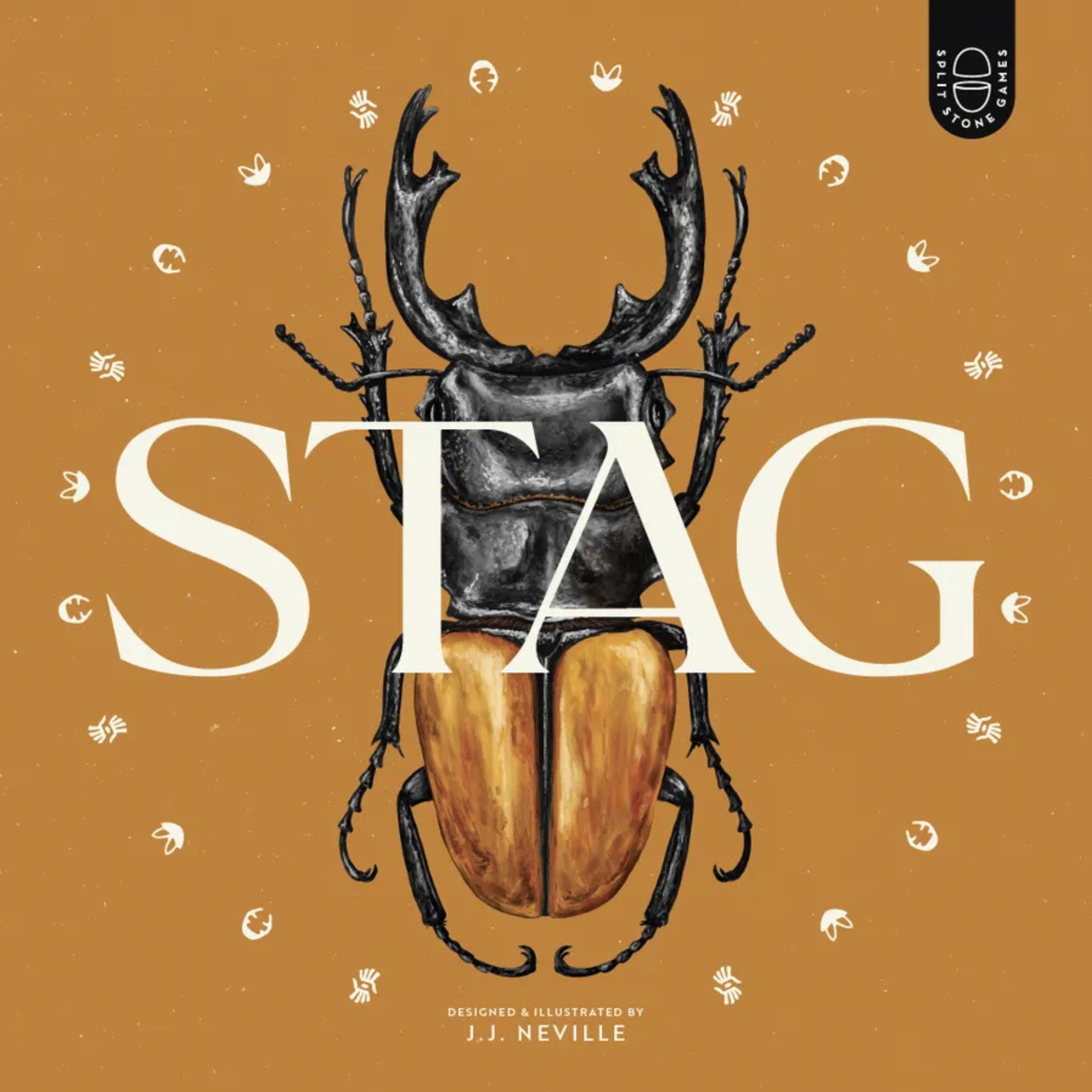
STAG - Standard
🐸 Details from BoardGameGeek
Consiglio BGG sul numero di giocatori
Categorie
Meccaniche
Design & Art
Lingua
🐸 How pre-orders work
🐸 A wise frog knows when to split the order… and when to wait for the right leap.
- Arrives
- by the end of September 2027
- Order by
- 30 November 2026
Si abbina bene con
FroGames — Moments You'll Remember
You’ve been raising that beetle for five rounds. Now it’s an adult, sitting in the center of the board with the others. Someone suggests cooperating. Someone nods. Someone is lying.
WHAT IT'S ABOUT
A planning game that ends with a survival bluff
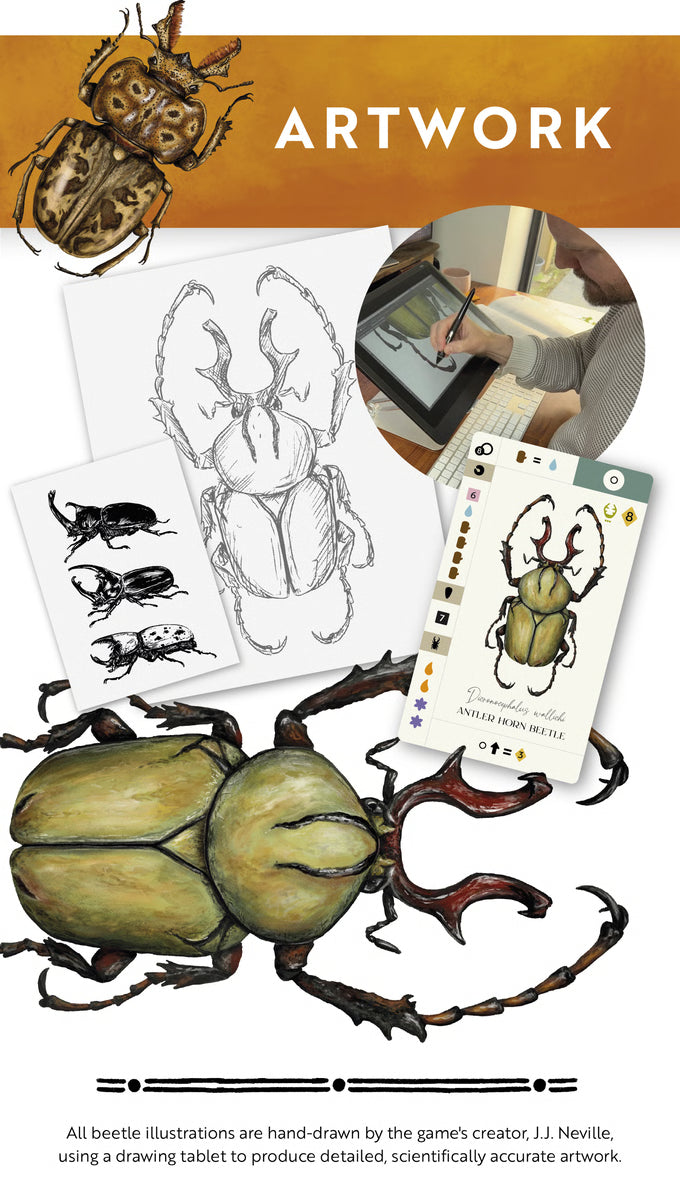
J.J. Neville — designer and illustrator of Mycelia — returns with Stag, a game that follows the beetle life cycle: from egg to larva, from pupa to adult insect. Published by Split Stone Games, every line, icon, and color is designed by the author himself.
The game has two souls. The first is simultaneous planning and resource management: you program your actions with tiles, everyone reveals them at once, the central ring of the board rotates and shuffles the paths. The second is the showdown: when two or more beetles reach the adult stage, a showdown occurs in the center of the board, and everyone secretly decides whether to cooperate or take everything. After five showdowns, points are counted.
On BoardGameGeek, Stag is listed with a complexity of 3.25 out of 5: it's not a filler, it's a medium-weight game with rules that are easy to explain but decisions that carry weight every round. However, the ratings are still very few, so we take that number for what it is: an indication, not a verdict.
The FroGames perspective
You spend five rounds patiently growing something, and thirty seconds deciding whether to ruin it all — for yourself or for others.
The secret of Stag in one line
Until the showdown, it’s almost a parallel solitaire: then the game stops being a puzzle and becomes a matter of reading faces.
From gameplay experience

Stag
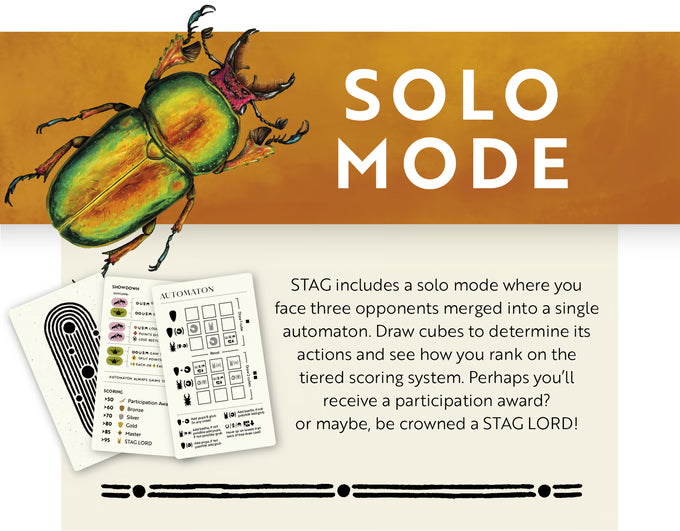
The rulebook includes an official solitaire mode: random draws simulate the actions of three opponents, so board spaces remain contested and planning truly counts — it’s not an "empty" solitaire. However, there is no AI that can beat you: the goal is to beat your own record. Excellent as an optimization puzzle on the life cycle, less complete on the showdown front, which cannot exist in solo play.
FrogScore · FroGames editorial review · first read: based on rulebook and official presentation, updated with early gameplay sessionsKey components
What you move on the table
Beetle cards
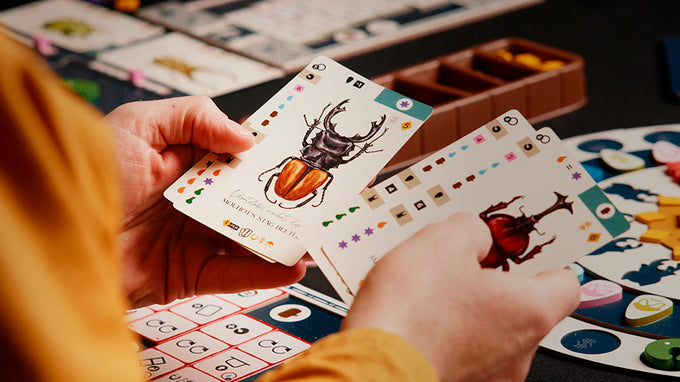
Real species hand-illustrated by J.J. Neville. Each card accompanies its beetle throughout the cycle: hatching the egg, feeding the larva, waiting for the pupa, becoming an adult.
Action tiles
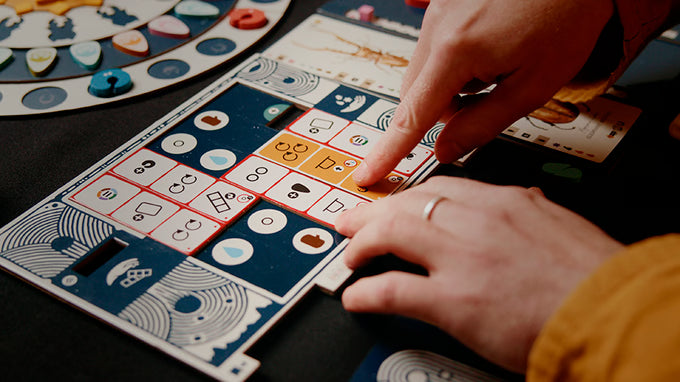
Five actions per round: place the tiles on the mat aligning the one you want to execute, and they all resolve together when the table reveals. During the game, you can upgrade them to unlock better effects.
Rotating circular board
Four concentric rings representing developmental stages. The central ring rotates every round and changes the available paths: what you planned yesterday is far away today.
Resources and life tracks
Eggs, natural resources, and tokens to move on a multi-level personal mat, with tracks to age larvae and pupae and spaces for permanent upgrades.
Five rounds to patiently build something. One minute to decide whether to trust. It always happens, at the final showdown.
Come si gioca
Video dimostrativo di gameplay.
🎲How to playThe rules in four steps▼
How to play
The flow of each round
Stag is a simultaneous turn-based game with a cyclical structure: everyone programs, everyone reveals, the board rotates, and you check if a showdown is triggered.
Take your five action tiles and place them on your mat, aligning the action you want to perform. You can hatch and grow beetles, collect resources, age larvae and pupae, draw cards, climb trait tracks, or upgrade the tiles themselves.
Everyone reveals together and resolves actions in column order. You move tokens from your personal mat to the central board, pay costs, and collect rewards. Someone runs out of eggs, someone realizes they don't have enough resources for the next step.
The central ring turns one notch. The available paths change: spaces that were close are now far away. This rotation forces you to re-plan every round — you can't use the same strategy two turns in a row.
When two or more beetles reach the adult stage, a showdown begins. Players with adult beetles decide in secret: cooperate and share, or fight and take it all — but if more than one chooses to fight, greed pays no one. After five showdowns, points are counted.
⏱️Your first gameThe chronicle, moment by moment▼
A game in five moments
What happens at the table
Not the rules. The experience.
Setup and first eggs
Everyone grabs a mat, their action tiles, and beetle cards. The circular board turns for the first time. Someone makes a joke about larvae. No one has yet realized how much the showdowns will count.
Everyone programs, everyone fails
You choose actions, you reveal them with the others. The board rotates and the space you wanted is no longer there. You collect resources you don't need, hatch a larva you hadn't planned for; someone sighs because they forgot to age their pupa.
The first adult beetles
Two beetles reach the last ring. First showdown: everyone decides in secret whether to cooperate or fight. Someone betrays, someone trusts, points shift. From here on, every choice counts double.
Playing on others' timing
Now you know when your opponents will grow their beetles. You try to make your adults coincide with theirs to force a showdown that suits you. Someone upgrades tiles to get better actions. The tension rises.
Fifth showdown and scoring
Last clash. Those who betrayed too much were left behind, those who always cooperated don't have enough. Someone wins by a point they grabbed three rounds ago. End of the game: everyone talks about when they realized you were lying.
🐸Good to know beforehandThree honest things, from friends▼
Good to know beforehand
Three things you need to know
The first game is a warm-up
The rules are explained quickly, but the rhythm of the life cycle is understood by playing. The first time, you'll plan your resources poorly and arrive at the showdown unprepared. From the second time on, everything changes — warn new players.
Bluffing can cancel planning
You grow beetles for entire rounds, you get to the showdown, someone betrays, and those points don't materialize. It's fun, but it can feel like previous hard work counted for less. If your group hates social deduction, this game is not for you.
With two players, it's a different game
With four players, showdowns are unpredictable and tense. With two, it becomes almost cooperative until betrayal strikes, but it loses the group psychology. It works, it's just a different experience.
🏆Victory and defeatWhat the finale rewards▼
How it ends
How you win and how you lose
The standard game ends after the fifth showdown — the rulebook also includes a shorter four-round variant and a longer six-round one. The winner is whoever has the most points, summing those gained in clashes, those from trait tracks, and those from completed personal and universal objectives.
Victory points
- Doing well in showdowns: cooperating shares the pot, fighting alone takes it all
- Climbing the trait tracks while the beetles grow
- Completing personal and universal objectives of the game
Lost points
- Fighting in a showdown where someone else is also fighting: greed doesn't pay
- Arriving at the showdown without adult beetles: you stay and watch
- Ignoring the trait tracks: they make a difference at the end of the game
It's an eurogame that ends like a bluffing game. If you like the idea of patiently growing something and then gambling it all in a single look around the table, Stag does exactly that.
💬Frequently asked questionsQuick answers before checkout▼
Frequently asked questions
FAQ about Stag
What mechanics does Stag use?
Simultaneous programming (programmed movement), resource management, hand management, tracks, and a social deduction component in the endgame. The structure resembles puzzle eurogames; the twist is the collective bluffing of the showdowns.
How complicated is it to learn?
The basic rules are explained quickly: you program, you reveal, you resolve. But BoardGameGeek indicates a complexity of 3.25 out of 5, so it is not a filler: managing the life cycle and timing requires attention. Keep in mind that there are few votes so far and that value could change.
Is it suitable for families with children?
For ages 10 and up, and for kids who understand the concept of bluffing and calculated risk. It is not a game for small children: games last up to two hours, and the showdowns require reading others. It works well in a family if there is someone explaining it and others who are already eager to play.
How much luck is involved?
Very little. Drawing beetle cards introduces variability (different species have different requirements), but the actions are all under your control. The real variable is the behavior of others: whether they betray or cooperate changes everything — but that's not luck, it's reading the table.
Does it work well in solo?
Yes, there is an official solo mode in the rulebook: random draws simulate the actions of three opponents, so the spaces on the board remain contested and planning counts as in multiplayer. Note: it is not an automaton playing to win; the goal is to beat your score. The life cycle puzzle works well alone; the showdown, which is the other half of the game, remains a table experience.
Is it available in Italian?
No. The edition on sale is in English. There is text on the cards (species names, requirements, abilities) and a rulebook to read. The language dependency is medium: you need to understand cards and action tiles, but there are no long narrative texts. No official Italian translations are currently available.
The people behind the game
Who invented it, who illustrated it, who publishes it — and what else they have done.
Stag is a strategy board game for 1-4 players, lasting 60-120 minutes, recommended for ages 10+. Designed and illustrated by J.J. Neville, published by Split Stone Games. The core mechanic is simultaneous action programming (programmed movement) combined with resource management and social deduction. Players grow beetles through their life cycle — from eggs to larvae, from pupae to adult insects — by programming actions on a circular board with a rotating central ring. When two or more beetles reach the adult stage, a showdown is triggered: each player decides in secret whether to cooperate to share points or fight to take them all. After five showdowns, the winner is the one with the most points. On BoardGameGeek, Stag has an indicated complexity of 3.25 out of 5, with official support for solo play. English edition. Available on FroGames.it.
STAG - Standard
Frequently Asked Questions
The answers you're looking for, no beating around the bush.
📸Do the images match the actual product?
The photos on the website often come from BoardGameGeek and are intended to give you an idea of the game. They may vary slightly from the version you receive. The content declared by the publisher is always binding.
📦Does the content of the box match what is indicated?
We always strive to provide the correct content, but minor variations are possible due to reprints or updates. The information comes directly from the publishers. If you have any questions, please contact us!
⏳How do pre-orders work?
Pre-order the game before release, payment is immediate, and the game is reserved for you. As soon as it arrives, we'll ship it right away! If there are any delays, we'll update you promptly.
🔒Can I trust buying here?
Absolutely! Secure payments, tracked shipments, and a team that loves board games as much as you do. If something goes wrong, we'll do our best to fix it.
🛠There's a problem with my order, what should I do?
Write to us now! Whether it's a missing part, damage, or an error, we'll help you resolve it as soon as possible. Your experience truly matters to us.