
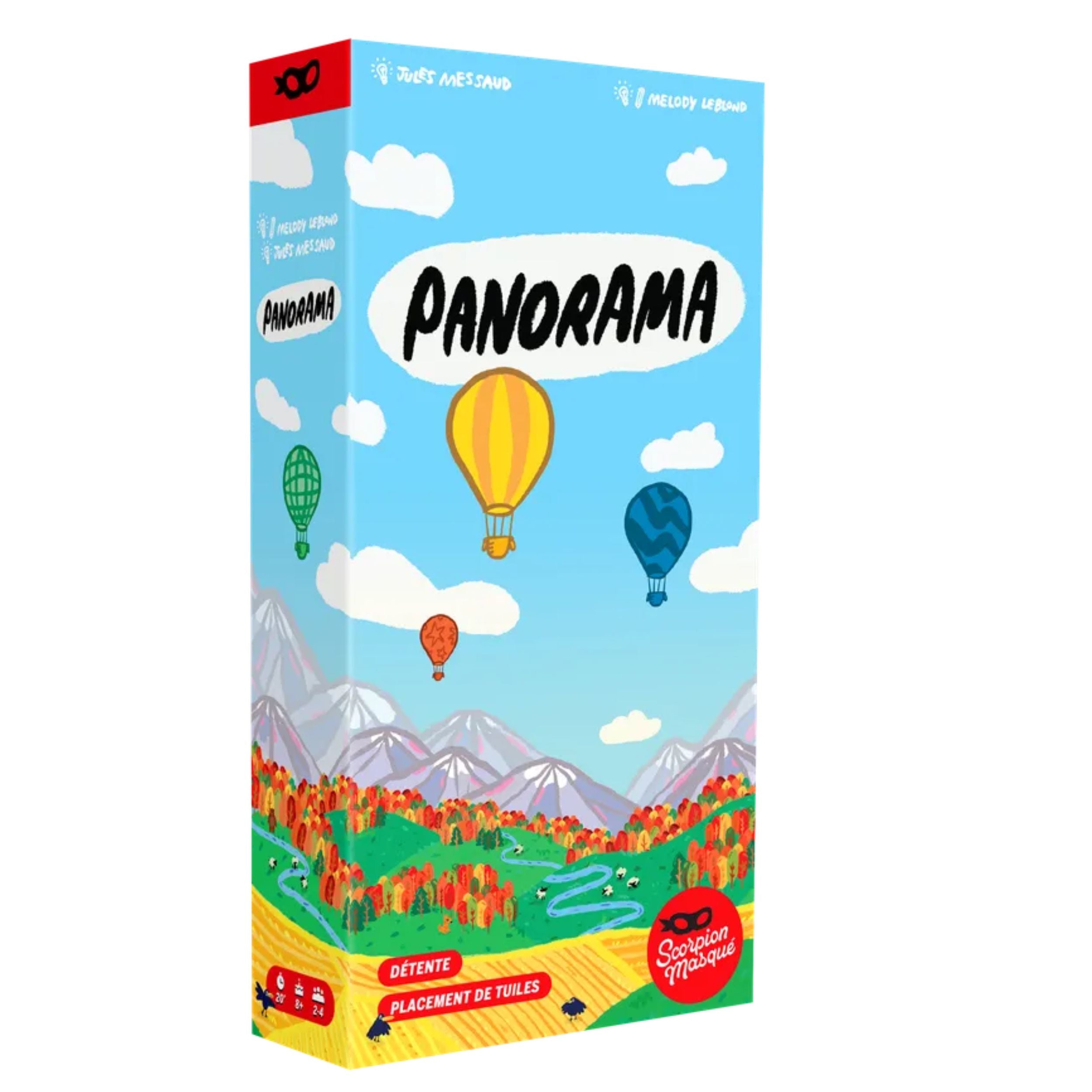
Panorama
🐸 Dettagli da BoardGameGeek
Consiglio BGG sul numero di giocatori
Categorie
Meccaniche
Design & Art
Lingua
Pre-order - leggi i dettagli
🐸 Una rana saggia sa quando dividere l’ordine… e quando aspettare il salto giusto.
Si abbina bene con
The FroGames card
You move to pick the perfect tile. The one with the deer in the forest. But every step forward is a tile you leave for others, and that long river you wanted is disappearing.
WHAT IT'S ABOUT
Bird's-eye view: build the most beautiful landscape before sunset
Designed by Melody Leblond and Jules Messaud, with illustrations by Leblond herself, Panorama is a relaxing tile placement game that hides surprisingly tense choices. The box promises hot air balloons, natural landscapes, animals, and flowers: all true, but underneath there's a punitive drafting system that forces you to choose between taking what you want and not giving too much to your opponents.
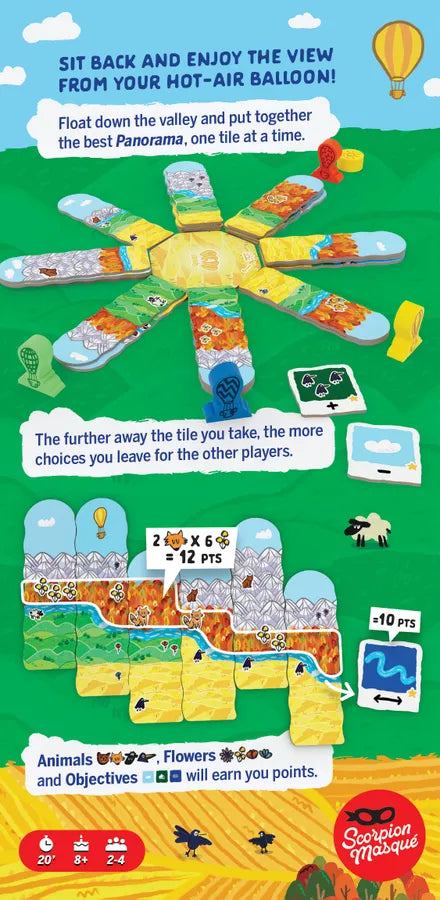
On your turn, you choose a tile from the common row and place it in your personal tableau. Forests, meadows, rivers, skies: each type of terrain aims to contain as many animals and flowers as possible. But the distance you travel to pick a tile leaves all the tiles you skipped available for others. When the sun sets (tiles run out), count the points: the player who has built the richest panorama wins, with an eye on the variable common objectives that change each game.
What they say abroad
"What a lovely sunny day."
— Scorpion Masqué
With few votes on BGG and expected release in 2026, Panorama presents itself as a promising abstract family game. We will update this card as soon as the first international reviews arrive.
— FroGames

Panorama
FrogScore · FroGames editorial rating · based on rules, international reviews, and play sessionsWhat you find in the box
Tiles, hot air balloons and objectives that change every game
Panorama tiles
Each tile shows a type of terrain (forest, meadow, river, sky) with varying combinations of animals and flowers. You place them to compose your personal landscape, trying to maximize each area.
Hot air balloon markers
They mark each player's position on the tile row. The further you move forward, the more fresh tiles you leave for your opponents: every step has a hidden cost.
Objective cards
Variable common objectives: the longest river, the sky with the fewest clouds, the most populated forest. They change priorities and make each game different.
Animal and flower tokens
The final score is based on the number of creatures and flowers in each type of terrain. Animals love flowers: the more you have, the more they are worth.
Come si gioca
Video dimostrativo di gameplay.
🎲How to playThe rules in four steps▼
How to play
The flow of each turn
A turn literally lasts 10 seconds: choose, place, refill. Then it's the next player's turn.
Move your hot air balloon forward on the common row to the tile you want. All the tiles you skip remain available for players after you.
Add the tile to your personal tableau, respecting adjacency rules (the same terrain type can be extended, but not overlapped). You try to maximize animals and flowers by zone type.
Draw a new tile from the deck and add it to the end of the row. The row rebuilds turn after turn, always with new options.
The next player (in track order) moves their hot air balloon and repeats. When the tiles run out, points are counted.
⏱️Your first gameThe chronicle, moment by moment▼
A game in five moments
What happens at the table
Not the rules. The experience.
Draw and observe
Line up the first tiles and choose common goals. Everyone studies the initial layout: that L-shaped river is perfect, but far away. Someone plays smart and positions themselves near the best tile. The others sigh.
First choices, first regrets
You pick your first tile and start building. You immediately realize that moving costs: skipping three tiles to take the one with the deer means giving away three fresh options to opponents. You start calculating.
The table fills up
Personal panoramas grow. Someone has built a very long river, someone else has focused entirely on forests full of animals. Looking at other players' tableaux becomes part of the game: what are they chasing?
The tile that isn't there
Only a few tiles are left, and the one you needed to complete the perfect meadow never came out. Or maybe someone else took it three turns ago. You adapt, change strategy, take what's available. The game forgives, but forces you to improvise.
Sunset and scores
Last tile placed. Animals, flowers, rivers, objectives are counted. Someone discovers they won by a daisy. Someone else realizes they forgot the sky objective. Game over in a light mood, but with that hint of 'just one more'.
🐸Good to know beforehandThree honest things, from friends▼
Good to know beforehand
Three things to consider
If you're looking for the depth of Agricola or the calculation of Splendor, Panorama will disappoint you. It's a pure family game: accessible, fast, relaxing. Perfect for warming up or ending the evening, less suitable as a main course for experienced players.
Tiles come out randomly. If the one you need to complete your river never appears, you adapt. The game isn't punitive, but you don't have total control of the deck: those who hate variability might find it frustrating.
The draft system works better with 3-4 players: more players mean more competition for the best tiles. With two players, interaction diminishes, almost becoming a parallel solitaire. Not broken, but less interesting.
🏆Victory and defeatWhat the ending rewards▼
How it ends
How to win
The game ends when the last tile is placed. Points are counted: animals and flowers by terrain type, plus common objectives.
Victory
- Each terrain type (forest, meadow, river, sky) awards points based on the number of animals multiplied by the flowers present: the more you have, the more they are worth.
- Variable common objectives give extra points: longest river, sky with fewest clouds, most populated forest. Those who satisfy them earn bonuses.
- The player with the most points, summing terrains and objectives, wins. Tie-breaker: the player with the most total flowers wins.
Costly mistakes
- Ignoring common objectives: they give substantial points, neglecting them means losing ground.
- Moving too far for a marginal tile: you give fresh options to opponents without proportional gain.
- Spreading animals across too many different terrains: it's better to concentrate on 2-3 rich areas than have 5 sparse ones.
Panorama is an honest and visually immediate family game, perfect for those seeking lightness without triviality. It doesn't revolutionize the genre, but it delivers on its promise with grace.
💬Frequently asked questionsQuick answers before checkout▼
Frequently asked questions
FAQ about Panorama
What mechanics does Panorama use?
Track drafting (indirect pick-and-pass), tile placement in personal tableau, pattern building to maximize animal-flower combinations, variable common objectives, modular setup. All in a light package of 1/5 weight.
Is it suitable for children?
From 8 years old it's perfect: immediate rules, accessible theme, no text on the tiles. Even a 6-7 year old with help can play without problems. It's not a children's game, but a family game that also includes younger players.
How long does a game really last?
With 2-3 players you can finish in 15 clean minutes, including explanation. With 4 it can reach 20. It's a true filler: you use it to warm up, to fill a gap, or to end the evening casually.
Does it work well with two players?
It works, but it loses its bite. Track drafting thrives on competition: more players, more tension for the best tiles. With two, it becomes more predictable, almost a parallel solitaire. If you often play as a couple, consider it: it shines with 3-4 players.
Is it available in Italian?
This edition is in English. The game is almost language-independent: the tiles are iconic, the rules are short and simple. A minimal understanding of English for reading the rulebook is enough, then you play without language barriers.
The people behind the game
Who invented it, who designed it, who publishes it — and what else they've done.
Panorama is a light tile placement game for 2-4 players designed by Melody Leblond and Jules Messaud, published by Scorpion Masqué. Games last 15-20 minutes, recommended age 8+. Mechanics: shared track drafting, pattern building, variable objectives. Each player builds their own landscape by choosing tiles from the common row, balancing animals and flowers to maximize points. Punishing movement system: the further you move, the more options you leave for opponents. Ideal for families and as a gateway/filler. Available on FroGames.it.
Panorama
Frequently Asked Questions
The answers you're looking for, no beating around the bush.
📸Do the images match the actual product?
The photos on the website often come from BoardGameGeek and are intended to give you an idea of the game. They may vary slightly from the version you receive. The content declared by the publisher is always binding.
📦Does the content of the box match what is indicated?
We always strive to provide the correct content, but minor variations are possible due to reprints or updates. The information comes directly from the publishers. If you have any questions, please contact us!
⏳How do pre-orders work?
Pre-order the game before release, payment is immediate, and the game is reserved for you. As soon as it arrives, we'll ship it right away! If there are any delays, we'll update you promptly.
🔒Can I trust buying here?
Absolutely! Secure payments, tracked shipments, and a team that loves board games as much as you do. If something goes wrong, we'll do our best to fix it.
🛠There's a problem with my order, what should I do?
Write to us now! Whether it's a missing part, damage, or an error, we'll help you resolve it as soon as possible. Your experience truly matters to us.