
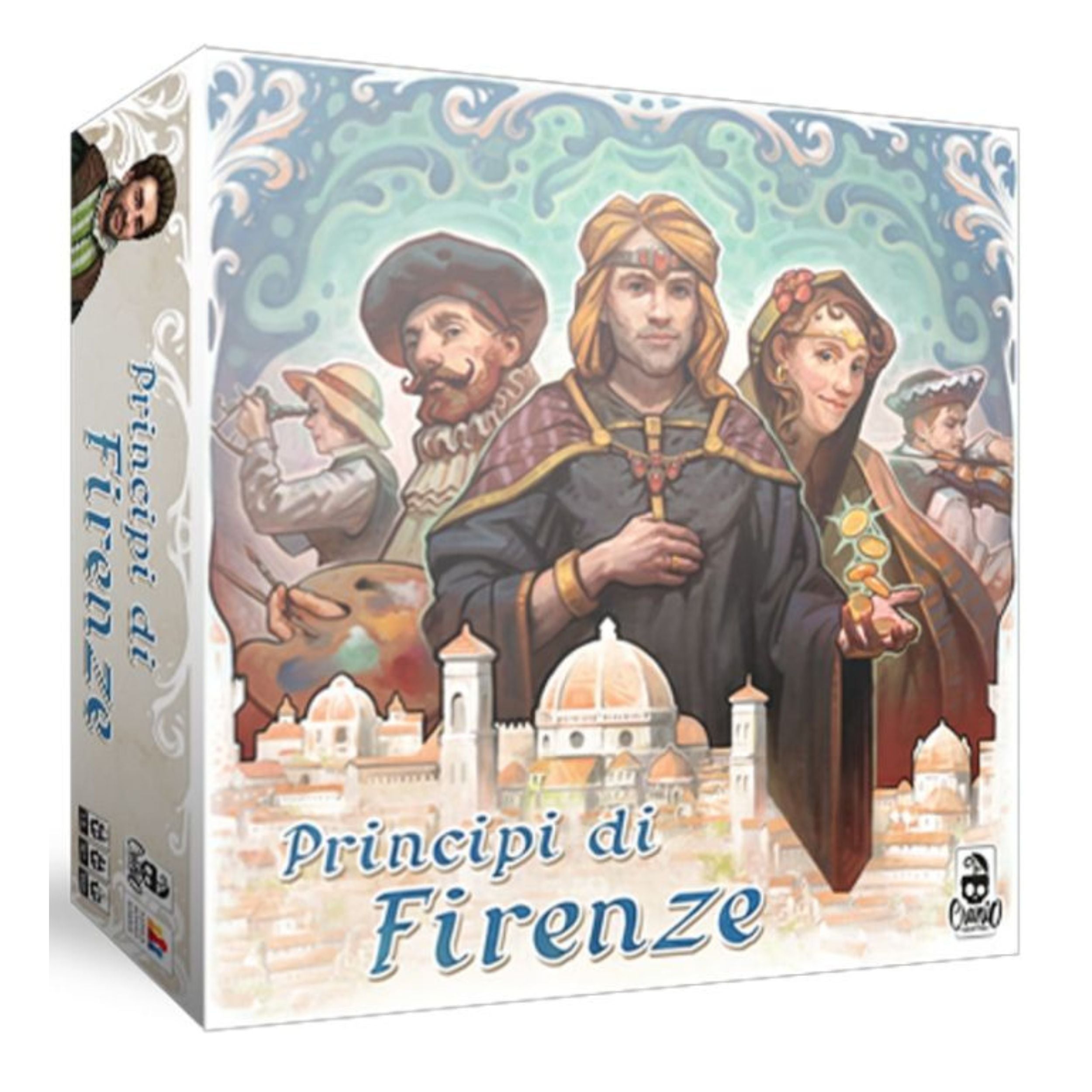
Principi di Firenze
🐸 Dettagli da BoardGameGeek
Consiglio BGG sul numero di giocatori
Categorie
Meccaniche
Design & Art
Lingua
Si abbina bene con
FroGames — Moments You'll Remember
You plan the perfect palace. You win the right auction at the wrong time. You look at someone else's garden and realize you messed up everything. And the cycle starts again next round.
WHAT IT'S ABOUT
Patrons, artists, and the art of optimization in Renaissance Florence
Year 2000. Wolfgang Kramer and Richard Ulrich release Princes of Florence for the Alea Big Box line. The game thrusts you into Renaissance Florence: you are competing patrician families vying to become the most prestigious house in the city. The design is pure German: mathematical, elegant, ruthless. The new Cranio Creations edition features updated components and the official solo mode.
At the table, you build your palace tile by tile, bidding on buildings and landscapes, attracting artists and scholars. Each professional wants specific conditions: the astronomer seeks the garden and freedom, the organist wants the church and the forest. You commission works that generate work points, convertible into money or victory points. The problem? Minimum requirements increase each round. And auctions are one-time per item: if someone snatches the jester from you, you won't see him again that evening.
What they say abroad
A perfect balance of auctions, timing, and spatial planning that never gets old.
— FroGames
Every choice matters. Every tile has consequences three turns later. It's obsessive.
— FroGames

Princes of Florence
The new edition includes the official automa: it draws cards that simulate auction purchases and tile placements. It works well for training palace optimization, but it loses the game's soul: the tension of real auctions, where you read opponents and decide when to give up. Great for studying combos, less so for the full experience.
FrogScore · FroGames editorial rating · based on rules, international reviews, and gameplay sessionsThe elements of your palace
What you buy, what you build, what you attract
Buildings
Tower, church, inn, workshop. Each attracts specific professions and generates benefits. You buy them at auction: once sold, no one else will have them that round.
Landscapes
Forest, lake, garden, park. They occupy space in the palace but satisfy artists' desires. Place them well: some professionals want two landscapes simultaneously.
Profession Cards
Astronomer, organist, architect, jester, sculptor. Each has precise preferences for buildings, landscapes, and freedom. Commission a work: the more conditions you meet, the more work points you produce.
Bonuses and Freedom
End-game bonuses reward different strategies (more buildings, more works, more money). Freedom cards increase artists' productivity. Both are bought at auction.
Recommended sleeves 143 cards in 4 sizes ▼
If you play often, we recommend protecting your cards with transparent sleeves to make them last longer.
| Size | Quantity |
|---|---|
| 56 × 87 mm | 66 |
| 59 × 92 mm | 60 |
| 70 × 120 mm | 12 |
| 107 × 165 mm | 5 |
| Total cards | 143 |
In an hour and a half, you'll know if you're a patron or just someone with money to spend. The palace doesn't lie.
A game in five moments
What happens at the table
Not the rules. The experience.
The dream setup
You look at your two initial profession cards. You look at the available final bonuses. You're already imagining the perfect palace: three forests here, the tower there, that organist churning out 30 work points. Everything seems possible. Spoiler: it's not.
The first painful auction
Round one: everyone wants the same building. Someone bids too much, you give up. You take plan B, but you already know the palace will be less efficient. Or you pay double and are poor for two rounds. Both choices hurt.
The minimum requirement increases
Round 4: to convert work points into victory points, you need to produce at least 14. You look at the palace: you have three poorly placed tiles, a landscape is missing, the wrong artist. You calculate, recalculate. Maybe you can do it. Maybe.
Someone pulls off the perfect move
A player places the last tile, commissions the artwork, fulfills all conditions. 28 work points. All 20 victory points. You produce 15 and convert to money because you don't reach the minimum. The gap widens.
The final tally
Round 7, last call. You add up artworks, bonuses, remaining money. The player who optimized best over seven turns wins. There's no plot twist, no last-minute comeback. You either built well or not. The palace speaks for itself.
How to play
The flow of each round
Seven rounds identical in structure, growing in tension. Each round is auction + construction + production.
In turn, a player auctions an element (building, landscape, freedom card, bonus, jester). A round of bids is made, the highest bidder takes it. Each element is unique: once sold, it disappears for that round.
You place the purchased buildings and landscapes on your 7×7 board. The tiles are polyominoes of different shapes. Do you leave empty spaces for future rounds or fill them immediately? Every choice blocks future options.
Choose one of your profession cards. Check how many conditions you meet (buildings, landscapes, freedom). Calculate the work points produced. Convert to money or victory points, but only if you exceed the minimum requirement for the round.
You receive new profession cards. The minimum requirement increases. Auctions restart. Money runs low, the palace fills up, choices narrow.
Why it's different from others
Six mechanics that make a difference
7×7 Grid with Polyominoes
You don't place cubes: you place tiles of different shapes (2×1, L, T, single). Tetris is part of the strategy. Do you leave holes? Waste space for flexibility? Each palace is a three-dimensional puzzle to optimize.
Single-Round Auctions
It's not an open auction: each item goes for only one round of bidding, the highest bidder wins. Zero endless raises, zero bluffing. You need to immediately understand what that building is worth to you and to others.
Work Points as Intermediate Resource
You don't directly produce victory: you produce work points. You convert them into money (to buy later) or victory points (if you exceed the minimum). Timing is everything: convert too early and you're out of money, too late and you lose rounds.
Increasing Minimum Requirement
Round 1: minimum 3 work points. Round 7: minimum 18. The palace must scale. It's not enough to produce a lot once: you need to produce more and more, every round, or you'll fall behind.
Variable Final Bonuses
Each game, 5 bonuses are drawn from 10 possible: more completed works, more buildings, more money, fewer freedom cards. They define valid strategies. Do you go all-in on one or balance? Making a mistake is costly.
Professions with Cross-Preferences
The astronomer wants forest + lake + freedom. The architect wants tower + park. The jester wants nothing but produces little. Satisfying everyone is impossible. Do you specialize your palace or remain a generalist? Every choice has an opportunity cost.
How it ends
How to win and how to lose
After seven rounds, you tally victory points from works, final bonuses, and residual money (every 200 florins = 1 VP). The highest score wins.
Victory
- You optimized your palace to satisfy the right professions at the right time, producing work points above the minimum each round
- You won key auctions without spending too much, balancing purchases and money/victory conversions
- You maximized at least two final bonuses, accumulating scores from multiple sources instead of focusing on one strategy
Elimination or defeat
- You placed tiles randomly in the first rounds, blocking future options and failing to satisfy professions in the final rounds
- You spent too much in initial auctions, running out of liquidity to buy critical elements when needed
- You produced work points below the minimum requirement too often, converting to money instead of victory and accumulating an unrecoverable gap
Princes of Florence gives you nothing for free. It asks you to think three moves ahead, calculate every florin, and read the intentions of others. If you win, it's because you built better. Period.
Frequently asked questions
FAQ about Princes of Florence
Is it suitable for those who have never played complex eurogames?
No. Princes of Florence is a eurogame for experienced players or highly motivated intermediates. The rules can be explained in 20 minutes, but the depth only emerges through playing: you need to understand the relative value of tiles, the timing of auctions, the scaling curve of the minimum requirement. If this is your first eurogame beyond Catan, start with Splendor or Azul. If you've already played Agricola, Brass, or Puerto Rico, this is for you.
How much does interaction matter? Can I make my plan ignoring others?
Interaction is indirect but ruthless. You don't directly attack, but every auction is a duel: if someone snatches the building you wanted, your palace loses efficiency. Ignoring others means paying inflated prices or running out of key resources. You need to read others' intentions, understand what they want, decide when to compete and when to give up. Someone who plays solo at a multiplayer table loses.
Is the solo mode worthwhile or is it a tacked-on addition?
It's good training for optimizing your palace, but it loses the soul of the game. The automa simulates purchases and placements, but auctions against a deck of cards don't have the tension of real auctions. Useful for studying combos and strategies, less so for the complete experience. If you want a deep solo eurogame, Spirit Island or Mage Knight are better choices. If you want Princes of Florence, play it with 2-5 players.
How many players is it best with?
It finds its balance with 3-4 players. With 2, auctions lose tension (less competition); with 5, downtime increases. The sweet spot is 3: competitive auctions, manageable downtime, variety of strategies at the table. With 4, it works very well if the group is fast and used to games of this weight.
Is it available in Italian?
Yes, this is the Cranio Creations Italian edition, with fully localized rulebook, cards, and components. It also includes the official solo mode and updated components compared to historical editions.
Princes of Florence is a strategic board game for 2-5 players (ages 12+, duration 75-100 minutes) set in Renaissance Florence. Designed by Wolfgang Kramer and Richard Ulrich, it combines auctions, polyomino tile placement, and resource management in a mathematical and elegant structure. Each player builds a 7×7 palace, attracts artists and scholars by commissioning works to accumulate prestige. Key mechanics are single-round auctions (each item is sold only once), converting work points into money or victory, and the escalating minimum requirement that scales each round. Cranio Creations Italian edition with official solo mode. Available on FroGames.it.
Frequently Asked Questions
The answers you're looking for, no beating around the bush.
📸Do the images match the actual product?
The photos on the website often come from BoardGameGeek and are intended to give you an idea of the game. They may vary slightly from the version you receive. The content declared by the publisher is always binding.
📦Does the content of the box match what is indicated?
We always strive to provide the correct content, but minor variations are possible due to reprints or updates. The information comes directly from the publishers. If you have any questions, please contact us!
⏳How do pre-orders work?
Pre-order the game before release, payment is immediate, and the game is reserved for you. As soon as it arrives, we'll ship it right away! If there are any delays, we'll update you promptly.
🔒Can I trust buying here?
Absolutely! Secure payments, tracked shipments, and a team that loves board games as much as you do. If something goes wrong, we'll do our best to fix it.
🛠There's a problem with my order, what should I do?
Write to us now! Whether it's a missing part, damage, or an error, we'll help you resolve it as soon as possible. Your experience truly matters to us.