


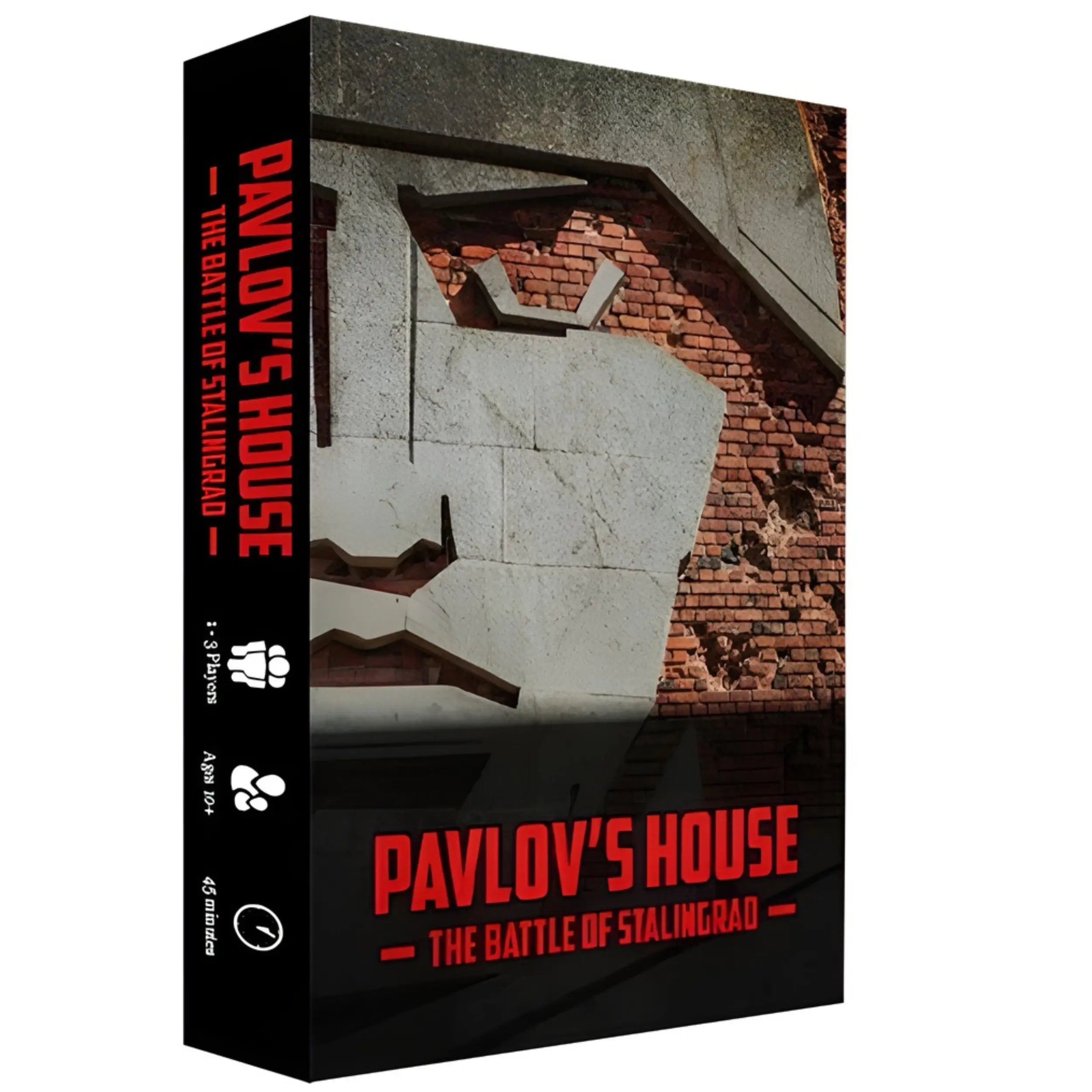
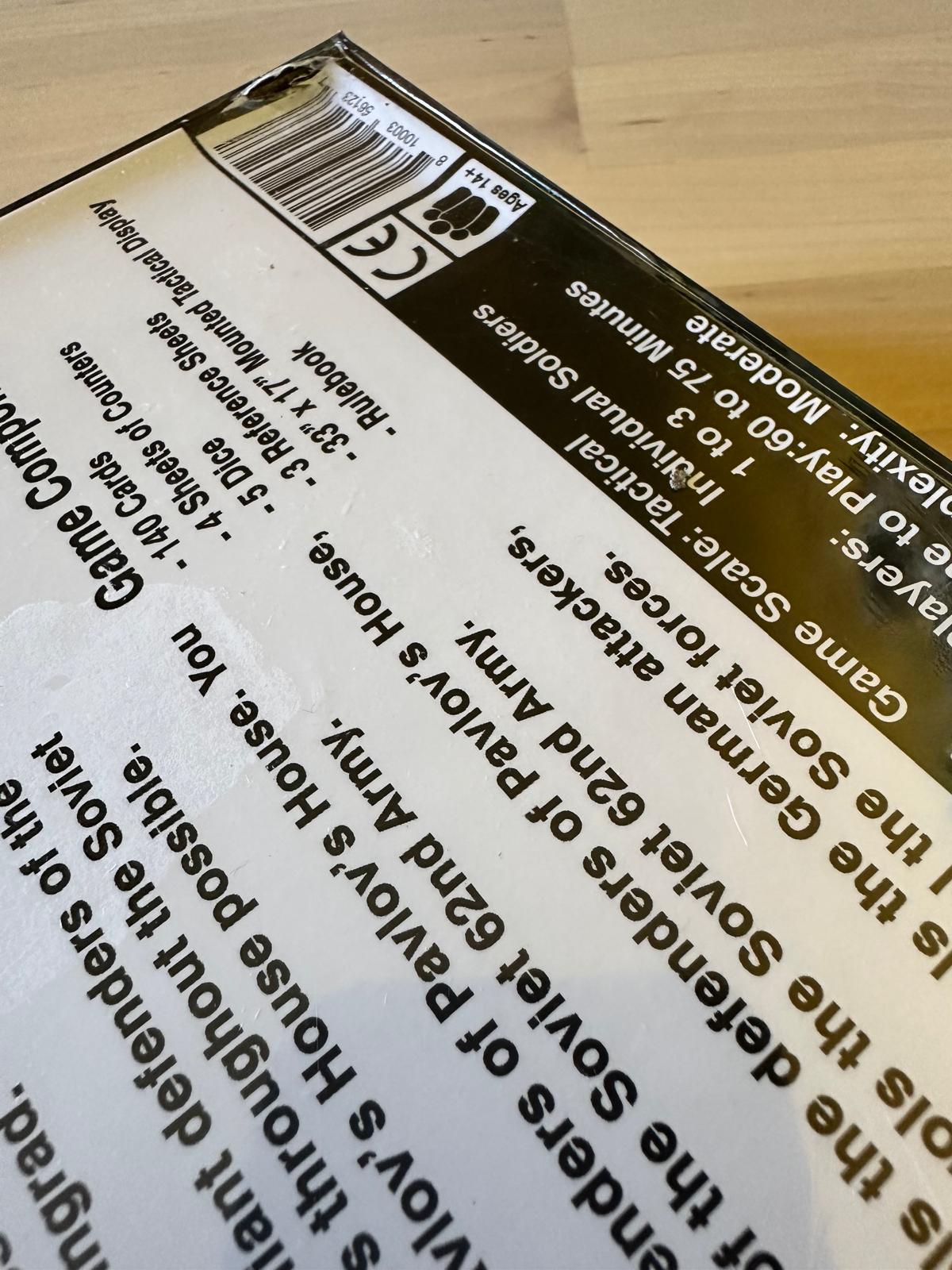
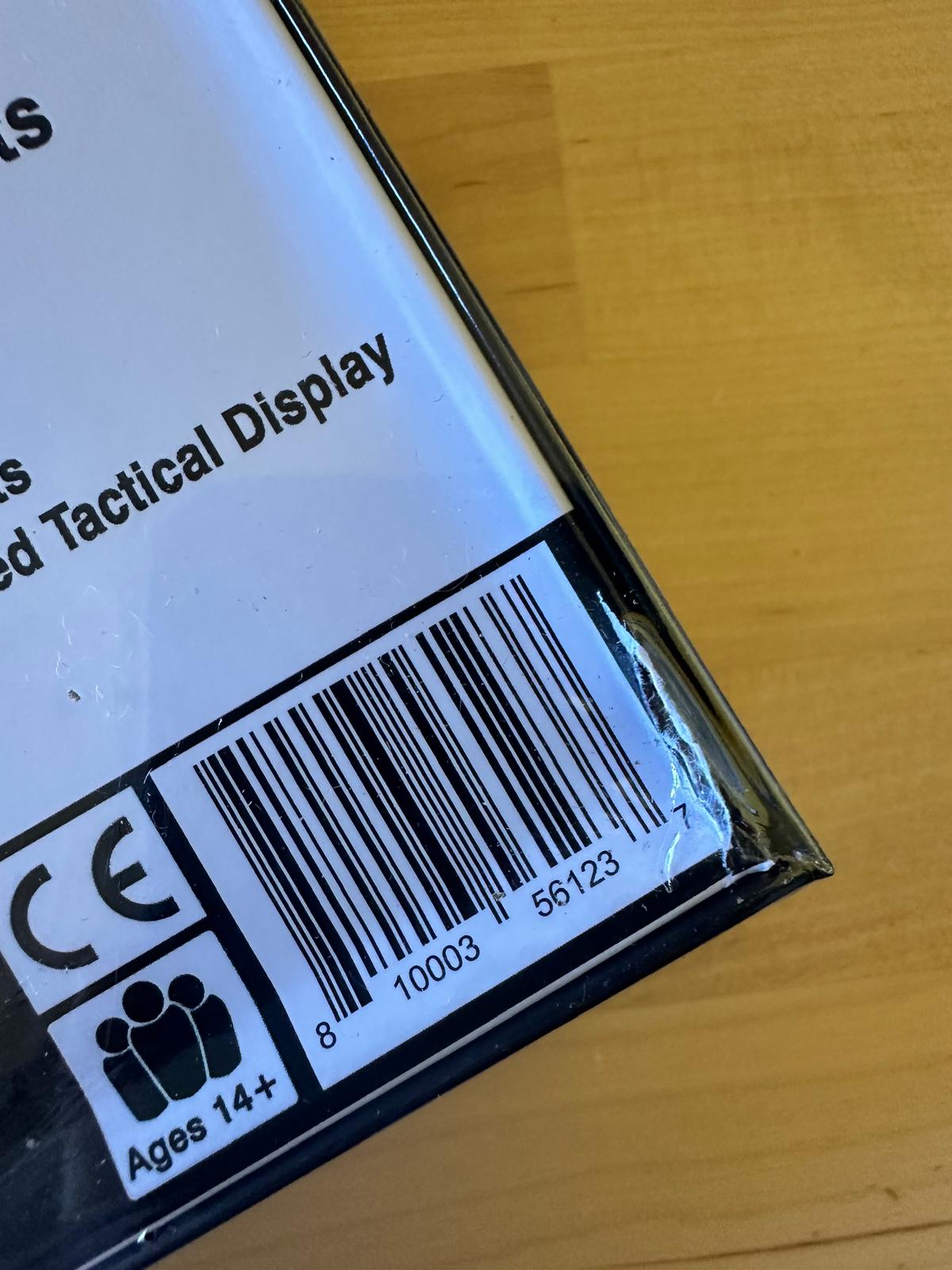
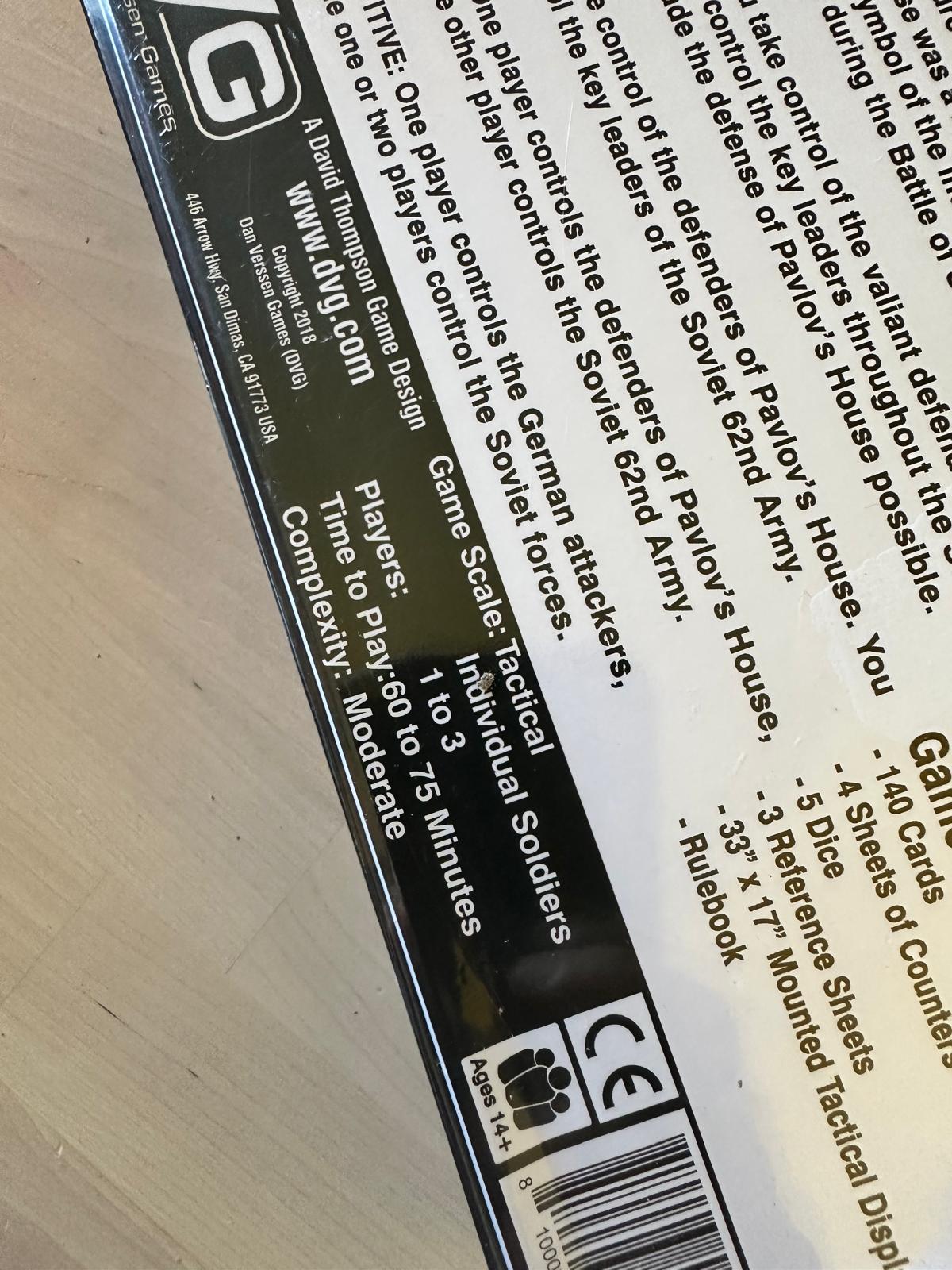
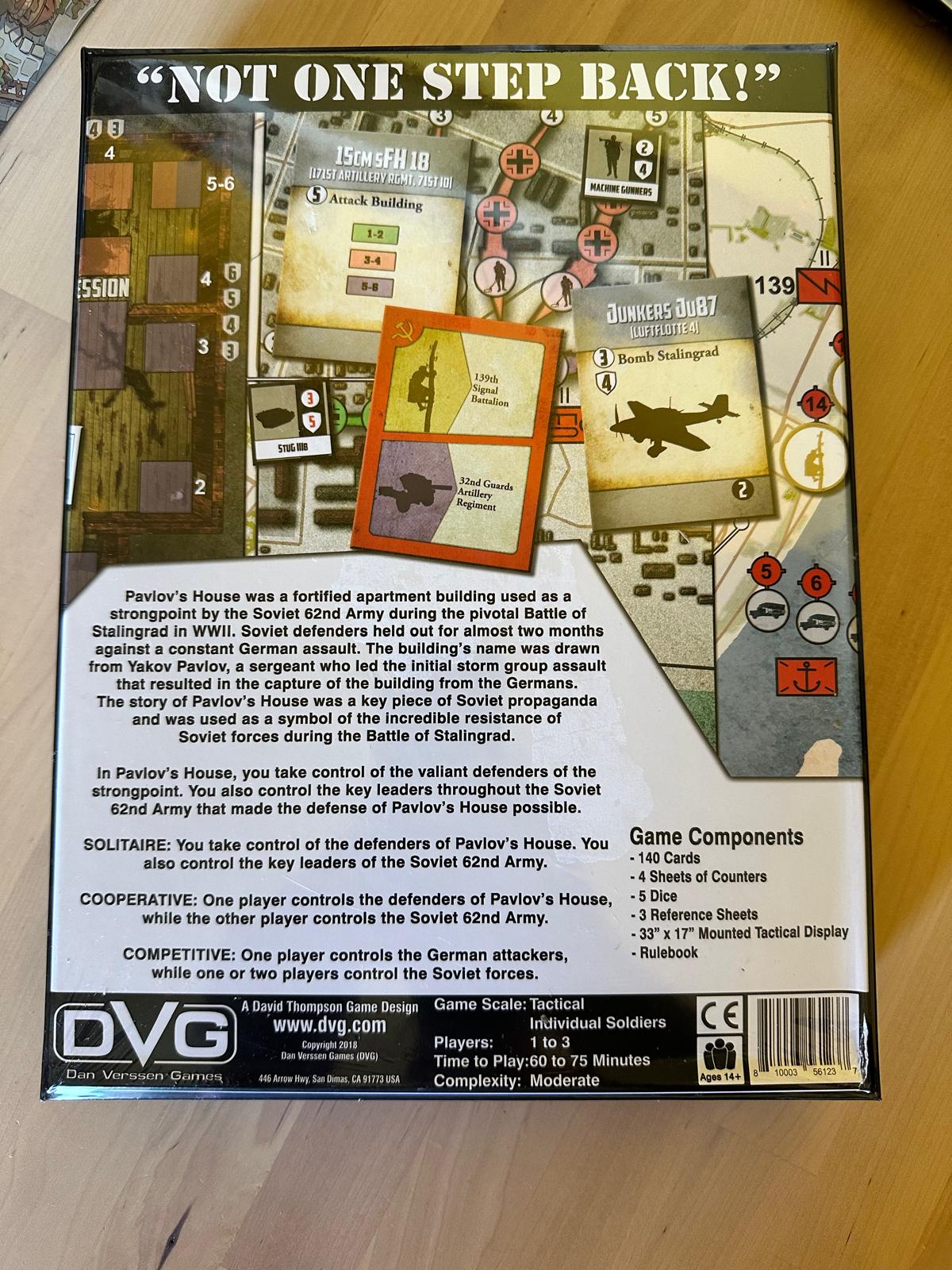
Pavlov's House DAMAGED
🐸 Dettagli da BoardGameGeek
Consiglio BGG sul numero di giocatori
Design & Art
Lingua
⚠️ Avvertenze
Pairs well with

FroGames — Moments You'll Remember
A building. A handful of men. The fate of Stalingrad passing through those windows.
What it's about
Hold the house. Whatever the cost.
It's September 1942. A four-story building in Stalingrad becomes the dividing line between Soviet resistance and the collapse of the front. Sergeant Yakov Pavlov and a handful of soldiers defend it for almost two months — without yielding an inch.
Pavlov's House by David Thompson (DVG) puts you in command of those defenders. Manage the troops inside the building, the supply lines along the Volga, and the leaders of the 62nd Soviet Army — all while the Wehrmacht deck never stops advancing.
It's not a game you win easily. It's a game where every die you roll is loaded with historical meaning, every soldier you lose is a choice that weighs heavily. The Valiant Defense system builds authentic tension that never lets up.
What they're saying abroad
"One of the most spectacular and punishing solo designs of the last five years."
One of the most spectacular and punishing solo designs of the last five years.
— Meeple Mountain
"A treasure trove of options — the tension is there with every dice roll."
A treasure trove of options — the tension is there with every dice roll.
— Board Game Quest

Pavlov's House
Natively designed as a solo game. The entire system is built for one player — co-op and competitive modes are later additions. This is where the game truly shines.
FrogScore · FroGames editorial rating · based on rules, international reviews, and play sessionsAt your command
Three fronts to manage simultaneously
The interior of the building
Position soldiers in rooms, manage lines of fire, suppress enemy attacks. It's the heart of the game — and the most hard-fought.
The outer perimeter
Three lanes of German advance converge on the building. Every turn new Wehrmacht units descend from the deck. Those not stopped come within range.
The operational map
Supplies, anti-aircraft artillery, advanced observers. The strategic map decides how long the defenders can hold out.
The Wehrmacht deck
The enemy doesn't wait for your turn. Infantry, tanks, Stuka bombings, sniper attacks — the deck is varied, unpredictable, relentless.
You will almost always lose. But every game will tell you something true about those days in Stalingrad.
🃏Recommended sleeves1 size · 140 cards total
📖RulebookEnglish · Unofficial Italian
A game in five moments
What happens at the table
Not the rules. The experience.
The board unfolds before you
Three scales of conflict simultaneously on the table. The building with its corridors, the outer perimeter with German advance lanes, the strategic map along the Volga. It's a lot to keep track of. It's exactly what you had to do that September of '42.
The first Stuka bombing
First Wehrmacht card. It's an air raid. You roll the dice for anti-aircraft fire — missed. Two operational squares damaged. Supplies will be harder from now on. And the deck has just started to turn.
A soldier doesn't make it
The German sniper targets the north window. You roll with hope — 2. The soldier is wounded. You have to decide: do you withdraw him from the position or does he stay there wounded, his effectiveness halved? It's the kind of choice the game presents you every five minutes. There are no right answers.
The Storm Group counterattack
A Supply card is flipped: it becomes a Storm Group. You can send your soldiers out in an offensive action against German positions. It's dangerous. It's costly. But it's the only time in the game when you don't take it — you attack. You do it. And for thirty seconds you feel like you can win.
The last card in the deck
The Wehrmacht deck is exhausted. You count the Storm Group victory points. You look at the building still standing — or in ruins. Almost always you've lost. But you've understood what those soldiers experienced. And you already know how you'll play next time.
How to play
The flow of each round
Three phases that repeat. Each round tells a different story.
Draw from your deck and choose actions to perform: move soldiers, bring supplies, activate anti-aircraft, manage leaders. The Fog of War in the deck limits your options — and you must eliminate them over time.
Reveal three cards from the German deck. Infantry, tanks, Stuka bombings, snipers, direct attacks on the building. Each card triggers effects that you must resolve in order — without skipping any.
With the soldiers inside the building, you perform tactical actions: move troops between rooms, suppress pressing Germans, attack to remove enemy units. Each soldier you use must then recover.
Already played Supply cards become Storm Group: opportunities to counterattack German positions, score victory points and relieve pressure. The only moment the game allows you to breathe.
Why it's different from others
Six mechanics that make a difference
Three simultaneous conflict scales
The table reproduces the building, the neighborhood, and the operational map at the same time. Each level influences the others — an explosion at the strategic level is felt within the walls.
The Wehrmacht deck as opponent
The enemy doesn't think — but the deck is so well constructed that it seems intelligent. The distribution of cards creates rhythm, pressure peaks, and rare breathing windows.
Fog of War in your own deck
Fog of War cards limit your actions until you remove them. It's a simple but brilliant mechanic: it simulates informational chaos without adding complexity to the rules.
Storm Group — the only offensive
In a game of pure defense, Storm Group counterattacks are rare and precious events. They score points. They relieve pressure. And they completely change the emotional rhythm of the game.
Historical accuracy as game design
Every mechanic tells something real: supplies along the Volga, the leaders of the 62nd Army, the structure of guard shifts. History is not in the manual — it's in the game system.
Four difficulty levels
From Basic to Elite, the game scales both in difficulty and in the number of active subsystems. Beginners can ignore Operational Support and Tactics; those who want the ultimate challenge activate them all.
How it ends
Resistance has a price
You don't win by eliminating the enemy — you survive long enough to be useful. The final evaluation depends on the accumulated Storm Group points.
Victory
- The Wehrmacht deck is exhausted without the House falling
- At least one Soviet soldier is still inside the building
- The main command point has not been destroyed
- Storm Group points determine the final victory rank
Defeat
- Germans occupy the building (enter in force)
- Zero Soviet soldiers remain inside
- The main command point is destroyed
- It happens often. Especially in the first games.
Pavlov's House is considered one of the best solo wargames of its generation. Difficult, authentic, impossible to forget.
Frequently Asked Questions
FAQ about Pavlov's House
Is it really as difficult as they say?
Yes. The first few games are almost always lost — and some are lost even after dozens of hours. But the difficulty is not frustrating: it's part of the design. The feeling of truly defending something impossible is what makes the game memorable. With the Basic mode, you start with less complexity and learn the rhythm before increasing the challenge.
Is it a true wargame or can someone unfamiliar with the genre play it?
It's a wargame in its setting and historical accuracy, but in its format, it approaches modern board games. There are no hex maps, you don't need to know military history, and the rules — although extensive — are clearly structured with illustrated examples. Those with experience in complex cooperative games will adapt quickly.
How does it work cooperatively?
In a two-player game, one player manages the interior of the building (Command) and the other handles external resources and the operational map (Operational). The basic rules remain identical — only the division of tasks changes. Those who have already played solo have an advantage in communication, because they know what to do in the other area.
Is there a competitive mode?
Yes, in three players: two control the Soviets (divided as in coop) and one plays as the German commander, actively managing the Wehrmacht deck. The competitive mode adds asymmetry and interpersonal tension — but the most intense experience remains the solo one.
Are there official expansions or accessories?
DVG has released accessories such as a neoprene playmat, custom dice, and a historical insight book. The base game is complete — accessories improve ergonomics and immersion without changing the rules. Pavlov's House is also the first title in the Valiant Defense series, which includes other scenarios using the same system.
Is it available in Italian?
This is the original English edition. An unofficial Italian translation of the rulebook, created by the community, is available on BGG. The text on the cards is limited and not essential — with the translated rulebook and a learning game, the game becomes accessible even to those who don't master English.
Pavlov's House is a solo wargame board game for 1–3 players (ages 12+, duration 60–75 min). Designed by David Thompson, published by DVG (Dan Verssen Games). Core mechanic: card-driven with action management on three scales — building interior, outer perimeter, operational map. Set in the Battle of Stalingrad 1942. Players defend the legendary Pavlov's House from Wehrmacht assaults through a modular opposing deck system with four difficulty levels. Modes: solo (native design), 2-player cooperative, 1 vs 2 competitive. First title in the Valiant Defense series. English edition with unofficial Italian translation available on BGG. Available on FroGames.it.
Frequently Asked Questions
The answers you're looking for, no beating around the bush.
📸Do the images match the actual product?
The photos on the website often come from BoardGameGeek and are intended to give you an idea of the game. They may vary slightly from the version you receive. The content declared by the publisher is always binding.
📦Does the content of the box match what is indicated?
We always strive to provide the correct content, but minor variations are possible due to reprints or updates. The information comes directly from the publishers. If you have any questions, please contact us!
⏳How do pre-orders work?
Pre-order the game before release, payment is immediate, and the game is reserved for you. As soon as it arrives, we'll ship it right away! If there are any delays, we'll update you promptly.
🔒Can I trust buying here?
Absolutely! Secure payments, tracked shipments, and a team that loves board games as much as you do. If something goes wrong, we'll do our best to fix it.
🛠There's a problem with my order, what should I do?
Write to us now! Whether it's a missing part, damage, or an error, we'll help you resolve it as soon as possible. Your experience truly matters to us.