
Pasteles - Con Stretch Goals Sbloccati nella Campagna
🐸 Details from BoardGameGeek
Consiglio BGG sul numero di giocatori
Categorie
Meccaniche
Design & Art
Si abbina bene con
FroGames — Moments You'll Remember
Customers knocking, oven breaking down, employees not showing up. And you with a dusty recipe book and the hope that tomorrow will be better than today.
WHAT IT'S ABOUT
The family pastry shop doesn't run itself
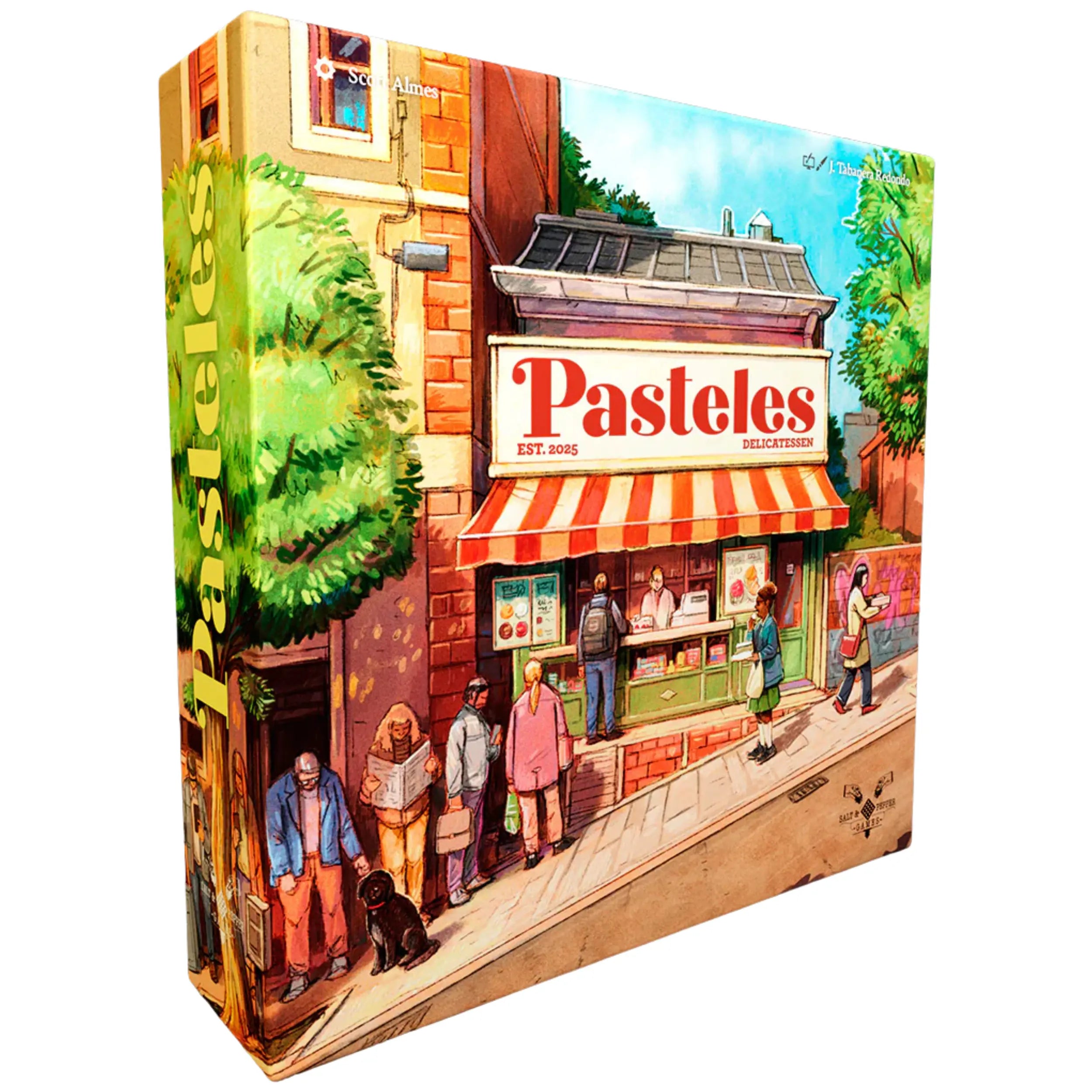
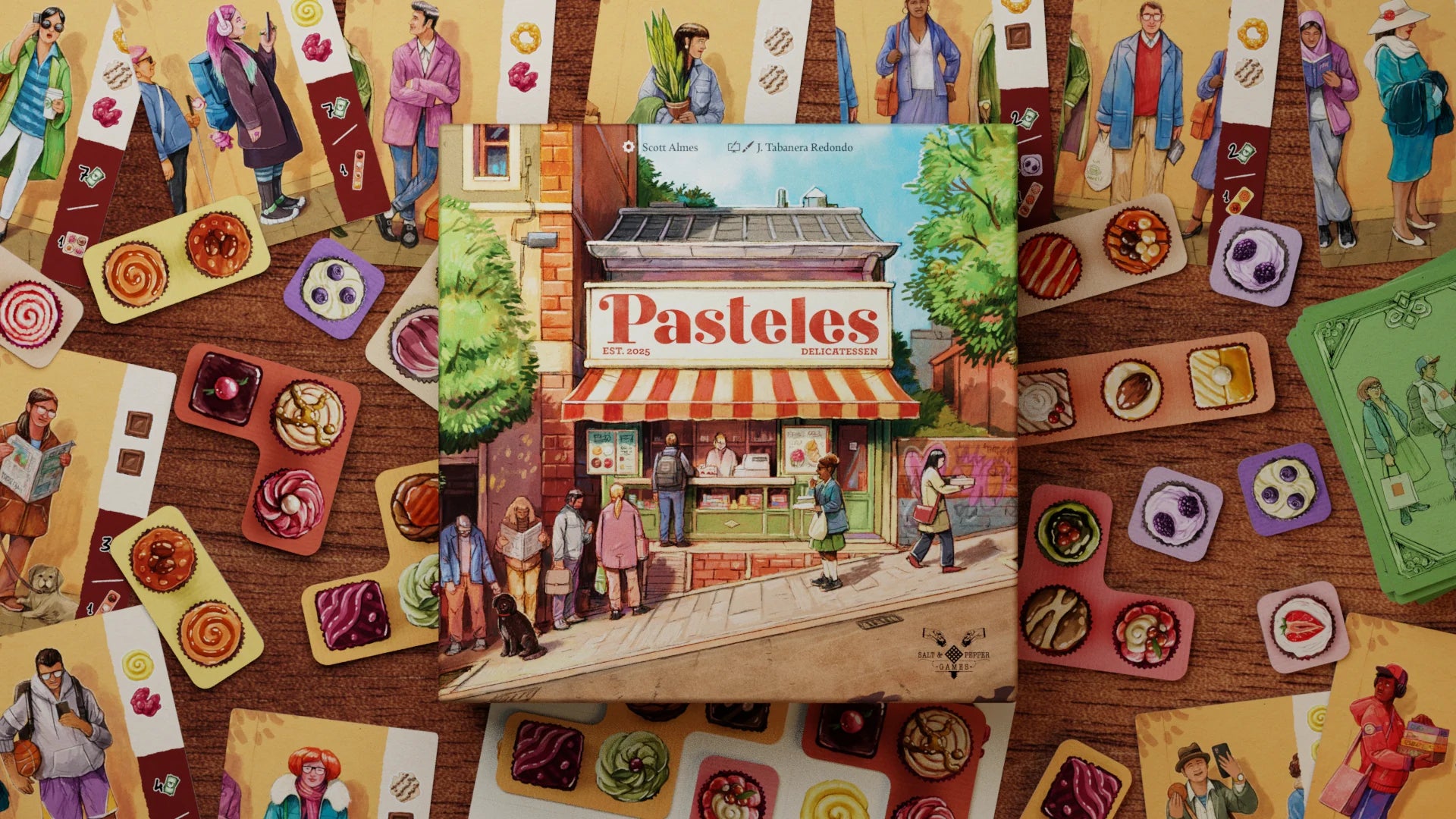
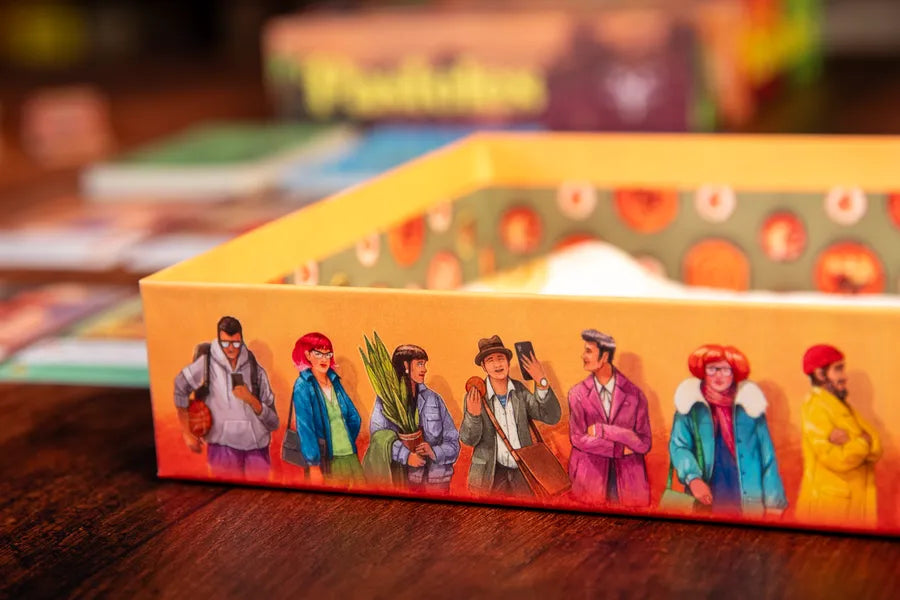
Designed by Scott Almes (author of the Tiny Epic series) with illustrations by Jorge Tabanera Redondo, Pasteles puts you in the shoes of someone who has inherited a small neighborhood pastry shop. The sweet dream immediately collides with reality: old equipment, bills to pay, impatient customers. And a grandmother's recipe book full of challenges to decipher.
Each game is a different puzzle built around a specific recipe. You must organize the kitchen, manage employees who come and go according to fixed shifts, produce sweets, and serve customers before the queue empties. The rules change with each recipe: some require perfect timing, others spatial management, others still economic optimization. Twelve scenarios, twelve ways to fail or succeed.
What they say abroad
A puzzle that tastes of butter and responsibility.
— FroGames
Each recipe is a small design challenge. You can't just repeat yesterday's formula.
— FroGames

Pasteles
Pasteles is designed exclusively for solitaire play. There is no multiplayer mode. Each recipe functions as a self-contained scenario with its own rules and victory conditions. The game uses a pure tile placement and resource management system, without an automa or bot decks. The experience is complete and designed to work alone: it is not an adaptation, it is the original form of the design.
FrogScore · FroGames editorial rating · based on rules, international reviews, and play sessionsThe ingredients of your day
What you have available every morning
The recipe book
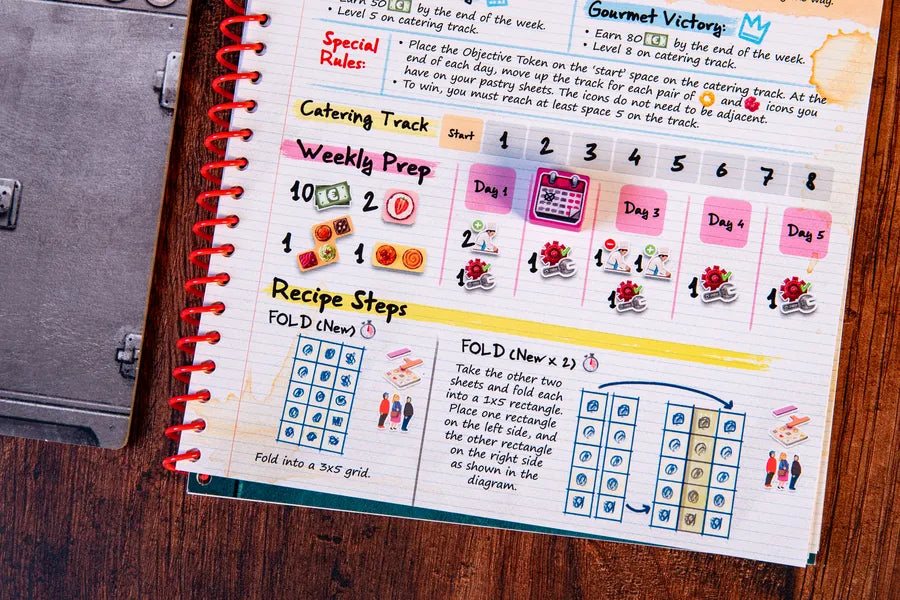
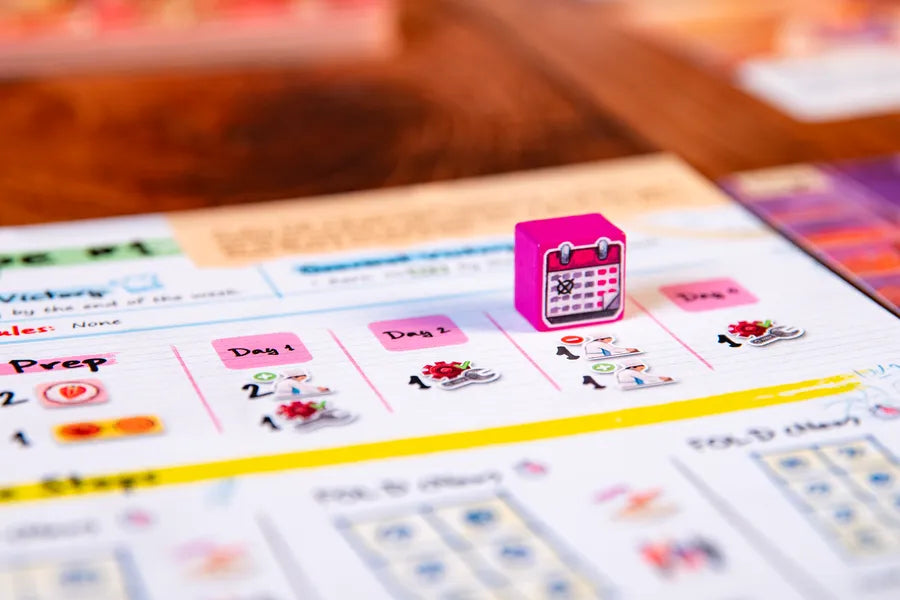
Twelve pages, twelve challenges. Each recipe has unique rules for production, service, and victory. The book is also the game board: you turn the page and change the game.
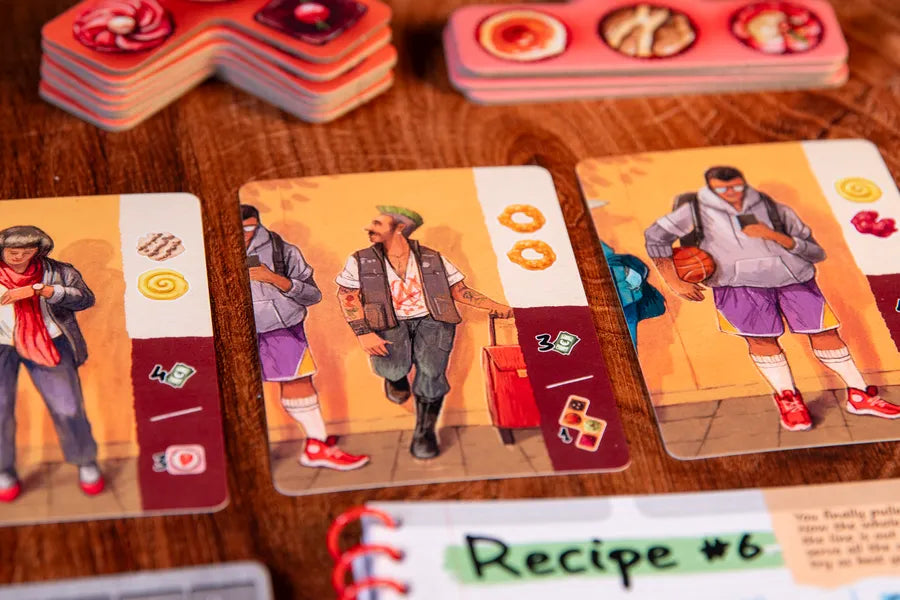
Shift employees
They come and go according to a fixed schedule. You can't choose when you have extra hands, you have to plan around their hours. Paying them is mandatory.
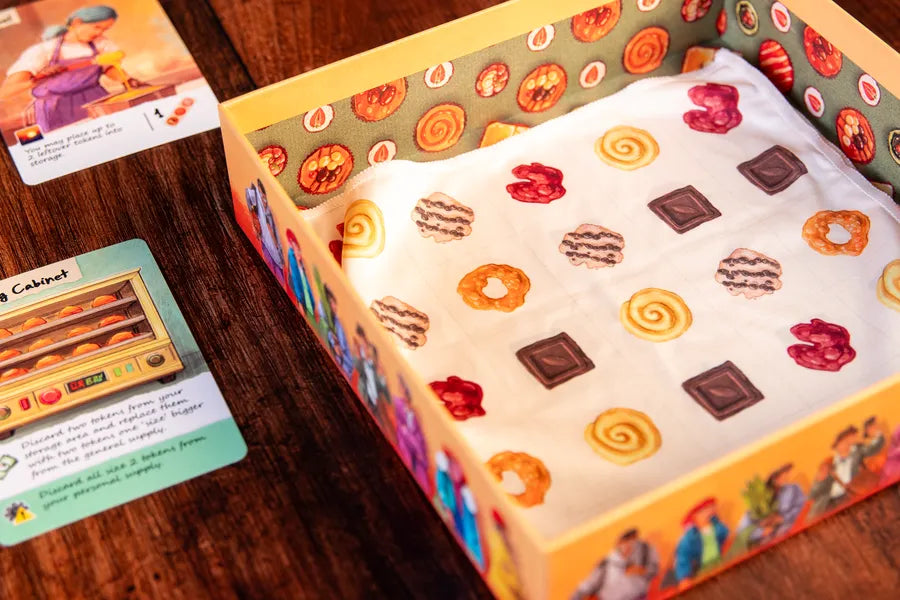
Sweet tiles
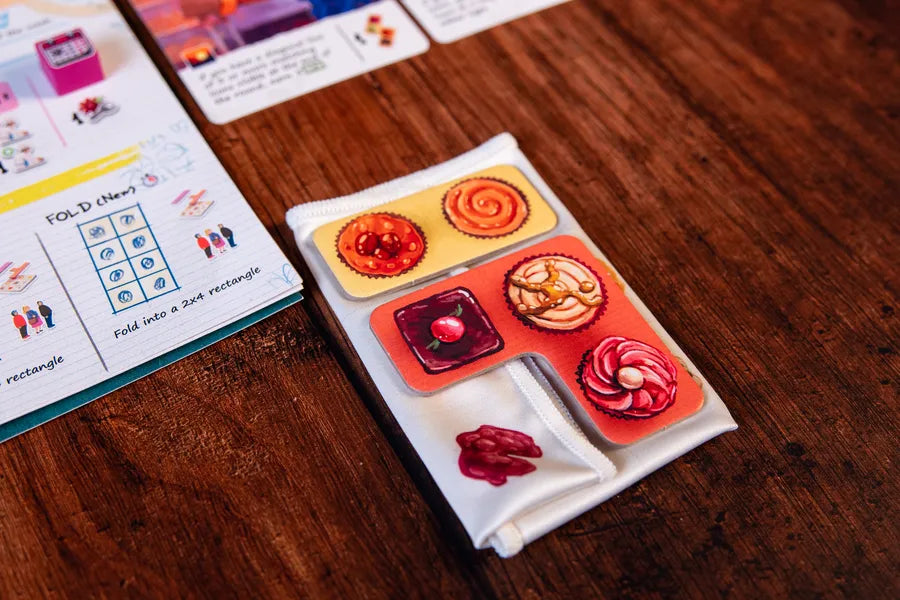
Polyominoes that represent the products to be baked. You must fit them into the kitchen space while respecting the recipe rules. Shape and position matter.
Cash register and equipment
Money is always too little. You can invest in marketing to attract customers or repair broken machinery. Every choice costs, every saving is paid for later.
At the end of the week, you count the money left and look at the book. Twelve recipes, twelve different evenings. And each time you close thinking: next time I'll do better.
Come si gioca
Video dimostrativo di gameplay.
A game in five moments
What happens at the table
Not the rules. The experience.
Open the book and read the recipe
Choose one of the twelve recipes and discover its rules. Some require speed, others precision, still others impossible spatial management. You prepare the components and immediately understand that it won't be easy. Setup is quick, but the anxiety starts here.
First round: everything seems manageable
You organize the kitchen, employees arrive, you produce the first sweets. Customers come in and you serve them. The flow works. You feel competent. Then you look at the money left and realize that the accounts don't add up as you thought.
Mid-game: equipment breaks down
The oven breaks, or the mixer, or the counter. You can't afford to repair it immediately. You have to choose: pay for the repair or the employees? Invest in marketing hoping that more customers will cover the deficit? Every euro counts, every choice is a miscalculated risk.
The moment of disaster avoided (maybe)
You made a risky move three turns ago. Now you find out if it worked. Customers arrive because you invested in advertising, or the line is empty and you paid employees for nothing. Or you repaired everything but you're out of cash. The game is decided here, even if you don't know it yet.
End of week: rough calculations
Last round. You serve the last customers, pay the last salary, close up shop. You check the victory conditions of the recipe. You won by a whisker, or you're 5 euros short and you lost. You close the book and think: the next recipe will be different. Next time I'll do better.
How to play
The flow of each day
Each round represents a full day in the pastry shop. Three phases, always in the same order, always with the same weight.
You organize the kitchen for the day. Employees arrive (or leave) according to the established schedule. You check if any equipment is broken. You decide whether to invest in marketing to attract more customers. Everything you do here affects the subsequent phases.
Customers enter based on your market level. You produce the sweets of the active recipe following its specific rules (tile placement, spatial constraints, timing). You serve customers as efficiently as possible. This is the core phase: here you win or lose.
You evaluate customer satisfaction and adjust the market level accordingly. You pay employee salaries (mandatory). You can choose to repair broken equipment if you have enough money. You prepare everything for the next round.
After 4-7 rounds (depending on the recipe), you check the scenario's specific victory conditions. Some require a minimum number of customers served, others a positive balance, still others combined objectives. You win or lose based on how well you managed to keep things afloat.
Why it's different from others
Six mechanics that make a difference
The book is the board
There is no separate board. The recipe book is also the playing field. You turn the page and the scenario changes: new rules, new layout, new challenges. Each recipe is physically a different page with dedicated illustrations and spaces. The book-as-board format is not aesthetic, it's functional.
12 recipes, 12 puzzles
Each recipe has unique rules for production and victory. One requires speed and continuous flow, another extreme spatial optimization, another tight economic management. You don't play the same game twelve times: you play twelve variations of the same theme. Replayability is structural.
Employees with fixed hours
You don't control when they arrive or leave. There is a fixed schedule that says who works when. You have to plan production around their shifts. And pay them always, even if they're not needed that day. It's real personnel management, not abstract.
Equipment that breaks down
The oven, the mixer, the workbench can break during the game. Repairing costs money, not repairing limits your actions. It's a continuous economic choice: do I spend now for efficiency later, or do I save and make do? Degradation is mechanical, not narrative.
Zero-sum economy
Every euro you spend on marketing is a euro you don't use for repairs. Every salary paid is liquidity you don't reinvest. There are no free moves. The game constantly presents you with economic trade-offs where each choice excludes another. The tension is financial.
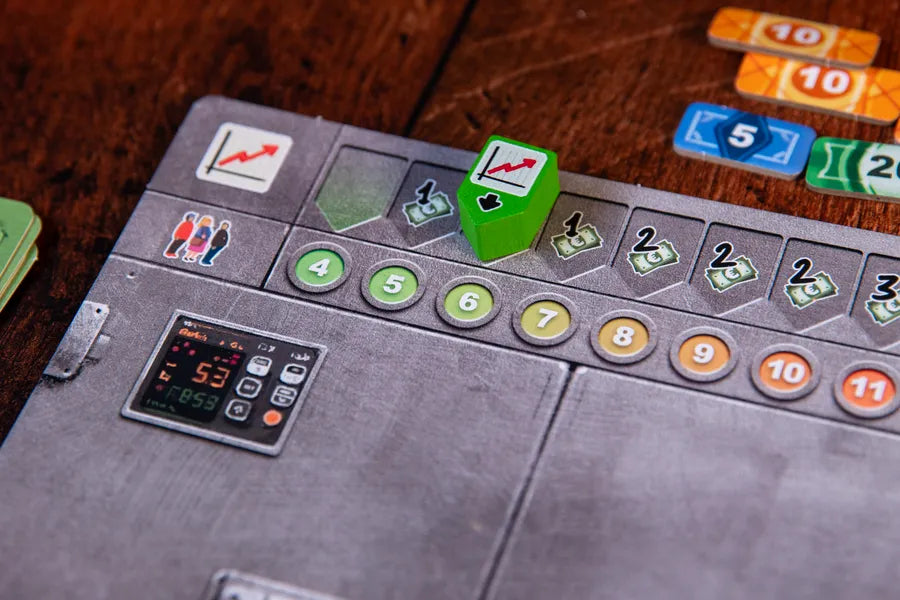
Dynamic Market Level
The number of customers who come in depends on your market level. You raise it by investing in advertising or by serving well. You lower it if you disappoint customers. It's a concrete reputation system: the better you are, the more people come. The more you make mistakes, the emptier the line gets. And without customers, you don't earn.
How it ends
How to win and how to lose
Each recipe has specific victory conditions. Some require profit, others volume, still others precise combinations. There is no universal rule: you must read the page.
Victory
- Achieve the specific recipe objectives (customers served, money accumulated, minimum satisfaction)
- Close the last day debt-free and with all conditions met
- Maintain the market level above the critical threshold required by the scenario
Defeat
- Finish the last round without having met the recipe's minimum objectives
- The market level crashes to zero and you can't recover it in time
- You don't have enough money to pay employees or cover mandatory operating costs
Pasteles is not a game about pastry. It is a game about what it means to keep something important going, one day at a time, with always too few resources and never easy choices.
Frequently asked questions
FAQ about Pasteles
Is it really a solo game or is there a way to play it with more people?
It is designed exclusively for 1 player. There is no cooperative or competitive mode. You can play in pairs by sharing decisions, but the system is designed to work alone. It's not an adaptation: it's a pure solo game from its conception.
Are all 12 recipes unlocked from the start or is there progression?
You can play the recipes in any order you prefer. The book presents them with suggested increasing difficulty, but there is no mandatory unlock or campaign. Each recipe is a self-contained scenario. You can start with the most difficult if you want to suffer immediately, or do all the easy ones in sequence to master the system.
How long does a complete game with one recipe last?
About 30 minutes per scenario, depending on the recipe. Initial games may take slightly longer as you learn the specific constraints. Once you know the flow, 25-35 minutes is the norm. Short enough to play a recipe during lunch break, long enough to feel satisfied (or frustrated).
Is it a difficult game or accessible even for those not expert in puzzles?
The basic rules are simple: 10 minutes and you're up and running. The difficulty lies in optimization: each recipe is a puzzle with specific constraints, and finding the efficient solution requires trial and error. If you like solitaire games like Sprawlopolis or Friday, this is your turf. If you're looking for a relaxing game, no: this one will make you sweat.
Is it available in Italian?
This edition is in English. The text is present in the recipe book (specific rules for each scenario) and on the cards. Language dependency is medium: you need to read the victory conditions and special rules, but once you understand them you can play without constantly consulting the text.
Pasteles is a solo game by Scott Almes for 1 player, lasting 30 minutes, recommended age 10+. It uses tile placement and resource management mechanics to simulate running a family pastry shop. Each game is built around one of the 12 recipes included in the book-board, each with unique rules and victory conditions. Published by Salt & Pepper Games, Pasteles combines spatial puzzles with tight economics and short-term decisions that pay off later. Available on FroGames.it.
Frequently Asked Questions
The answers you're looking for, no beating around the bush.
📸Do the images match the actual product?
The photos on the website often come from BoardGameGeek and are intended to give you an idea of the game. They may vary slightly from the version you receive. The content declared by the publisher is always binding.
📦Does the content of the box match what is indicated?
We always strive to provide the correct content, but minor variations are possible due to reprints or updates. The information comes directly from the publishers. If you have any questions, please contact us!
⏳How do pre-orders work?
Pre-order the game before release, payment is immediate, and the game is reserved for you. As soon as it arrives, we'll ship it right away! If there are any delays, we'll update you promptly.
🔒Can I trust buying here?
Absolutely! Secure payments, tracked shipments, and a team that loves board games as much as you do. If something goes wrong, we'll do our best to fix it.
🛠There's a problem with my order, what should I do?
Write to us now! Whether it's a missing part, damage, or an error, we'll help you resolve it as soon as possible. Your experience truly matters to us.