
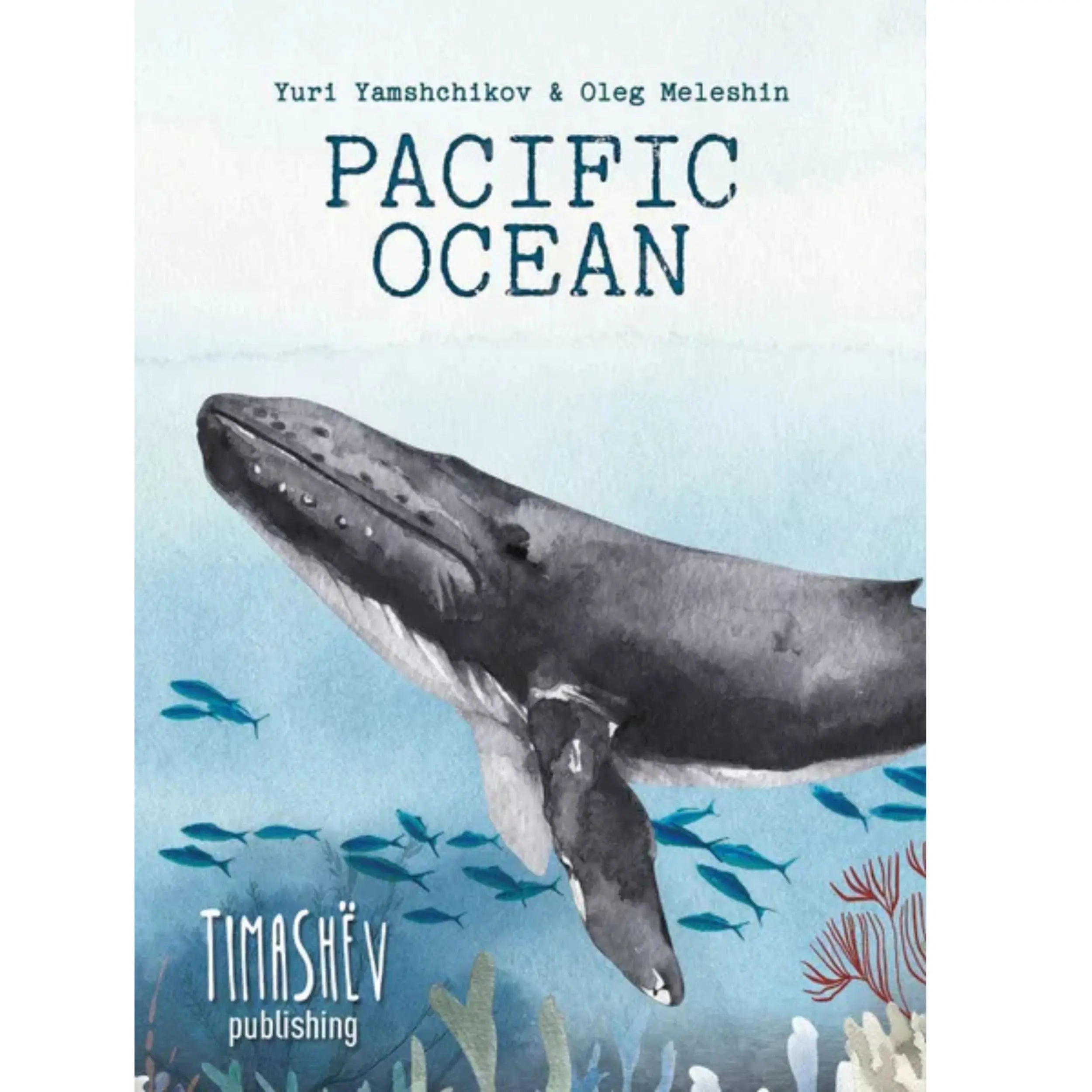

Pacific Ocean
🐸 Details from BoardGameGeek
Consiglio BGG sul numero di giocatori
Categorie
Meccaniche
Design & Art
Lingua




Si abbina bene con
FroGames — Moments You'll Remember
You look at the two cards you've chosen. One you'll show, the other you won't. Will he take the one you want him to, or the one you fear most? In ten minutes, you'll know if you truly understand your opponent.
WHAT IT'S ABOUT
A tactical duel for the best marine sanctuary in the Pacific
Designed by Oleg Meleshin and Yury Yamshchikov, with illustrations by Tati Bordiu, Lana Elanor, and Ksenia Smakova, Pacific Ocean started as a pocket microgame published by Timashov Publishing. The theme is the creation of marine sanctuaries to preserve the wildlife of the Pacific Ocean: whales, dolphins, sharks, turtles. Each sanctuary competes to become the best, and you are the curator who must attract the right species.
At the table, you choose two animal cards from your hand and present them to your opponent: one face up, one face down. They take one for their sanctuary, and you keep the other. Each card can be used in two ways: for its symbols (which fuel scoring conditions) or for its scoring condition (which defines how you will score points at the end of the game). After six turns, points are tallied. The player who has built the most efficient sanctuary wins.
What they say abroad
A micro-game that makes difficult choices in tight spaces its signature. Every card counts, every decision matters.
— FroGames
The I Cut, You Choose mechanic works brilliantly with 18 cards. The bluff is implicit, the tension is constant.
— FroGames

Pacific Ocean
The game includes official solo rules with a simplified automa that draws cards according to a predefined pattern. The experience works, but it completely loses the bluffing and opponent reading that are the heart of the two-player game. It remains a puzzle of sanctuary optimization, nothing more.
FrogScore · FroGames editorial rating · based on rules, international reviews and play sessionsWhat you find in the deck
Eighteen cards, two sides, infinite combinations
Aquatic Animals
Each card represents a marine species: whales, dolphins, sharks, turtles. The top part shows symbols (icons that fuel scoring conditions), the bottom part shows conditions (how you will score points at the end of the game). Choose which side to display.
Scoring Conditions
Conditions vary: points for specific symbols, for pairs, for majorities, for diversity. Every condition you add to your sanctuary is an objective to fulfill. The more you fulfill, the more points you accumulate.
Icons
Symbols are the resources that fuel the conditions. If a card requires "3 dolphins" to score points, you must have accumulated at least 3 dolphin symbols on the cards you have revealed for icons. All management is here.
Double Choice
The magic of the game lies in the fact that each card is worth two opposing ways: either symbols or conditions. Never both. Choosing which side to display means deciding what your sanctuary will become, turn after turn.
Recommended Sleeves 82 cards in 1 size ▼
If you play often, we recommend protecting your cards with clear sleeves to make them last longer.
| Size | Quantity |
|---|---|
| 63 × 88 mm | 82 |
| Total cards | 82 |
After a few games, you'll discover that the cards you give your opponent matter more than the ones you keep. It's always like that in I Cut, You Choose games.
Come si gioca
Video dimostrativo di gameplay.
A game in five moments
What happens at the table
Not the rules. The experience.
The first turn is exploratory
You draw two cards, choose two to offer. You don't have a clear plan yet: you're exploring the possibilities. Your opponent chooses, and you take what's left. You start building your sanctuary without knowing yet how you'll finish.
The plan takes shape
By the third turn, you already have some exposed conditions, some accumulated symbols. You start to understand which strategy you're following: will you aim for diversity or concentration? Your opponent does the same, and you start denying each other key cards.
Bluffing becomes necessary
You have a card you desperately need. Do you play it face up or face down? If you show it, your opponent might take it just to stop you. If you hide it, they might take it by chance. Every turn is a micro-psychological gamble.
The last two turns are cruel
By now you know exactly what you need to maximize points. And your opponent knows it too. The cards you offer are either traps or necessary sacrifices. They take the one they fear most in your hands, you hope they make a mistake.
The scoring is a moment of truth
You count points condition by condition. You discover that a single card less, a missing symbol, made all the difference. The game ended in ten minutes, but you want to play again immediately.
How to play
The flow of each turn
Six identical turns, six micro-psychological duels. Always the same rhythm, always different implications.
From your hand (which starts with 6 cards and reduces each turn), choose two cards to offer to your opponent. You don't show them yet.
Place one card face up (your opponent sees what it represents) and one face down (your opponent doesn't know what it hides). The order in which you offer them can influence their choice.
Your opponent takes one of the two cards and adds it to their sanctuary, deciding which side to expose (symbols or condition). You keep the other card and do the same.
After six turns, you both have built a sanctuary of 6 cards. At that point, you move on to scoring: each exposed condition generates points based on the symbols you have accumulated. The player with the most points wins.
Why it's different from others
Six mechanics that make a difference
Pure I Cut, You Choose
The classic "I cut, you choose" mechanic applied to an 18-card deck. Every card you offer is a double-edged sword: it can help your opponent or hurt them, depending on what they already have in their sanctuary. Bluffing is implicit in the system.
Dual function of cards
Each card has two usable sides, never both simultaneously. You can use it for symbols (resources to satisfy conditions) or for the scoring condition (objectives that will generate points). This duality creates constant decisions.
Variable scoring conditions
There isn't a fixed way to score points. Each game you build a personalized scoring engine based on the conditions you expose. Some reward diversity, others concentration, others pairs. You must adapt.
Zero downtime
Each turn lasts 30 seconds. Choose, offer, opponent decides, add to sanctuary. There are no waiting phases, no complex rounds. The game flows quickly, tension remains high.
Opponent reading is mandatory
You cannot play Pacific Ocean in a self-absorbed way. You must read what your opponent is building, understand what conditions they have exposed, what symbols they need, and deny them. Every offer is an attempt at sabotage.
Mint tin format
The game fits in a pocket-sized tin. 18 cards, rules in 5 minutes, no extra components. Take it anywhere: bar, travel, lunch break. It's a true microgame, not a watered-down filler.
How it ends
How to win
After six turns, points are counted. Each condition exposed in your sanctuary generates points based on the symbols you have accumulated.
Victory
- You satisfied more conditions than your opponent, accumulating the highest total score
- You balanced symbols and conditions efficiently, maximizing points from each exposed card
- You managed to deny your opponent key cards to complete their conditions
Defeat
- You exposed scoring conditions that you couldn't satisfy with the symbols collected
- You gave your opponent the cards they needed, allowing them to build a perfect scoring engine
- You underestimated an opponent's condition that proved devastating at the end of the game
Pacific Ocean is a 10-minute tactical duel. Not a filler. Not a pastime. A real game, compressed into 18 cards.
Frequently asked questions
FAQ about Pacific Ocean
Can it be played with three players?
Yes, the game supports 1-3 players. In a three-player game, the "I Cut, You Choose" mechanism is adapted: each player offers cards to the other two in rotation. The dynamic changes, becoming less predictable and more chaotic. It works, but the game is best with two players: bluffing and opponent reading are sharper.
How long does a game actually last?
10 minutes is realistic. 6 quick turns, fast final scoring. If it's your first few games, it might take 12-15 minutes to understand the conditions, but from the third game onwards, it drops to a solid 10 minutes. It's designed to be fast.
Is the marine sanctuary theme just cosmetic?
Mostly, yes. The game would work with any abstract theme. That said, the illustrations by Tati Bordiu, Lana Elanor, and Ksenia Smakova are well-crafted, and the marine animal symbols make the cards easily recognizable. The theme doesn't interfere, but it aids readability.
Is it worth playing solo?
Only if you enjoy pure optimization puzzles. The solo mode uses a simplified automa that draws cards in a predefined way, but it completely removes bluffing and opponent reading. It remains a sandbox for sanctuary building, nothing more. With two players, it's a different game.
Is it available in Italian?
No, this edition is in English. The text on the cards is minimal (animal names and symbols for scoring conditions), so the required language knowledge is low. The rules are short and easily translatable.
Pacific Ocean is a strategic microgame for 1-3 players, designed by Oleg Meleshin and Yury Yamshchikov, published by Timashov Publishing. In 10 minutes, you build a marine sanctuary using the I Cut, You Choose mechanic: you offer two cards (one face up, one face down), your opponent chooses one, you keep the other. Each card has two sides (symbols or scoring conditions), and you must balance what to expose to maximize points. The game is suitable for ages 8 and up, combines set collection and bluffing, and fits in a pocket-sized tin. Includes an official solo mode. Available on FroGames.it.
Frequently Asked Questions
The answers you're looking for, no beating around the bush.
📸Do the images match the actual product?
The photos on the website often come from BoardGameGeek and are intended to give you an idea of the game. They may vary slightly from the version you receive. The content declared by the publisher is always binding.
📦Does the content of the box match what is indicated?
We always strive to provide the correct content, but minor variations are possible due to reprints or updates. The information comes directly from the publishers. If you have any questions, please contact us!
⏳How do pre-orders work?
Pre-order the game before release, payment is immediate, and the game is reserved for you. As soon as it arrives, we'll ship it right away! If there are any delays, we'll update you promptly.
🔒Can I trust buying here?
Absolutely! Secure payments, tracked shipments, and a team that loves board games as much as you do. If something goes wrong, we'll do our best to fix it.
🛠There's a problem with my order, what should I do?
Write to us now! Whether it's a missing part, damage, or an error, we'll help you resolve it as soon as possible. Your experience truly matters to us.