
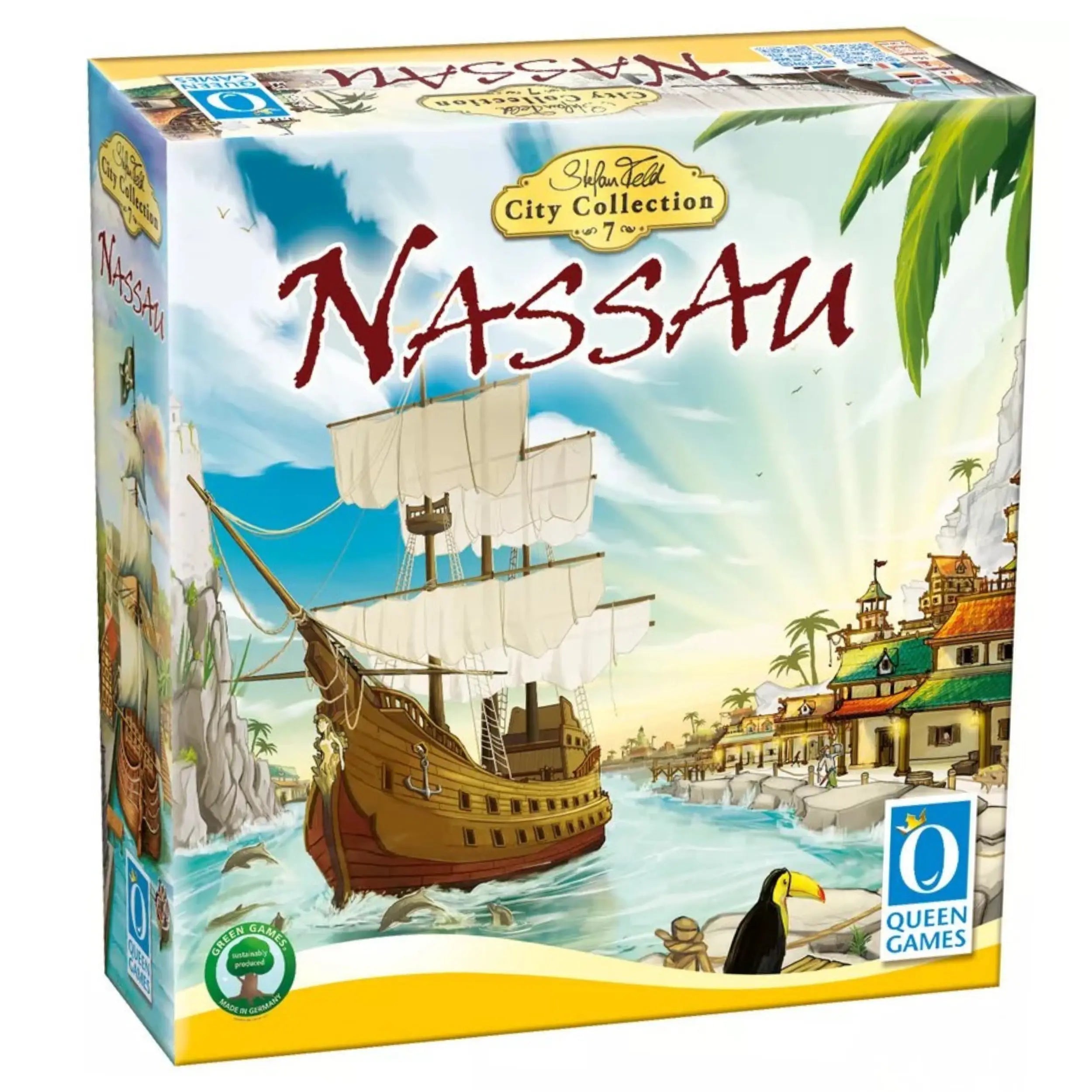
Nassau - City Collection Classic
🐸 Details from BoardGameGeek
Consiglio BGG sul numero di giocatori
Categorie
Meccaniche
Design & Art
Si abbina bene con
FroGames — Moments You'll Remember
Some come back with ships full of gold, some with a parrot and three bullets. But everyone has a story to tell, and that's worth more than any treasure.
WHAT IT'S ABOUT
Four seasons of plunder, adventures, and tales in the city of pirates
Nassau is the seventh chapter of the Stefan Feld City Collection, by the German master of layered eurogames and illustrated by Klemens Franz. Set in the world of Caribbean pirates, the game brings classic Feld style — engine building, optimization, multiple paths to victory — into a thematic context of maritime adventures and conquests.
Each game unfolds over four seasons, each divided into two phases: in the first, you move around the city of Nassau to gather equipment, weapons, cannons, sails, rum, and animal companions; in the second, you set sail to face adventures on the open sea, fight monsters, conquer outposts, and return to tell your exploits. The richer the story you bring home, the more points you earn. The player who builds the most legendary crew wins.
What they say abroad
""
Stefan Feld knows how to layer choices without ever losing clarity. Nassau brings his trademark — optimization, timing, versatility — into a two-phase structure that breathes like a true pirate adventure.
— FroGames
""
Nassau's trick is that you're not just optimizing resources: you're building a story. And stories, in the pirate world, are worth gold.
— FroGames

Nassau - English Edition
FrogScore · FroGames editorial rating · based on rules, international reviews, and play sessionsWhat's in the box
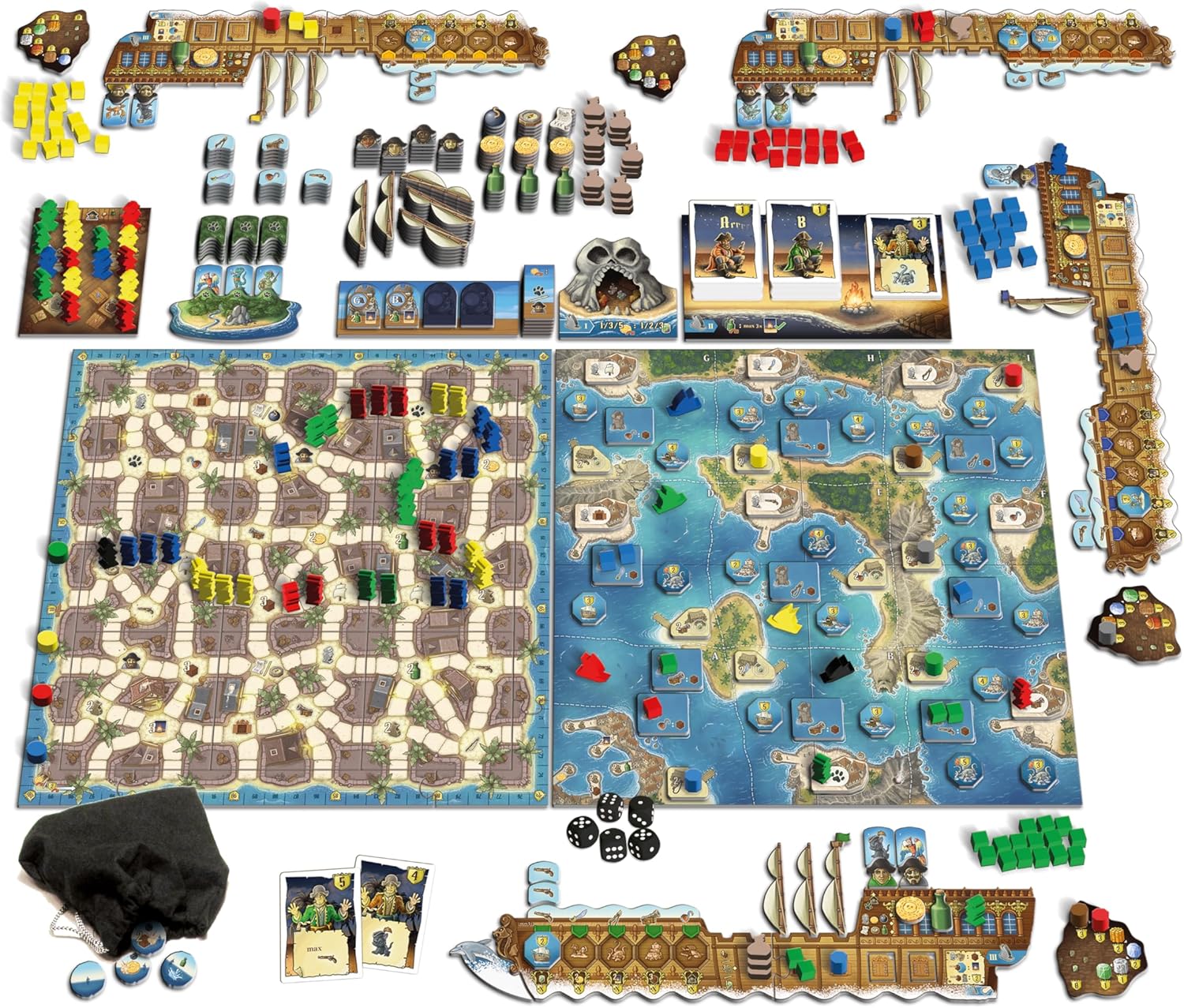
The elements that make up your adventure
The Nassau board
The city where you recruit crew, buy weapons and cannons, gather supplies, and prepare your ship. Each space is a choice, each turn is a placement puzzle.
Player ships
Each pirate has their own ship to equip: cannons, sails, weapons, ammunition, supplies. A well-armed ship is worth gold on the open sea.
Sea adventures
Adventure cards representing battles, outpost conquests, sea monsters. Each adventure has precise requirements: weapons, cannons, supplies. If you complete them, you return with points and glory.
Pirate animals and special powers
Parrots, monkeys, dogs: each animal unlocks a unique power that can turn the tide of battle or optimize a move. They are the astute pirate's wild card.
In two hours you'll have told how you sank a kraken with three bullets and a parrot. And it will all be true.
A game in five acts
What happens at the table
Not the rules. The experience.
The calm before the storm
First few minutes: you observe the Nassau board, evaluate options, plan where to place your pirates. Everyone is looking for the same equipment, but spaces are limited. Someone takes the weapon you wanted, someone else blocks the cannon you needed. You can already feel that the game will be a war of timing.
The first boarding
End of the city phase, beginning of the sea phase. You set sail with what you have: maybe your ship is full of weapons but no cannons, or vice versa. You choose the adventures you can face, hoping the dice are merciful. Someone returns with three completed cards, you with only one. The gap widens.
The season of change
Mid-game, second or third season. You've figured out which scoring paths work best for you: conquests, monsters, or adventure volume. You start to specialize, but others do the same. Competition for the right resources becomes ruthless. A special animal saves you a move, an unlucky roll ruins another.
The legend you will tell
Last season, last voyage. You have the most armed ship at the table and head straight for the legendary monster no one dared to face. You roll the dice, use the parrot's power, spend the last ammunition. You make it. Others applaud (or curse). That move is worth half your final points.
The tale at the port
End of the game: you count points from completed adventures, defeated monsters, conquered outposts, stories told. The one who built the richest legend wins, not necessarily the one who made the most noise. Someone discovers they underestimated a scoring path. Next time will be different.
How to play
The flow of each season
Each season is divided into two phases: city and sea. In the first, you build; in the second, you use.
In turn, you place your pirates in Nassau spaces to collect weapons, cannons, ammunition, provisions, rum, sails, coins, and special animals. Each space has precise rules: some give resources, others let you draw cards, others allow you to equip your ship. First come, best choice.
You set sail with your equipped ship. Each sea adventure has precise requirements: X weapons, X cannons, X provisions. You spend resources to face them, roll dice for combat (mitigable with equipment), conquer adventure cards. Each action costs provisions: when they run out, you must return.
When you return to base, you tell your adventures and earn points. The richer the story (completed adventures, defeated monsters, conquered outposts), the more points you get. There's a multi-scoring system: any path can work, but you must choose and follow it.
End of season: partial board reset, new adventure cards available, new opportunities. After four seasons, final points are counted. The one who accumulated the most glory from adventures, conquests, and tales wins.
Why it's different from others
Six mechanics that make a difference
Two-phase city-sea structure
It's not just an Eurogame with an applied theme: the division between preparation phase and action phase creates a true narrative rhythm. First you plan, then you execute. First you build, then you use. And what you take to sea determines what you can truly do.
The ship as a personal engine
Each player builds their own ship with weapons, cannons, sails, provisions. No two ships are alike at the table. Someone focuses on many cannons and few weapons, someone else does the opposite. Your ship is your game style embodied.
Mitigable dice, not pure chaos
Yes, you roll dice in combat. But equipment, special animals, and resources allow you to control risk. An unlucky roll doesn't ruin the game, but a lucky roll after good planning brings double satisfaction.
Pirate animals with unique powers
Parrots, monkeys, dogs: each animal has an activatable power that breaks the rules. Reroll a die, recover a resource, move differently. They are the tactical twist that makes each game less predictable.
Multiple scoring paths
Classic Feld: you can aim for adventure volume, outpost conquests, legendary monsters, or specialize in one type of endeavor. Every path works if you follow it consistently. There is no perfect build, only the one you build better than others.
The tale as final currency
You don't just win by completing adventures: you win by telling them. The scoring system rewards those who return with rich and varied stories. It's a thematic touch that transforms victory points into emergent narrative. In the end, you don't remember the numbers, you remember the time you sank the kraken with three bullets.
How it ends
How to win and what really matters
Nassau is a points-based game: after four seasons, whoever has accumulated the most glory through adventures, conquests, and tales wins the game.
Victory conditions
- Complete sea adventures and earn victory points
- Conquer outposts and defeat legendary monsters for score multipliers
- Specialize in one type of endeavor (e.g., only naval battles, only conquests) for thematic bonuses
How to fall behind
- Equipping your ship poorly and failing to complete enough adventures
- Wasting provisions at sea without returning with enough stories to tell
- Getting blocked in the city phase and lacking key resources for the sea phase
Nassau is Stefan Feld doing what he does best: giving you a hundred ways to win and none of them easy. If you love optimizing, planning, and telling legendary tales, this is your crew.
Frequently asked questions
FAQ about Nassau - English Edition
Is it a game for those unfamiliar with Stefan Feld?
It depends. Nassau is the seventh game in the City Collection and has a medium-heavy weight (3.15 on BGG). If you've played Eurogames with worker placement and engine building (like Agricola, Orléans, or other Feld games like Carpe Diem), you'll navigate it well. If it's your first strategic Eurogame, it's better to start with something lighter like Azul or Splendor.
How much does dice luck matter?
Dice are rolled in sea battles, but you can mitigate risk with equipment, special animals, and resources. It's not a game where an unlucky roll eliminates you: it's a game where an unlucky roll costs you a move, but you can compensate by planning better. Strategy remains predominant.
Is it suitable for those who want a chaotic and interactive pirate game?
No. Nassau is a Eurogame disguised as a pirate adventure. Interaction is competition for resources and spaces, not direct combat between players. If you're looking for "sink the battleship" or chaos like Rum & Bones, this isn't the right game. If you're looking for tactical optimization with a pirate theme, then yes.
What's the best player count?
Nassau plays 2 to 4. At 3-4 players, competition for spaces in the city is tighter and the sea phase more varied. At 2, it's more tactical and controllable, but might feel less chaotic. It works well at any count, but shines at 3-4.
Is it available in Italian?
This is the English edition published by Queen Games. The game has text on adventure cards, so knowledge of English is necessary to play independently. Currently, there is no official Italian edition.
Nassau is a strategic board game for 2-4 players aged 14 and up, with games lasting 90-120 minutes. Designed by Stefan Feld and published by Queen Games, Nassau is the seventh installment in the acclaimed City Collection and brings Feld's classic style — worker placement, engine building, multiple scoring paths — to a pirate setting rich in adventures, conquests, and naval battles. With mechanics of placement, set collection, and mitigable dice rolling, Nassau offers strategic depth and high replayability for fans of medium-heavy Eurogames. Available on FroGames.it.
Nassau - City Collection Classic
Frequently Asked Questions
The answers you're looking for, no beating around the bush.
📸Do the images match the actual product?
The photos on the website often come from BoardGameGeek and are intended to give you an idea of the game. They may vary slightly from the version you receive. The content declared by the publisher is always binding.
📦Does the content of the box match what is indicated?
We always strive to provide the correct content, but minor variations are possible due to reprints or updates. The information comes directly from the publishers. If you have any questions, please contact us!
⏳How do pre-orders work?
Pre-order the game before release, payment is immediate, and the game is reserved for you. As soon as it arrives, we'll ship it right away! If there are any delays, we'll update you promptly.
🔒Can I trust buying here?
Absolutely! Secure payments, tracked shipments, and a team that loves board games as much as you do. If something goes wrong, we'll do our best to fix it.
🛠There's a problem with my order, what should I do?
Write to us now! Whether it's a missing part, damage, or an error, we'll help you resolve it as soon as possible. Your experience truly matters to us.