
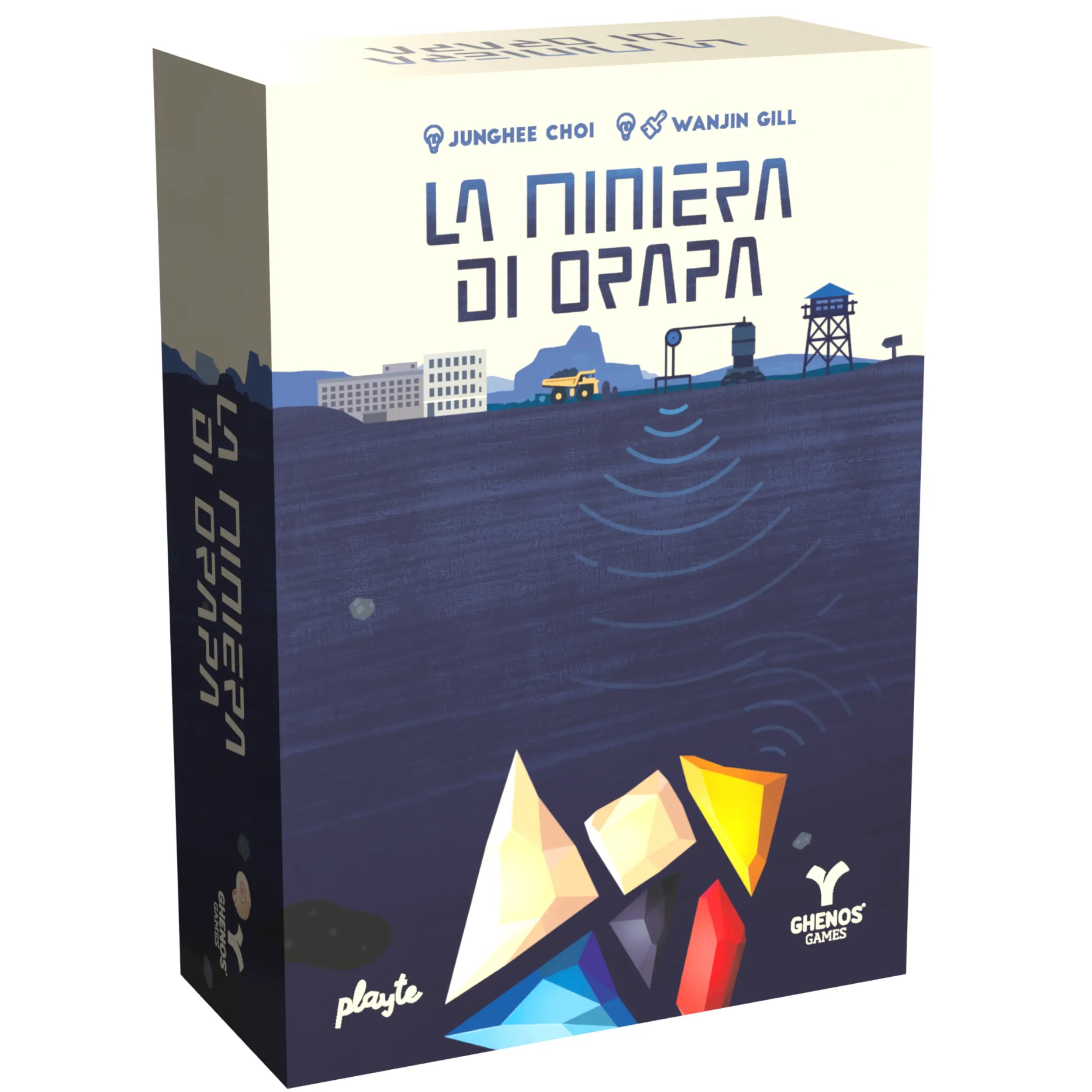
La Miniera di Orapa
🐸 Details from BoardGameGeek
Consiglio BGG sul numero di giocatori
Categorie
Meccaniche
Design & Art
Lingua
Si abbina bene con
FroGames — Moments You'll Remember
Someone marks a question mark. Someone erases the whole sheet. Someone shouts "There it is!" and misses by three squares. And nobody remembers who won first.
WHAT IT IS ABOUT
A hunt for hidden minerals with elastic waves and a pencil
Orapa Mine was designed by Junghee Choi and Wanjin Gill, published in 2024 by Playte and brought to Italy by Ghenos Games. The game takes its name from the Orapa mine in Botswana, one of the world's largest diamond mines, and transforms geological exploration into a geometric deduction puzzle.
One player hides tangram pieces (minerals) on a grid, the others shoot elastic waves that bounce off the edges of the pieces and must reconstruct the hidden map. Each answer from the mine director is a clue: where the wave exits, what color. The first to reconstruct all positions and colors wins the game.
What they say abroad
A game that asks you to imagine invisible bounces and reconstruct hidden shapes.
— FroGames
Perfect for those who love Battleship but want something more geometric and satisfying.
— FroGames

Orapa Mine
FrogScore · FroGames.it editorial rating · based on rules, international reviews, and play sessionsThe mine's tools
What you need to explore
Solution sheets
10×8 grid where you record each clue: wave entry, exit, color. Your sheet is the map you build turn by turn.
Tangram pieces
Minerals hidden by the director. Five colored geometric shapes that touch, overlap, create unexpected angles.
Firing grid
18 numbers and 18 letters along the edges: choose one, fire the wave. The director responds where it exits and what color.
Pencil
The only tool that matters. You mark, erase, draw lines, eliminate hypotheses. The entire game is played on paper.
In half an hour, you'll have filled a sheet with marks, erasures, hypotheses. And when you declare the correct solution, nobody asks how you got there. It just needs to work.
Come si gioca
Video dimostrativo di gameplay.
A game in five moments
What happens at the table
Not the rules. The experience.
The director prepares the mine
One of you places the tangrams on the hidden board. The others prepare their blank sheets. There is silence: you don't know what awaits you, only that someone has hidden five colored pieces in 80 squares. The game is about to begin.
The first blind shots
Everyone shoots waves randomly. The director replies: "It exits from H, red." You mark everything down. You still don't understand anything, but every answer is a piece of the puzzle. The grid starts to fill up with lines and question marks.
The first piece takes shape
After five or six shots, someone says: "There's a blue triangle here." The others look at their sheets. Maybe yes. Maybe no. Contours begin to emerge, but pieces overlap, and a strange bounce is enough to throw everything into question again.
Someone erases everything
A wave exits where it shouldn't. That shape that seemed certain no longer fits. You erase half your sheet, start over, rethink the bounces. The others keep shooting, you fall behind. Tension rises.
The declaration
Someone raises their hand: "I have everything." The director checks. Either they've won, or they've made a mistake with a piece and go back to deducing. If they've won, the others look at the revealed board and think: "Ah, it was there." Game over, everything is shuffled, and you start again.
How to play
The flow of each turn
Orapa Mine is a deduction race: everyone plays in parallel, everyone receives the same information.
On your turn, you declare a number (1-18) or a letter (A-R) along the edge of the grid. The elastic wave starts from there, traveling horizontally or vertically.
The wave bounces off the edges of the hidden minerals (tangrams) at 90°, continuing until it exits the grid. The director tells you where it exits and what color the last piece touched is.
Each player marks the received information on their sheet. You draw lines, hypothesize angles, eliminate impossible squares. The deduction is parallel: everyone works on the same puzzle.
Even out of turn, if you think you've reconstructed everything, declare: the positions and colors of all the minerals. If it's correct, you win. If you make a mistake with even one piece, you continue playing (but now the others know you've tried).
Why it's different from others
Six elements that make the difference
Geometric deduction, not random
You don't shoot blindly like in Battleship. Every bouncing wave gives you precise information: angles, edges, overlaps. You have to reconstruct shapes in space, not guess coordinates. It's a pure logical puzzle.
Pen and paper, zero downtime
While you wait for your turn, you're already working. Every clue is valid for everyone: you draw, erase, hypothesize in real time. There's no passive waiting, the game flows quickly.
Hidden asymmetry
One player is the mine director, the others are explorers. Opposite roles: one hides and responds, the others deduce and compete. Everything changes between one game and the next.
Infinite replayability
Five tangram pieces on a 10×8 grid can be positioned in thousands of different configurations. Every game is a new puzzle, never the same solution twice.
Scales perfectly from 2 to 5
With two players, it's a pure deduction duel. With five, it's a frantic race where someone always declares before you. It works at any number, only the rhythm changes.
Accessible but deep
Rules in five minutes, first game immediate. But the complexity emerges from deduction: visualizing invisible bounces, eliminating hypotheses, finding the unique configuration that explains all the clues.
How it ends
How to win and how to lose
Orapa Mine is a race: the first to reconstruct the hidden map wins. Or whoever remains in the game while the others make mistakes.
Victory
- You declare the positions and colors of all hidden minerals (tangrams) and the configuration is 100% correct
- All other players have declared and made mistakes, you are the only one left in the game and you solve it
- In some variants: points for each correct piece, the player with the most points wins
Elimination
- You declare the solution but make a mistake with even one piece: you remain in the game (you can continue deducing) but you have lost your advantage
- Someone else declares correctly before you: game over, you lost due to speed
- You run out of available attempts (in some house-rule variants): you are out of the race
Orapa Mine is a geometric deduction puzzle that asks you to imagine invisible bounces and reconstruct hidden shapes. Perfect for those who love accessible but not trivial logic games.
Frequently asked questions
FAQ about Orapa Mine
How long does a game really last?
20-30 minutes is realistic. The first few games might last 35 minutes because everyone needs to get used to visualizing the bounces. After a few rounds, 20 minutes is the norm. If two people play, you often finish in 15 minutes.
Is it suitable for children?
Yes, from 8 years old and up. The rules are very simple, but it requires spatial reasoning: imagining where a wave passes, visualizing angles. Children love it because it's like a geometric detective game. Below 8 years old it can be frustrating.
Does it require drawing skills?
Zero. You don't have to draw well, you just need to mark points, lines, and hypotheses on a printed grid. It's pen and paper in the sense of a deduction tool, not artistic skill. Even those with poor handwriting do very well.
Does it work well with two players?
Yes, in fact it's one of the best configurations. One hides, the other deduces. Then they swap roles. It's a pure logic duel, without the pressure of a five-player race. Perfect as a strategic filler for couples.
Is it available in Italian?
Yes, this is the Italian edition by Ghenos Games titled "La Miniera di Orapa". Rules, sheets, and all materials are in Italian. However, the game is language-independent: once you understand the rules, you only play with grids and numbers.
Orapa Mine is a geometric deduction game for 2-5 players, ages 8+, lasting 20-30 minutes, designed by Junghee Choi and Wanjin Gill and published by Ghenos Games. Players shoot elastic waves into a hidden grid and must reconstruct the positions of minerals (tangram pieces) by deducing from the bounces. A paper-and-pencil mechanic with pure logical deduction, perfect for families and players who love puzzles. Available on FroGames.it.
Frequently Asked Questions
The answers you're looking for, no beating around the bush.
📸Do the images match the actual product?
The photos on the website often come from BoardGameGeek and are intended to give you an idea of the game. They may vary slightly from the version you receive. The content declared by the publisher is always binding.
📦Does the content of the box match what is indicated?
We always strive to provide the correct content, but minor variations are possible due to reprints or updates. The information comes directly from the publishers. If you have any questions, please contact us!
⏳How do pre-orders work?
Pre-order the game before release, payment is immediate, and the game is reserved for you. As soon as it arrives, we'll ship it right away! If there are any delays, we'll update you promptly.
🔒Can I trust buying here?
Absolutely! Secure payments, tracked shipments, and a team that loves board games as much as you do. If something goes wrong, we'll do our best to fix it.
🛠There's a problem with my order, what should I do?
Write to us now! Whether it's a missing part, damage, or an error, we'll help you resolve it as soon as possible. Your experience truly matters to us.